
Adobe and NVIDIA extended their collaboration on October 15, 2026, accelerating Photoshop, Premiere, Substance 3D, Frame.io, and Brand Concierge. The Adobe and NVIDIA AI creator partnership combines local computation on RTX Spark with cloud pipelines for video and multimedia search. Adobe claims performance gains of up to two times faster on selected workloads, though no single benchmark covers every project, machine, or feature.
We reviewed the Adobe press release and NVIDIA's public documentation on RTX Spark. The performance figures are company-reported measurements on selected workloads. No independent evaluation replicating the full test set under identical file versions, software builds, and hardware conditions has surfaced as of this writing.
What Changes Inside Creative Tools
Photoshop, Premiere, and Substance 3D are being optimized for the RTX Spark superchip, which integrates local AI memory and computation. Adobe says it redesigned parts of Photoshop around GPU-accelerated compositing. In Premiere, playback, rendering, effects, color grading, and AI features including Enhance Speech and Object Mask all receive RTX acceleration.
The direction shifts focus from a single generator to the entire workflow. That's the same transition we covered in our piece on AI agents for freelancers and small businesses: the value isn't just in producing an output, but in connecting tools, data, and revision cycles without losing editorial control.
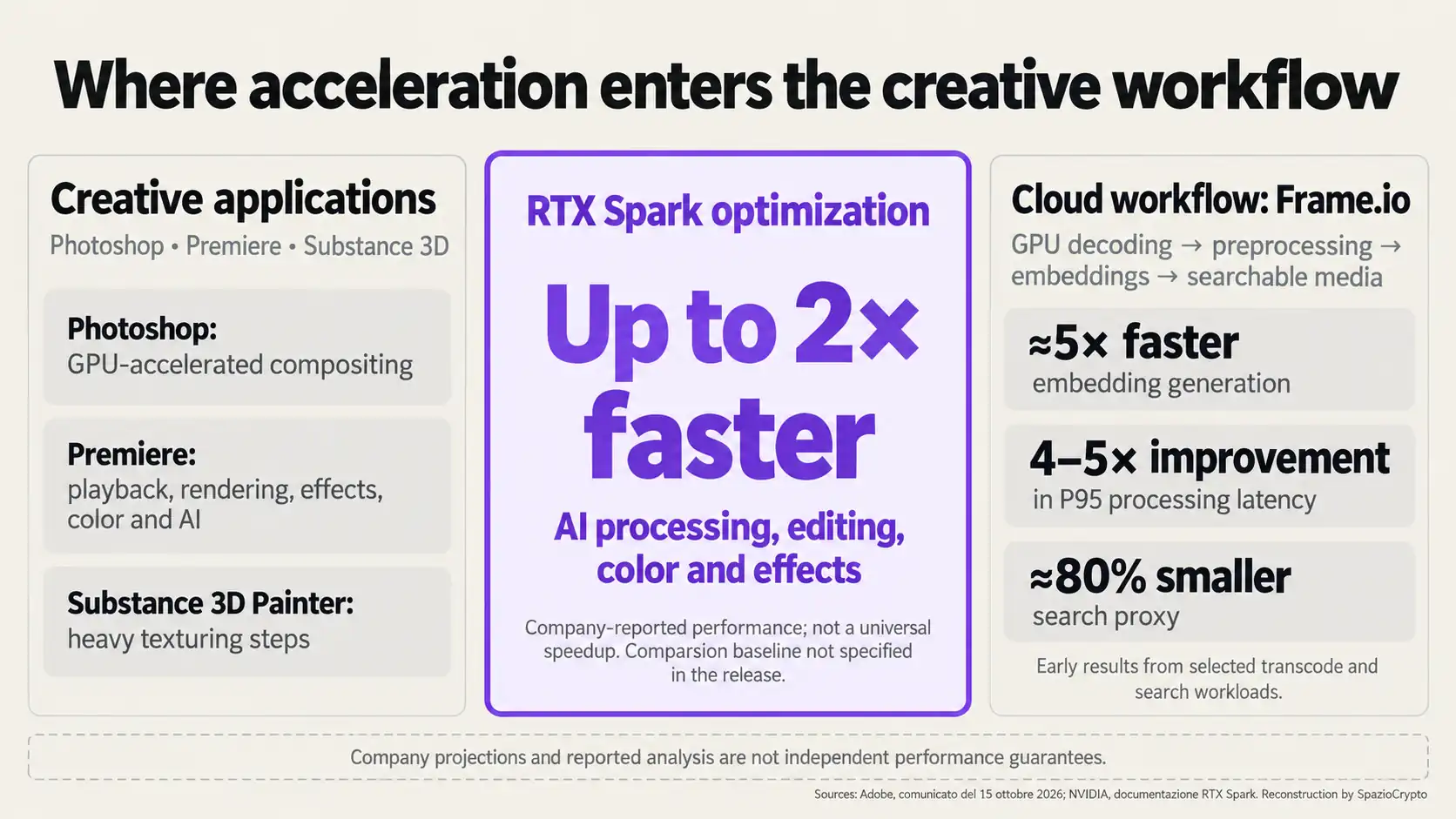
“Up to 2x” Is Not a Universal Speed
Adobe uses the phrase “up to 2x faster” for AI processing, editing, color, and effects. That ceiling matters. Some operations may approach the doubling claim; others vary by format, clip duration, available memory, plugins, model type, and system configuration. The press release doesn't offer a weighted average across a complete project.
For a creator, the useful question isn't whether one feature wins an isolated test, but how much total time is saved across ingest, cut, revision, and delivery. NVIDIA is expanding its role well beyond chips, as our analysis of NVIDIA's AI investments shows. The Adobe deal brings that strategy directly into everyday production tools.

Frame.io Accelerates in the Cloud
Frame.io uses NVDEC for hardware decoding and TensorRT with CUDA for preprocessing and embedding generation. The goal is to process media assets earlier in the pipeline and make them searchable faster. Adobe reports initial results on selected transcoding and search workloads, not a new service delivering the same speed gain to every customer from day one.
Here, AI isn't necessarily creating an image. It's indexing archives, identifying content, and cutting the time needed to locate a scene. That's a less visible form of automation, but often more practical for teams managing thousands of assets. Distributed rendering capacity, a theme we explored in our piece on compute networks for creators, is becoming part of the production chain.
Agents Don't Replace the Editor
Adobe labels some applications as agentic and connects Brand Concierge to NVIDIA's open Nemotron models. In creative work, “agent” means software capable of executing goal-driven sequences, not an autonomous director claiming authorship of the finished piece. The announcement doesn't say Premiere will cut a complete film without human oversight.
That distinction also protects attribution. A system can accelerate masking, search, or audio cleanup without generating the core content. Provenance remains an open question, as we noted in our piece on invisible AI text watermarks: speed and traceability need to move forward together.
Local and Cloud Become One Pipeline
RTX Spark brings local AI computation to a compact workstation; Frame.io uses accelerated cloud infrastructure. The project doesn't pick between them. It divides the tasks: interactive operations stay close to the creator, while indexing and library management run on shared systems. This architecture can reduce waiting times and large file transfers, but Adobe's announcement doesn't publish costs, minimum hardware requirements, or precise availability timelines for each feature.
Infrastructure dependency remains central. Our global AI infrastructure map shows that models, GPUs, energy, and software are layers of the same chain. An application-level gain can come from a library update, a decoder improvement, or a new memory profile, not just from a generative model.
For creative teams, adoption will require measurement at each production phase. An editor might save minutes on transcription and masking, then lose them checking inconsistent AI outputs. An archive can become searchable faster. Only if the embeddings recognize people, locations, and scenes with enough accuracy. Adobe doesn't publish recall rates, search error rates, or cross-generation hardware comparisons in this announcement.
Portability is another open point. The more features depend on specific optimizations, the more a studio needs to evaluate open formats, plugin compatibility, and the practical ability to migrate a project elsewhere. The partnership promises cross-layer integration, but the press release doesn't specify which components will be available on competing hardware or at what performance level.
The most persuasive benchmark would be a complete, repeatable production run: identical raw material, identical operation sequence, identical final export, with time, energy consumption, and manual interventions all measured. A list of isolated speed gains describes technical potential. An end-to-end test would show editorial value. Until that exists, the “2x” figure remains a company-declared ceiling on selected tasks: useful as a directional signal, insufficient for estimating the return on an upgrade.
Version stability across updates matters too. A speed advantage loses its value quickly if plugin versions, model updates, or software builds change the output and force the team to revalidate their workflow from scratch.
What This Means for US and UK Studios
The announcement contains no region-specific launch information. Studios, agencies, and independent creators in the US and UK will access the features according to global commercial availability, compatible hardware, and their Adobe subscription tier. For smaller shops, the real question is the return on saved time, not the technical novelty alone. Upgrading to RTX Spark hardware is a capital decision; the productivity math needs to hold across a real project cycle before the investment makes sense.
Adobe and NVIDIA: What's Confirmed, What's Not
A quick breakdown of the announcement's claims:
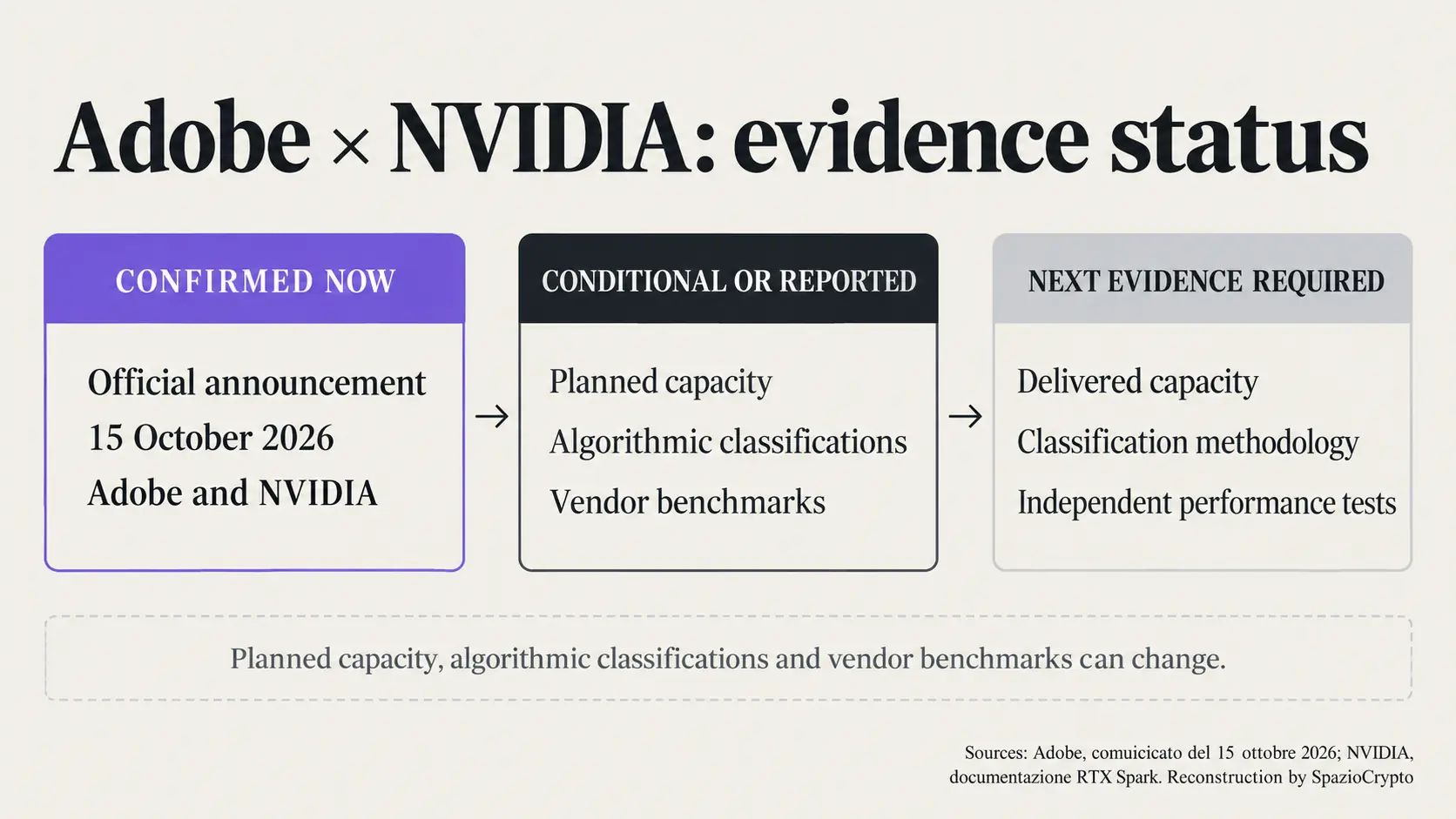
- Confirmed: extended collaboration, RTX Spark optimizations across Photoshop and Premiere, and accelerated cloud processing in Frame.io.
- Not disclosed: pricing, a detailed rollout calendar for each feature, complete hardware requirements, and independent benchmarks.
- Watch for: real-world tests on complete productions, availability by plan and region, energy consumption data, and provenance tooling.
The Bigger Picture
Our read is that the next competition among creative tools will be fought less on the strength of a single impressive clip and more on total time from raw material to delivery. Adobe and NVIDIA are welding hardware, applications, and cloud together because the bottleneck shifts across the entire pipeline, not just at one stage.
The signals worth tracking are reproducible benchmarks, cost-per-hour-saved, mask quality, search speed, and provenance control. If these elements improve together, AI becomes genuine creative infrastructure. If only generation speed increases, the review workload risks absorbing every efficiency gain made elsewhere.