

Ripple received final OCC approval for the Ripple National Trust Bank on October 26, 2026, completing a process that began with a conditional preliminary green light on December 12, 2025. The bank will manage the segregated reserves backing the RLUSD stablecoin, act as collateral trustee of those reserves for token holders, and offer fiduciary custody of digital assets once it opens. It is not a commercial bank: no insured deposits, no lending.
We reviewed Ripple’s press release, distributed via Business Wire and published on ripple.com, the OCC’s December 12, 2025 conditional approval letter signed by Stephen A. Lybarger, and the OCC’s announcement covering five conditional approvals issued that same day. As of October 27, no final order dedicated to Ripple appeared on the OCC’s public website. The confirmation comes from the company. CEO Brad Garlinghouse’s post on X could not be accessed with our tools.
Big news heading into @RippleSwell: the @USOCC has granted final approval for Ripple National Trust Bank.
— Brad Garlinghouse (@bgarlinghouse) October 26, 2026
This gives Ripple a federally supervised platform to support $RLUSD and provide digital asset custody to enterprises.
We’ve always said crypto and banks work better…
What the OCC Actually Approved
According to Ripple’s press release, the Ripple National Trust Bank has three defined functions: managing the segregated reserve assets that back RLUSD, serving as collateral trustee of those reserves on behalf of token holders, and providing fiduciary custody of digital assets, which will be “authorized at opening.” Ripple states that the approved business plan extends beyond RLUSD support alone. The OCC’s December letter described the same perimeter: management of a liquid-asset reserve for the stablecoin-issuing subsidiary, collateral trustee services, and crypto-asset custody for group entities and institutional clients.
The press release names no opening date, no operating location, and no executive team for the bank. It states only that the bank “commences operations” and that Ripple will continue working with regulators as the United States implements the framework of the GENIUS Act, the federal stablecoin law. On that front, the OCC recently finalized its implementing rules on stablecoin yield.
Who Issues RLUSD and Who Holds the Reserves
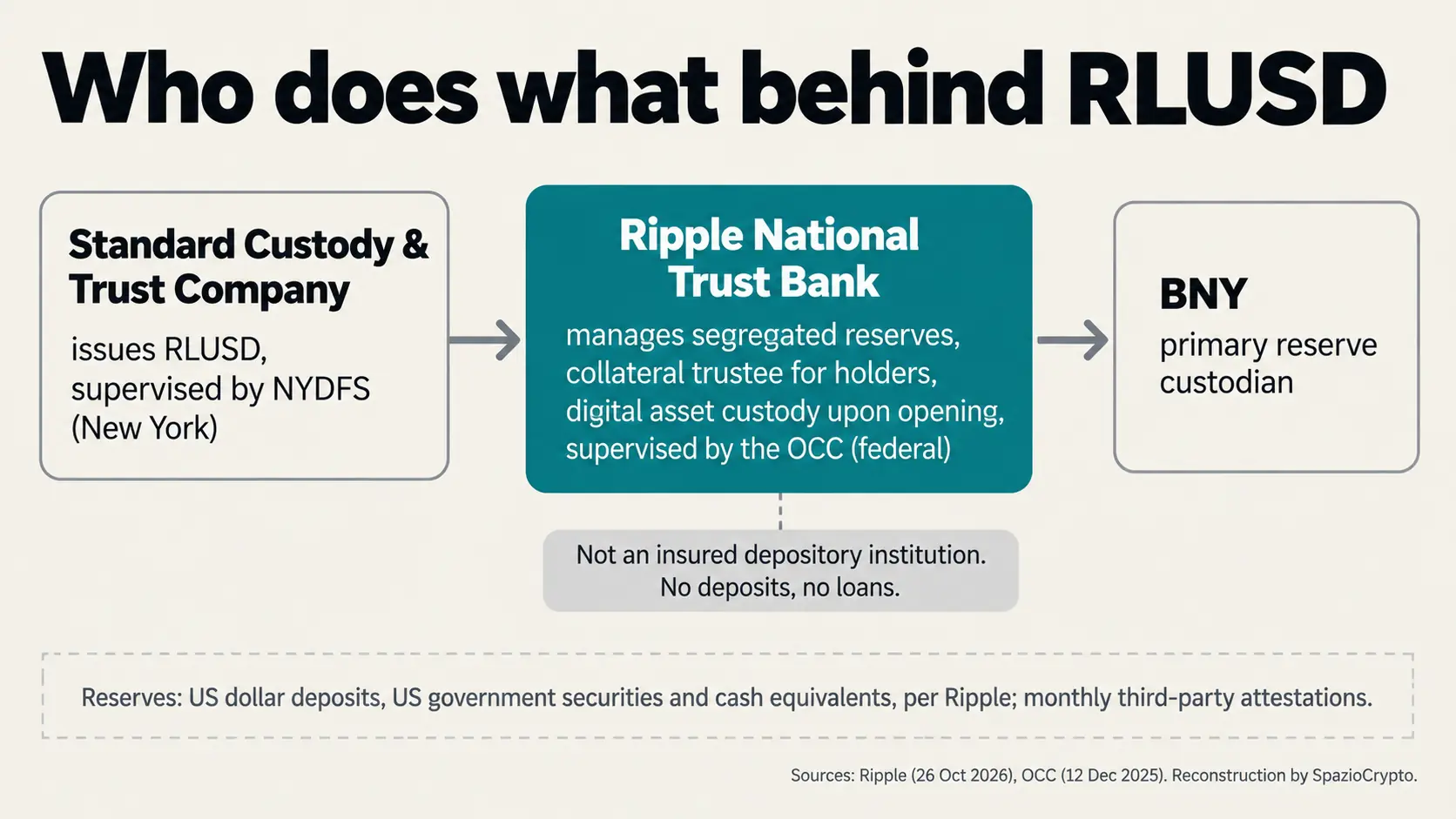
One distinction is worth getting right. RLUSD will continue to be issued by Standard Custody & Trust Company, a limited-purpose trust company supervised by the New York Department of Financial Services (NYDFS). The new national bank adds a layer of federal oversight to reserve management; it does not replace the issuer. According to Ripple’s press release, BNY serves as the primary custodian of the reserves, and RLUSD is backed by dollar deposits, U.S. Treasury securities, and other cash equivalents, with independent third-party attestations published monthly.
The result is a three-link chain: the NYDFS-supervised issuer in New York, the federally supervised trust bank, and the depositary bank. According to Ripple, RLUSD launched in December 2024 and carries a market capitalization of $2.5 billion, a company-provided figure we have not independently verified.
The Conditions Written Into the December Letter
The OCC’s December 12, 2025 letter, signed by Stephen A. Lybarger, Chief Licensing Officer, set precise requirements. The bank must maintain at least $11.7 million in Tier 1 capital, with a portion held in liquid assets equal to the greater of 50% of that capital or $5.85 million. It must also hold liquid assets covering 180 days of operating expenses, calculated under a stress and orderly wind-down scenario. Before final approval, the bank was required to submit the definitive architecture of its information systems and a risk management plan.
Several conditions remain in force after opening. For three years, any material change to the business plan requires advance notice to the OCC and its non-objection, as do appointments of new directors and senior officers. Activity is limited to trust company functions and related activities. The letter is explicit: the bank “will not be an insured depository institution.” The approval would have lapsed if the bank had not opened within 18 months of the December 12, 2025 letter, giving a deadline of approximately June 12, 2027, and the OCC stated it was not inclined to grant extensions.
The Other Approvals From December 12
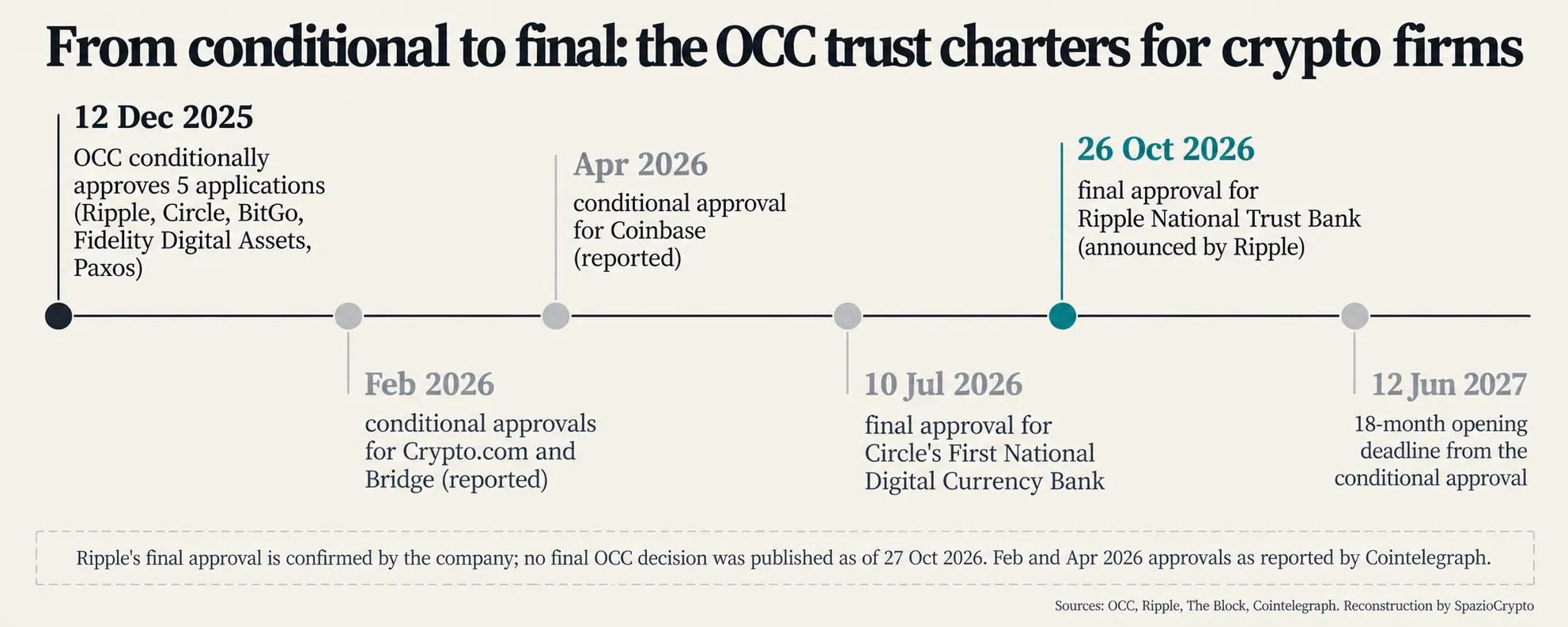
On December 12, 2025, the OCC conditionally approved five applications: two new trust banks (Ripple and Circle’s First National Digital Currency Bank) and three conversions of state trust companies (BitGo, Fidelity Digital Assets, and Paxos). OCC Comptroller Jonathan V. Gould said at the time that “new entrants into the federal banking system are good for consumers, the banking industry, and the economy.” Circle received its final approval on July 10, according to The Block, but with a narrower initial scope: custody for group entities, with USDC reserve management deferred to a later phase.
The contrast is notable. Ripple’s bank, per the press release, launches with RLUSD reserve management among its stated functions from day one. According to Cointelegraph, the OCC also granted conditional approvals in 2026 to Coinbase, Crypto.com, and Bridge, the payments company owned by Stripe. Circle, meanwhile, is pursuing international expansion, with plans to bring USDC to roughly 40 new markets.
What a National Trust Bank Cannot Do
A national trust bank charter is a specific, bounded authorization. It does not collect insured deposits, does not make loans. Operates within the fiduciary powers granted by the OCC. Ripple’s press release makes no mention of a Federal Reserve master account or direct access to central bank payment systems. For RLUSD holders, the protection comes from reserve rules and asset segregation, not deposit insurance.
Our read is that the main value of the approval lies in dual oversight (state-level in New York via NYDFS, federal via the OCC) rather than in new activities per se. For institutional clients, the decisive question is who controls the reserves and under what rules. The same logic is pushing traditional banks toward crypto custody, as Deutsche Bank’s upcoming custody service in Germany illustrates.
What This Means for European and UK Investors
The OCC authorization applies in the United States and does not change RLUSD’s status in Europe, where the EU’s MiCA regulation governs crypto-assets. Ripple received a preliminary letter from Luxembourg’s CSSF in June for operating as a crypto-asset service provider under MiCA, with final conditions then still outstanding. We have not verified whether RLUSD currently qualifies as a MiCA-compliant stablecoin (an e-money token or asset-referenced token under the regulation).
That detail matters for users on European platforms. Several EU member states, following guidance consistent with MiCA enforcement, have flagged non-compliant stablecoins and required platforms to restrict new purchases and manage existing positions within a set timeframe. U.S. federal oversight of reserves does not substitute for EU issuer authorization: anyone holding stablecoins on European platforms should check which regulatory regime applies to that specific token.
Ripple National Trust Bank: What’s Confirmed, What’s Not
A clear-eyed summary of the record so far:
- Confirmed: OCC conditional approval dated December 12, 2025, requiring at least $11.7 million in Tier 1 capital and 180 days of operating expenses in liquid assets; final approval announced by Ripple on October 26, 2026; RLUSD remains issued by Standard Custody & Trust Company; the bank will not be an insured depository institution.
- Not disclosed: a final order published by the OCC; the actual opening date; the bank’s operating location and executive team; a Federal Reserve master account.
- To watch: publication of the OCC’s final order; the launch of custody services for institutional clients; the transfer of RLUSD reserve management to the new bank; RLUSD’s status under MiCA.
The Bigger Picture
Our read, stated as such: this approval marks a structural shift for U.S. stablecoins, moving them from purely crypto-native products to structures with one foot in the federal banking system, short of becoming commercial banks. Ripple gains federal oversight of its reserves and a custody authorization it can sell to institutional clients. The price is a tight framework: capital and liquidity requirements locked in, three years of OCC scrutiny over business plan changes, no deposits, no loans. Company wins don’t automatically move the token, a pattern worth remembering given that XRP has remained flat through several favorable developments.
Three signals are worth tracking from here. First: whether the OCC publishes a final order, which would make any additional conditions public. Second: when RLUSD reserves actually transfer to the new bank and custody opens to clients. Third: the fate of the other December 2025 applicants, starting with Paxos and Fidelity Digital Assets, and the new 2026 cohort including Coinbase, Crypto.com, and Bridge.