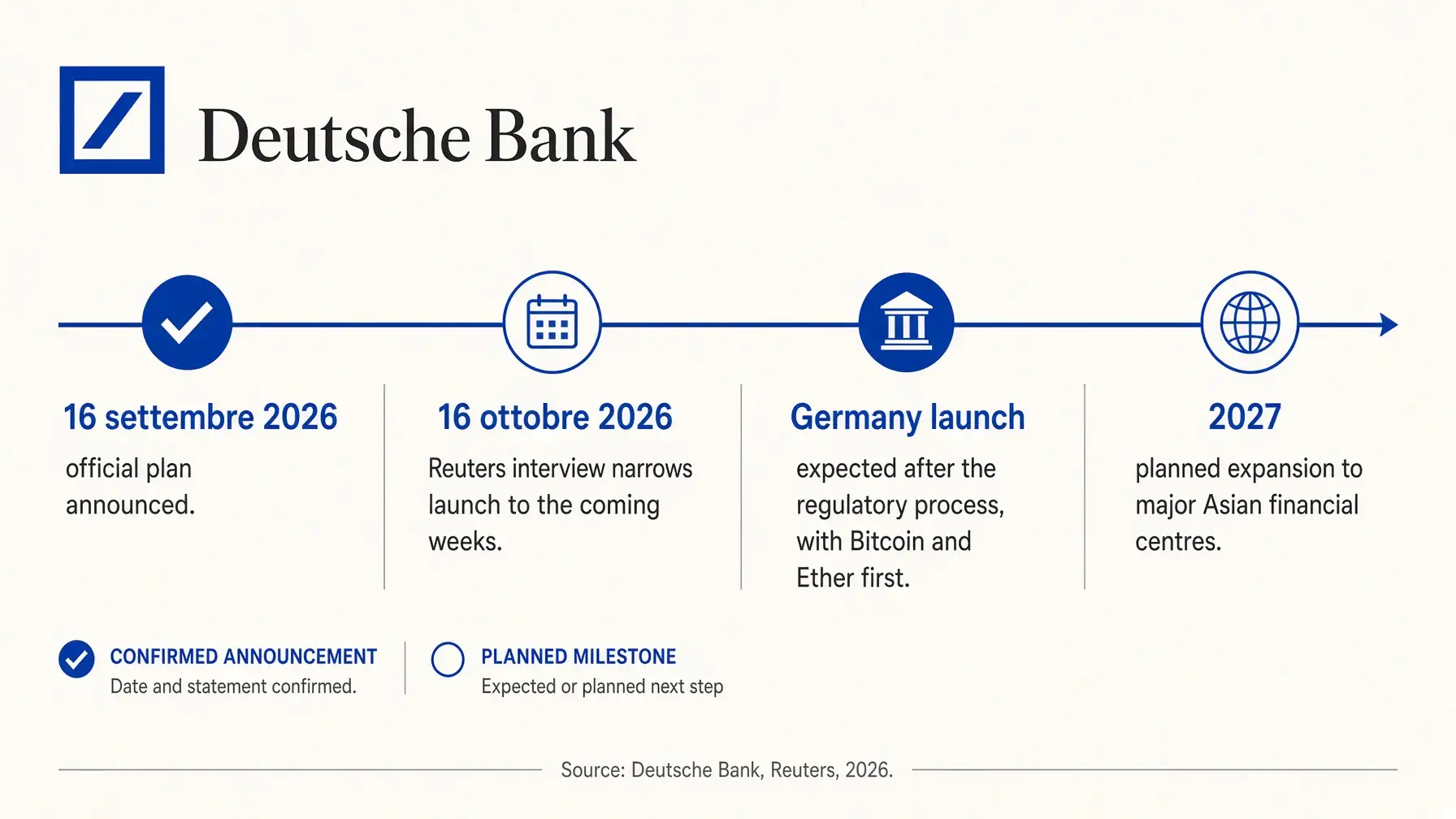
Deutsche Bank is preparing to launch regulated crypto custody in Germany within weeks, starting with Bitcoin and Ether for institutional and corporate clients, according to a Reuters interview published on October 16, 2026. The bank then plans to add stablecoin-related services and extend the offering to major Asian financial centers in 2027. The timeline is more precise than anything the institution had previously stated: Deutsche Bank first outlined the project in a September 16, 2026 announcement without specifying a date this close.
The launch remains conditional on completing the regulatory approval process. Deutsche Bank has not announced that the service is already open, has not confirmed which Asian markets it will enter, and has not set a date for stablecoin functionality. What it has done is establish a clear sequence: regulated custody in Germany first, then on- and off-ramps for major stablecoins, then broader Asian expansion.
TL;DR: Deutsche Bank told Reuters on October 16, 2026 that its Bitcoin and Ether custody service in Germany will launch within weeks, pending final regulatory approval. An Asian expansion targeting major financial centers is planned for 2027.
What Deutsche Bank Has Confirmed
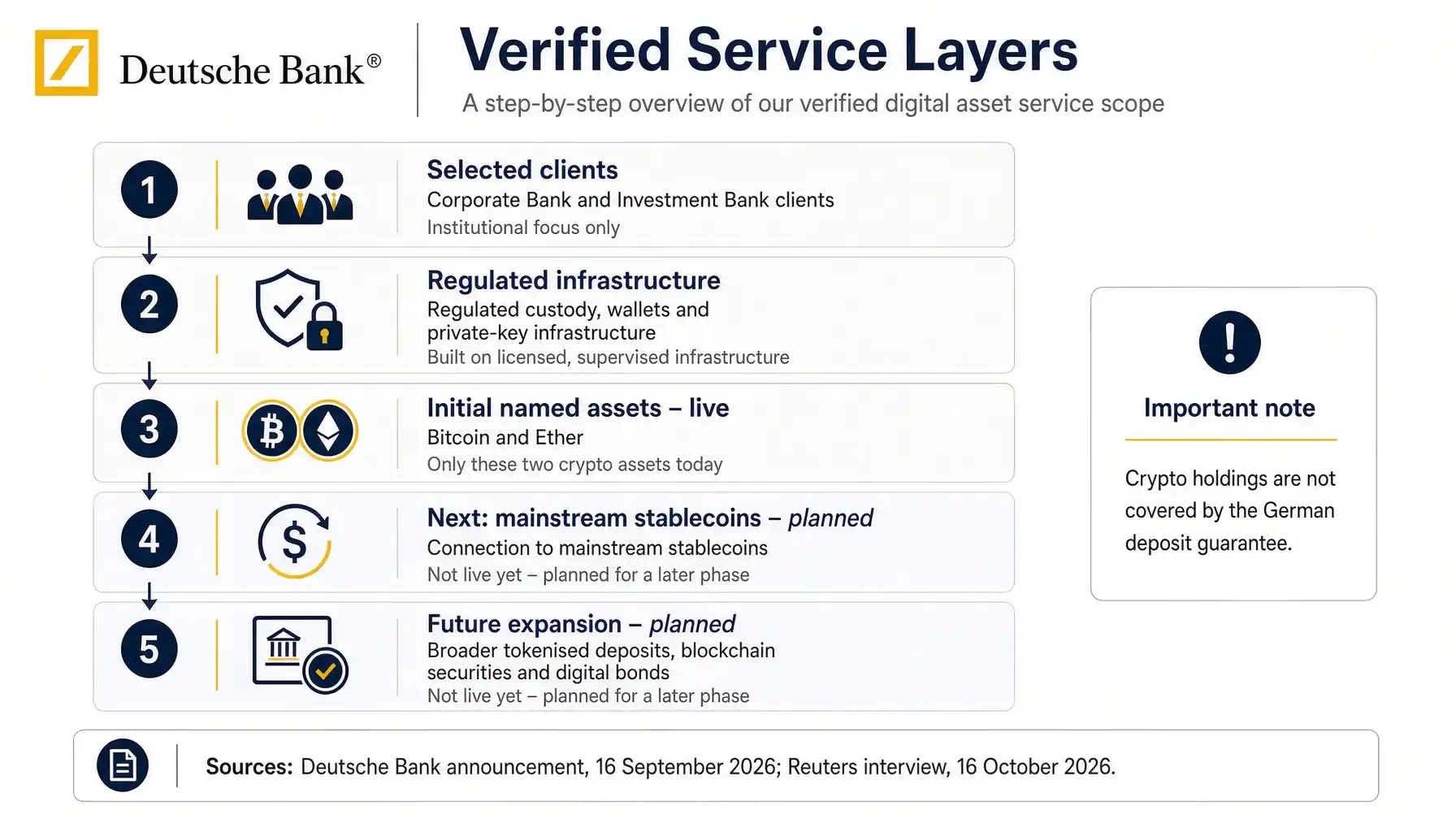
Gerald Podobnik, global head of the Corporate Bank division, told Reuters the German debut is expected “in the coming weeks.” The initial offering covers the safekeeping of Bitcoin and Ether. In a second phase, the bank intends to help clients move funds to and from widely used stablecoins, and to develop tokenized deposits, blockchain-based securities, and digital bonds.
The official September 16, 2026 announcement restricted the initial client base to a selected group within the Corporate Bank and Investment Bank. It described an infrastructure covering wallets, private key management, and regulated custody of selected assets. The announcement also specified that custodied crypto assets are not covered by deposit guarantee schemes, a distinction that matters: this is a custody service offered by a bank, not a traditional bank deposit.
Deutsche Bank is not starting from scratch. It is part of Qivalis, a European banking consortium exploring a euro stablecoin. SpazioCrypto has reported how 37 banks, including Deutsche Bank, UniCredit, and Intesa, are evaluating Ethereum as the public infrastructure for that project. Custody, tokenized money, and settlement are not isolated initiatives: they are components of a single architecture.
Deutsche Bank: What Is and Is Not Confirmed
- Confirmed: Custody launch in Germany expected within weeks, initially covering Bitcoin and Ether.
- Confirmed: Expansion to Asian financial centers planned for 2027.
- Confirmed: Initial client base drawn from the Corporate Bank and Investment Bank.
- Not confirmed: Exact launch date, which Asian markets, and which stablecoins will be supported.
- Condition: The project remains subject to completing the regulatory approval process.
Why Custody Comes Before Trading
For a global bank, holding digital assets is the control point for customer identity verification, asset segregation, key security, and transaction record-keeping. Trading can be layered on afterward, but without a compliant custody foundation it's difficult to offer integrated services to corporates, funds, or treasuries.
The sequence echoes what Italy's Banca Sella did when it became the first Italian bank admitted to crypto services under MiCA, using custody and transfer as its initial perimeter. The two projects are not identical: Banca Sella operates under the Italian framework and has completed its notification, while Deutsche Bank's launch is still conditional. The parallel is about industrial sequencing, not regulatory status.
For institutional clients, the value goes beyond avoiding a lost private key. A bank can embed anti-money laundering controls, operational limits, multi-authorization workflows, and reporting directly into the treasury processes clients already use. That integration is where large institutions can genuinely compete with native crypto custodians.
The European Model Taking Shape
MiCA created a common framework, but it did not create a single path to market. Crypto operators must obtain a full CASP (Crypto-Asset Service Provider) license; credit institutions can use a lighter notification procedure for services compatible with their existing banking license. The list of MiCA-authorized operators shows banks, exchanges, and specialist custodians entering the same market from very different starting points.
Deutsche Bank's scale and commercial relationships could shift crypto custody from a specialist product into a standard component of institutional cash management. That said, the bank has not published data on contracted clients, expected volumes, or fee structures. The Corporate Bank's stated 8% annual growth target through 2028 covers the entire division, as reported in Deutsche Bank's guidance, not the custody service alone.
The clearest signal is organizational. The project sits inside the Corporate Bank, the unit that serves companies and financial institutions. That placement puts digital assets alongside payments, liquidity management, and risk tools, not in a separate innovation lab.
From Custody to Stablecoins
The second phase may matter more than the first. Enabling clients to move funds to and from stablecoins means connecting bank accounts to on-chain money. In that model, the bank doesn't necessarily have to issue every token: it can custody the assets, verify the client, convert bank money, and orchestrate settlement.
That strategy is consistent with Deutsche Bank's work on tokenized deposits and digital securities. In September 2026, the bank described its ambition as building an infrastructure capable of hosting multiple forms of digital money side by side. The European context adds another layer: the ECB and several central banks have called for revisions to MiCA's stablecoin rules, a signal that the link between tokens and bank balance sheets is still being negotiated.
Custody and stablecoins are not two independent product lines. The first enables control of assets and keys; the second can become a 24/7 settlement medium. For a corporate treasury, the combination only works if compliance, liquidity, and reconciliation are all integrated in the same workflow.
The 2027 Asia Plan
Reuters reported that Deutsche Bank aims to extend the offering to major Asian financial centers in 2027. The bank has not specified which ones. Singapore and Hong Kong are plausible candidates given their established digital asset frameworks, but assigning them to the plan without confirmation from the bank would be inference, not fact.
The Asian expansion follows a straightforward commercial logic. Many Corporate Bank clients manage cross-border flows and need infrastructure that operates across time zones. A custody offering anchored in Germany can serve as a first node; a multi-jurisdictional network can support payments, collateral, and digital securities at greater scale.
Local licensing remains the open question. A service regulated in Germany does not automatically become distributable in Asia. Each market can impose its own requirements on licensing, asset segregation, transfers, and stablecoin handling. The 2027 target should be read as a stated objective, not a guaranteed delivery date.
What This Means for European Competitors
For other European banks, the move raises the competitive bar. UniCredit is searching for a technology partner for crypto custody and trading, while Banca Sella has already completed its MiCA notification. Deutsche Bank brings into the same space a global platform and a large international corporate client base.
The competition is not simply about who offers Bitcoin custody first. What counts is the ability to combine custody, payments, stablecoins, and tokenized instruments in a single offer. UniCredit has already tested credit tokenization through a digital Schuldschein for German corporates. The European market is converging on a model where blockchain sits beneath the banking product, often invisible to the end client.
For international corporates, the practical effect will depend on which products Deutsche Bank actually makes available, at what cost, and in which locations. None of those details have been published yet. The news narrows the calendar uncertainty; it doesn't resolve the operational question.
The Bigger Picture
Deutsche Bank appears to be repositioning digital assets from a technology experiment into a piece of core banking infrastructure. The sequence of moves is deliberate: first control the assets, then connect tokenized money, then extend the network where clients actually operate.
That ambition doesn't guarantee demand, revenue, or success. It does show that one of Europe's largest banks sees custody as a necessary building block for competing in the future of payments and capital markets. The distance between intention and product will become measurable in the weeks ahead: watch for confirmation that regulatory approval has been granted, the formal service launch, and the first commercial terms disclosed to institutional clients.