

Norway has effectively closed its electrical grid to new data centers, at least for now. On November 9, 2026, Statnett, the national transmission system operator, suspended new capacity reservations for data centers and halted the evaluation of several technical requests. The freeze is expected to last until August 1, 2027. That same day, the Oslo government announced a licensing regime that will decide which facilities deserve electricity and land based on their social utility, explicitly stating that crypto-dedicated data centers will not qualify.
This is not a mining ban, and it's not a blanket shutdown: existing connections remain intact, final rules are not yet written, and the government frames this as a policy objective rather than an immediate closure. But the principle Norway is putting on paper, that access to electrical power will be allocated based on the function of the computation it serves, sets a precedent that other European countries with cheap energy and saturated grids will watch carefully.
What Statnett Actually Decided
The Statnett measure is technical and temporary. The operator suspended new network capacity reservations for data centers, the evaluation of certain new requests, and applications for large loads connected directly to the 420 kV transmission backbone. The stated reason is system security: Statnett says it needs new technical requirements covering how data centers behave during network faults, the speed at which their load can fluctuate, and the risk of oscillations in the grid. A load of several hundred megawatts that switches on and off in milliseconds behaves nothing like a steel mill.
Those requirements must pass through public consultation and receive approval from the energy regulator RME before reservations can resume, with the freeze expected to lift no later than August 1, 2027. The exceptions are clearly defined: existing connected sites are unaffected, facilities that have already obtained technical approval may proceed, and Statnett will evaluate regional projects close to service entry and smaller facilities on a case-by-case basis.
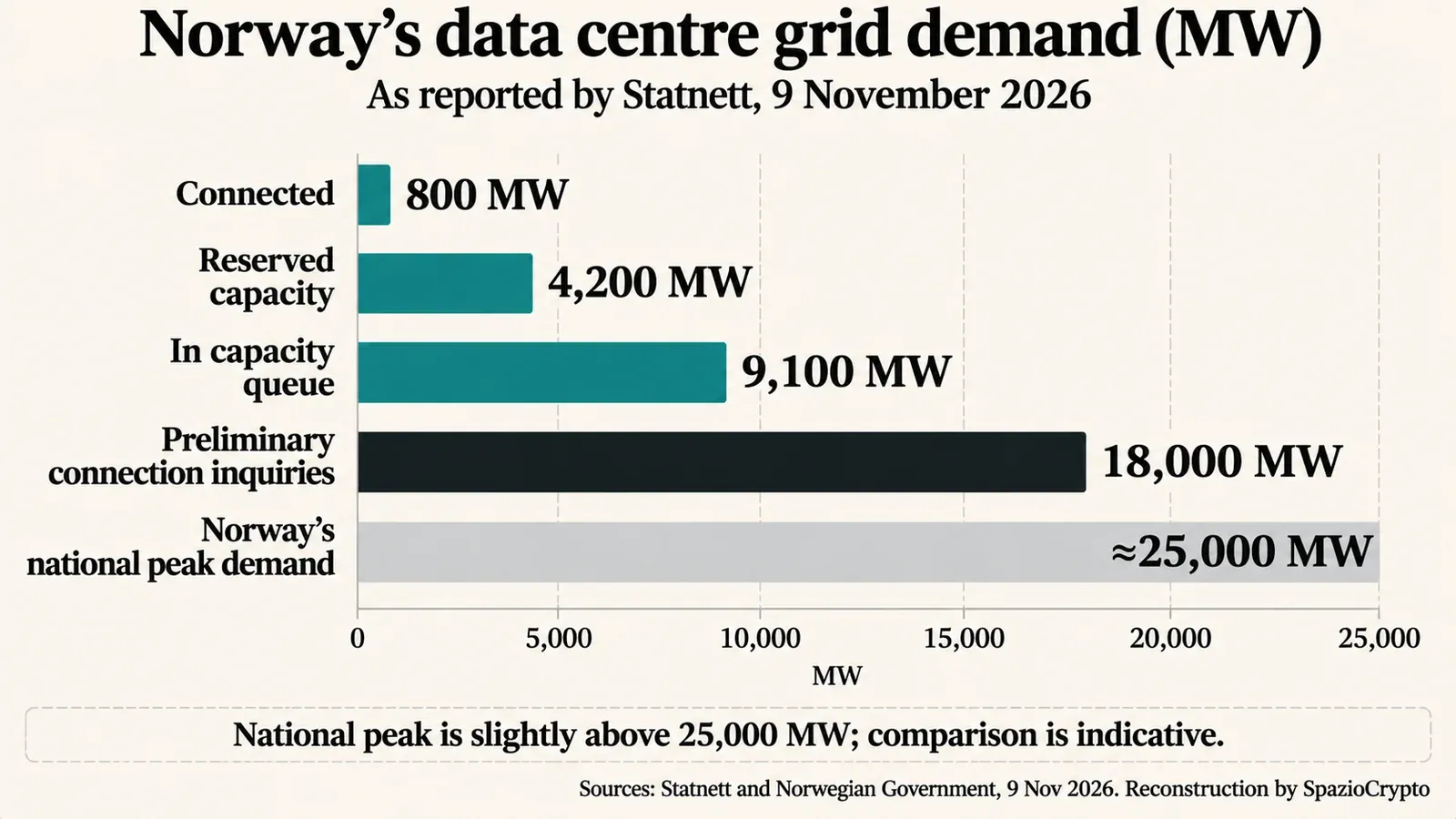
According to data published by Statnett, the operator received applications for approximately 26,000 MW of new consumption in 2026 alone, with three-quarters of that total coming from data centers.
The Numbers: A Queue Bigger Than the Country
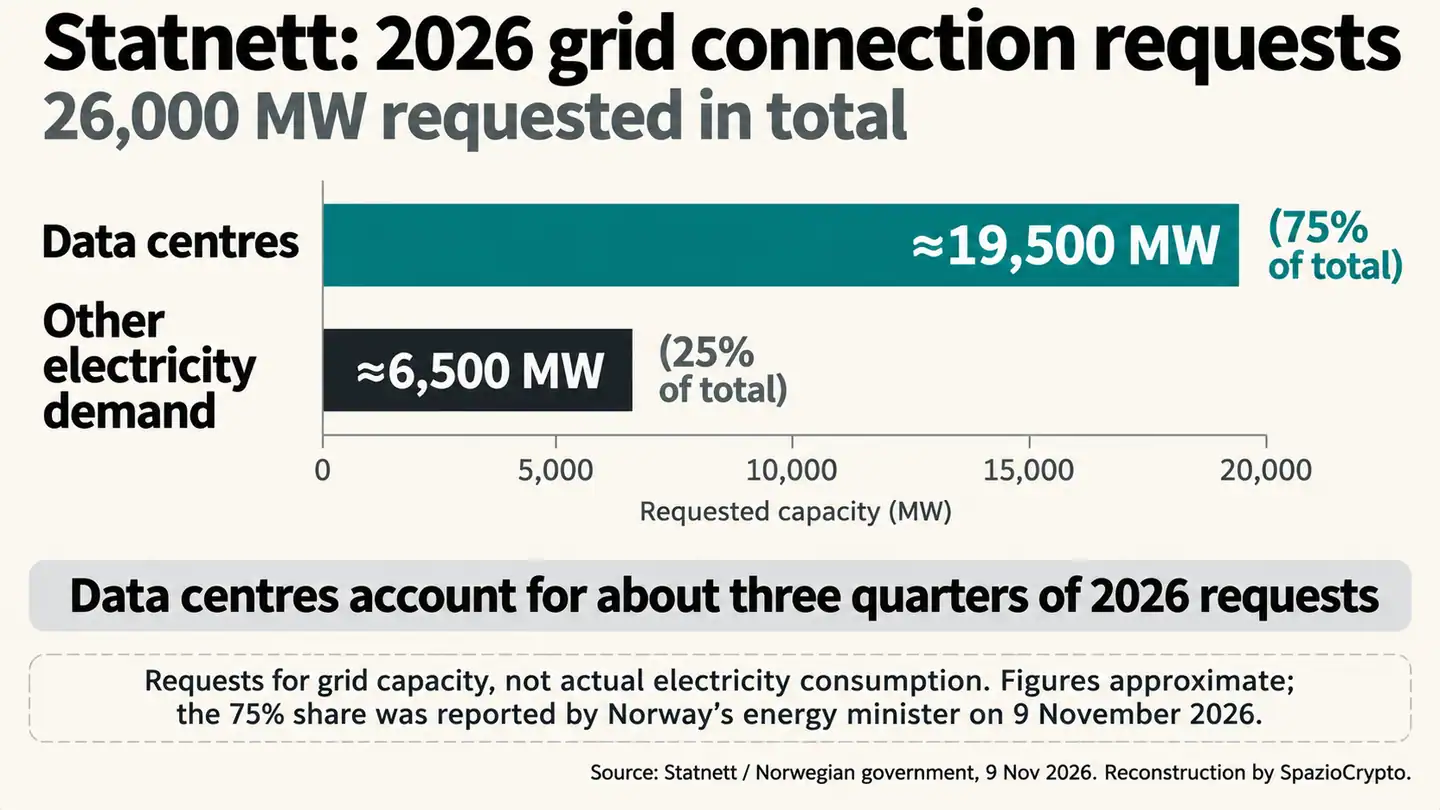
The official figures explain why the operator pulled the brake. Data centers already connected to the Norwegian grid currently consume around 800 MW. A further 4,200 MW have reserved capacity, and the government notes that figure alone represents roughly one-sixth of Norway's national peak consumption.
Projects totaling 9,100 MW sit in the connection queue. Beyond those, preliminary requests account for an additional 18,000 MW. Add the connected, reserved, and queued figures together and you reach 14,100 MW, approximately 56% of Norway's national electricity peak, which sits slightly above 25,000 MW according to Statnett data. Include the preliminary requests and theoretical data center demand alone exceeds the entire national peak in a single figure.
Nobody, including Statnett, argues that all of that capacity will actually be built. The 18,000 MW in preliminary requests are neither funded projects nor active construction sites, and a portion of the queue consists of speculative options held simply to avoid losing a place in line. But it is precisely this gap between theoretical demand and operational projects that Norway wants to stop managing on a simple first-come, first-served basis.
Data center capacity in Norway by stage of development, in MW, compared against national electricity peak consumption. Source: Statnett and Norwegian government, November 9, 2026; analysis by SpazioCrypto.
The Licensing Regime: Who Is “Socially Useful”?
The second decision of November 9 is political and comes directly from the government. Digitalization Minister Torgeir Micaelsen, alongside Energy Minister Terje Aasland, announced a licensing system under which anyone wishing to open and operate a data center in Norway must obtain authorization with attached conditions. Existing facilities will also be required to apply for a license and comply.
The stated objective is controlled growth of socially useful data centers. Micaelsen said he wants to secure the data centers Norway genuinely needs, adding that Norway does not want every type of data center, only those that deliver the greatest benefit to society. At the top of the priority list sit defense, police and civil protection, healthcare, critical infrastructure such as mobile networks and the financial system, national artificial intelligence capacity, and, with a favorable assessment, computing capacity serving the Nordic region and Europe more broadly.
At the bottom of the document, in language that leaves no room for interpretation, the government establishes that crypto activities will not be considered socially useful. Micaelsen explicitly named large global cloud companies and cryptocurrency firms as the entities to which Norway will restrict access to land and energy. The package also includes new grid connection rules, the principle that new data centers pay the network costs they generate, and the possibility of state ownership of strategically important sites.
The regime will take effect after August 1, 2027, and definitive principles are expected by autumn 2027.
What Has Not Been Decided
Precision matters here, because the headline “Norway bans mining” that will circulate is wrong. The government announced a draft law and a policy direction: the priority criteria, scoring systems, transitional arrangements for existing facilities, and penalties have not been published.
A crypto data center currently operating in Norway will not be switched off tomorrow. It will need to apply for a license once the regime is in force, and it is at that point that exclusion from the “socially useful” category will produce concrete effects, most likely in the form of denied expansion permits and lower priority for grid access.
Similarly, proposals for dedicated generation capacity, such as gas plants with CO2 capture or industry-funded offshore wind, are topics the government wants to discuss with operators, not approved projects. A practical issue also remains, one Norway has raised before: to exclude crypto operations, you need to know who is running them. The law therefore provides that data centers must declare who is behind the facility, who manages it, and what services it provides.
Norway's path to this point has been long. The country removed the electricity tax discount for Bitcoin miners back in 2023. In 2025, it announced intentions to ban new mining data centers to preserve energy supply, a move that Sweden had already pre-empted by raising taxes on data centers.
Composition of new consumption applications received by Statnett in 2026, approximately 26,000 MW in total, by applicant type. Source: Statnett, November 9, 2026; analysis by SpazioCrypto.
Why It Matters: Scarcity Is Capacity, Not Energy
Norway generates almost all of its electricity from hydropower, has some of the lowest power prices in Europe, and for years served as a natural destination for Bitcoin mining and energy-intensive data centers.
The problem the Statnett figures reveal is not the volume of energy produced in a year. It is the right to have available power at the specific point and moment it is needed: a 420 kV grid has finite capacity per node, and a 300 MW data center occupies a substantial share of that capacity regardless of how many hours a year it actually draws at full load.
The same constraint drove Russia to ban mining in the Moscow region until 2032, despite being an energy-exporting country. The shortage is not electricity itself; it is grid capacity where demand concentrates. Norway's addition to this debate is that the response is not a sectoral ban but a hierarchy. Crypto mining, global cloud, domestic AI, and public services are no longer treated as equivalent loads standing in a queue; they are uses with different social value that the state reserves the right to weigh.
For the crypto sector, which has grown accustomed to presenting itself as a flexible and interruptible load that benefits grid stability, this is a narrative defeat before it is an economic one. The Norwegian government chose not to accept that argument.
The European Precedent and the AI Bottleneck
The decision arrives as Europe discovers that the electrical grid is the binding constraint on artificial intelligence expansion, and as large mining operators convert their sites to AI hosting precisely because they already hold the grid connections that new entrants cannot obtain, as we have covered in tracking IREN's transition from Bitcoin miner to AI infrastructure giant and the infrastructure-driven rally among mining firms.
The Norwegian model complicates that strategy. If the license evaluates the function of the computation, a mining site seeking to convert to AI will need to demonstrate that the new load serves Norway or Europe, not an arbitrary global client. The same question will be put to hyperscalers. Countries such as Ireland, the Netherlands, and Denmark have already imposed moratoria or limits on data centers, but those decisions were framed in terms of quantity. Oslo introduces a quality criterion, and does so from a position of having enough clean energy to actually afford the choice.
We will follow the Statnett technical requirements consultation and the text of the licensing law in our sections dedicated to data centers, mining, and artificial intelligence. Norway has just written the opening chapter of a rule that others will copy.