

CryptoStar has switched off its last operational Bitcoin miners in Utah and is now searching for a new purpose for its data center facilities. In a shareholder update issued on November 27, 2026, the Canadian company listed on the TSX Venture Exchange under the ticker CSTR confirmed that its CryptoStar AI and HPC (high-performance computing) initiative still lacks the funding it needs. The previous operation has stopped; the one meant to replace it remains contingent on financial, commercial, and administrative conditions being met.
This article draws on the shareholder communication distributed by CryptoStar via CNW and reproduced on Stockwatch. Both publications carry the same update, not two independent verifications of operational facts. We have not reviewed the full text of any contracts, the company's original financial statements, or applicable Utah municipal ordinances.
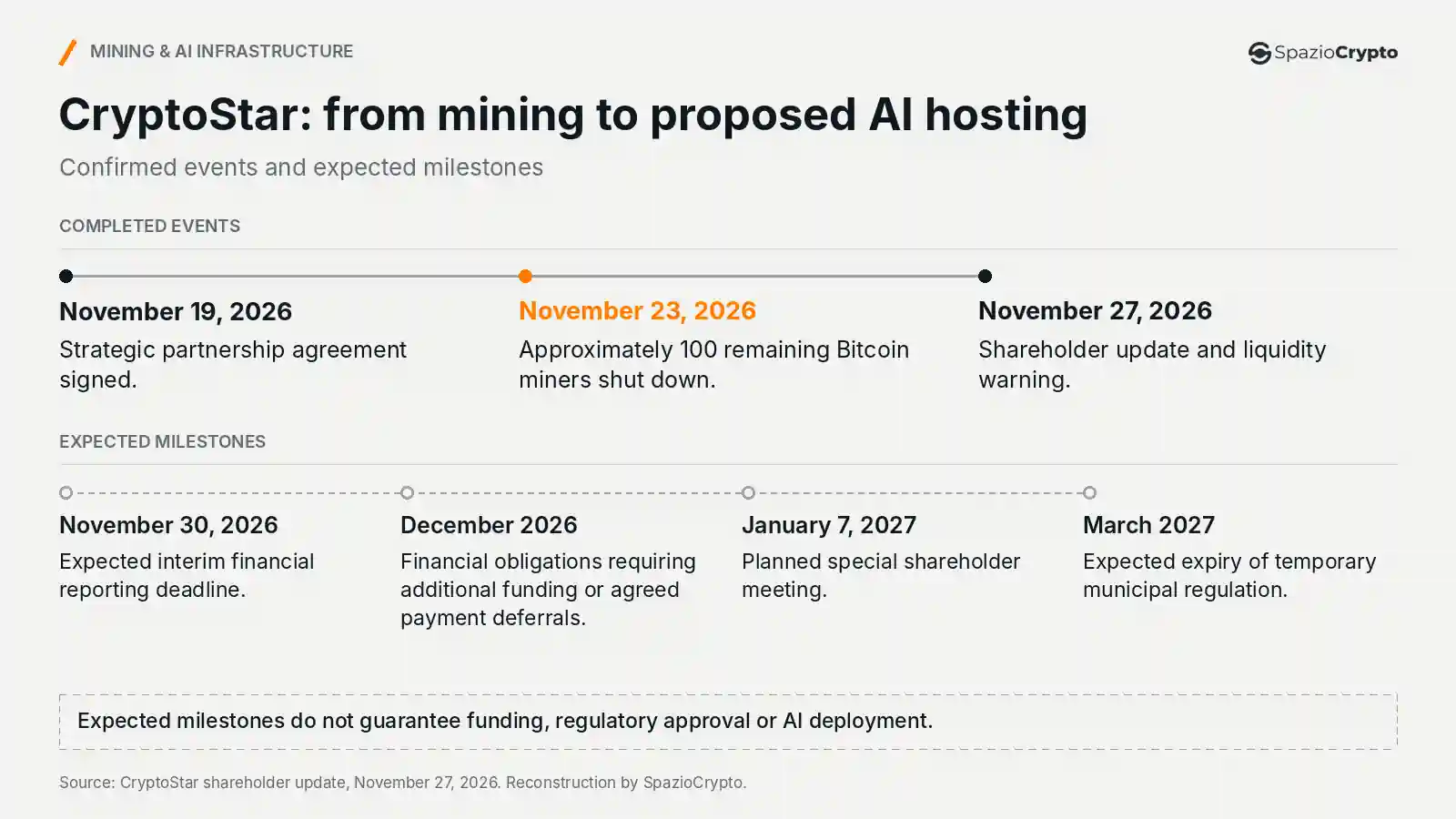
Bitcoin Miner Shutdown on November 23
CryptoStar USA, an indirect subsidiary of the group, deactivated roughly 100 machines still dedicated to Bitcoin mining on November 23, together with associated networking and cooling equipment. According to the company, a revised electricity tariff and a decline in the cryptocurrency's price had made the operation uneconomical. Essential site protection systems remain active. This is not a confirmation that the physical facilities have been fully dismantled.
The situation highlights an important distinction: physical availability of a data center is not the same as its economic viability. A facility can be grid-connected and technically functional while losing money every time the machines run. In Bitcoin mining, profitability depends on the ratio between revenues generated by computing power and the costs of running it. The price of Bitcoin is just one variable, alongside network difficulty, machine efficiency, and the contractual terms of the energy supply agreement.
This dynamic sits at the core of the broader trend we examined in our analysis of the transition of Bitcoin miners toward artificial intelligence. Switching off a machine does not automatically free up capacity that an AI customer can use. Between those two events lie distinct technical and commercial requirements. CryptoStar's communication does not quantify the electrical capacity that could be redirected to the new service, nor the cost of the modifications required.
Liquidity Comes Before the Pivot
The most pressing issue is December 2026. The group discloses limited liquid resources and, based on its own cash-flow projections, says it will need either new funding or negotiated deferrals to meet upcoming obligations. Amounts deferred by certain related parties since September remain outstanding. Bridge financing negotiations have not yet produced a binding commitment.
The risk extends beyond the ability to purchase new equipment. CryptoStar operates out of leased facilities, and the company itself warns that failure to meet obligations could jeopardize the lease agreements covering its Utah data centers. Those same properties are the foundation of the planned AI operation. The shareholder update also references the going-concern uncertainties already flagged in the interim financial report as of June 30.
A useful point of comparison is the Bitcoin-collateralized financing secured by MARA. That comparison does not imply CryptoStar holds similar reserves or can access equivalent terms. The point is structural: an infrastructure project must fund both the preparation phase and the period before revenues arrive. If current payments cannot be sustained, even a commercially attractive opportunity can become unreachable before it generates a single dollar.
An AI Partnership Is Not a Customer Order
On November 19, a CryptoStar subsidiary signed a partnership agreement with an unnamed U.S. provider of AI infrastructure platforms. The goal is to develop hosting services for customer-owned equipment, combining the partner's software with CryptoStar's infrastructure and operational capabilities.
This model differs from a miner directly purchasing a large fleet of GPU accelerators. In a hosting arrangement, the operator provides space, power, cooling, connectivity, and associated services for hardware owned by third parties. That can reduce the need to finance customer hardware directly, but it does not eliminate the costs of preparing the facilities, meeting agreed-upon standards, and keeping the systems running. The economic terms of any specific project have not been disclosed.
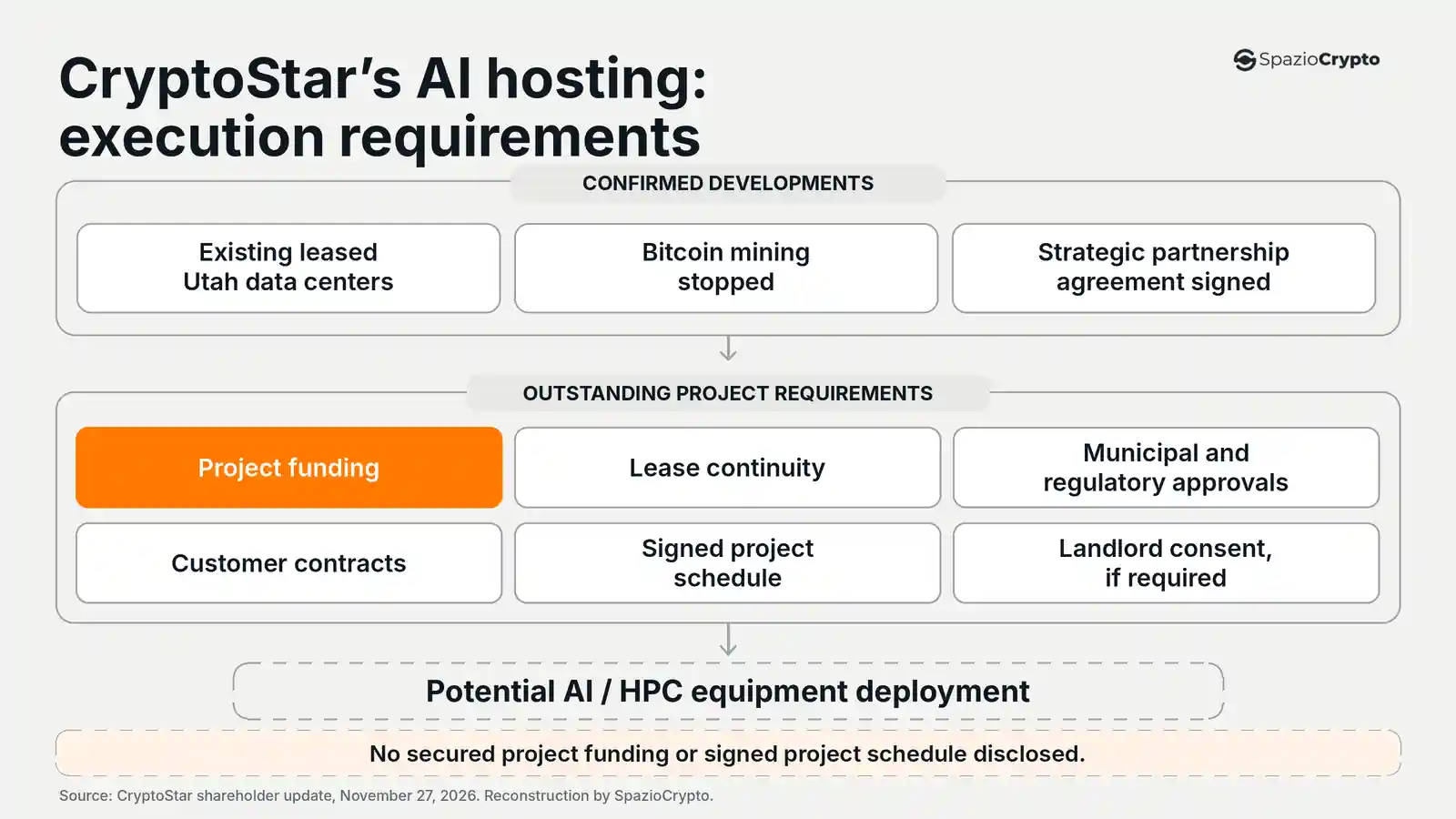
The agreement enables preliminary activities. It does not inject working capital or generate customer revenues. No contracts with end users have been announced, no resources have been allocated to specific projects, and no signed timelines exist. The possibility of a future corporate combination also remains under discussion. Our coverage of HIVE's HPC financing and its contract with Cohere illustrates the gap between a preliminary collaboration and a project backed by specific commercial and financial commitments.
Permits and Site Rights
Installing customer equipment will require applicable permits, including land-use authorizations and municipal licenses, in addition to financial resources and a signed project timeline. Depending on lease terms, landlord consent may also be needed. CryptoStar expects a temporary municipal ordinance governing data centers to expire in March 2027, but specifies that the expiry does not constitute automatic authorization for new activities.
A grid connection, in other words, is one element of a project, not a general license to run any type of computing workload. An HPC load can require different network configurations, power density levels, redundancy standards, and cooling solutions compared to Bitcoin mining. The specifics depend on the hardware type and service-level commitments involved. In this particular case, the company has not disclosed enough information to determine whether its facilities are already technically suited to house the planned equipment.
Our analysis of AI data center energy demand provides context for this race to secure infrastructure. The fact that the sector needs power does not guarantee every existing site a customer, nor does it set the price that customer would be willing to pay. Converting theoretical capacity into an actual delivered service requires a chain of verifiable steps.
Three Maturity Levels for Reading Mining-to-AI Pivots
We propose an analytical distinction, not an official market classification. At the first level are operators with signed commercial agreements and allocated resources for defined projects. Even there, deliveries and revenues remain to be verified. At the second level are projects starting from available infrastructure that must still be converted into usable capacity and structured under appropriate contracts. At the third level sit initiatives that depend, above all, on the company's ability to keep operating and retain rights over its sites.
CryptoStar, in our reading of the disclosure, falls into the third category. The gap separating it from already-contracted initiatives, such as those examined in our coverage of TeraWulf and the miner conversion trend, is a matter of the sequence of commitments that must be satisfied, not necessarily the quality of the technology being proposed. The scale of the AI market cannot substitute for completing those steps.
Even the presence of signed contracts, for that matter, does not prove revenues have accrued. Our article on CleanSpark's results and its data center segment draws precisely this distinction between agreements, fit-out work, and revenue recognition. For CryptoStar, the journey starts from a position that precedes all of that: securing the means to honor existing obligations and keep the facilities accessible.
Upcoming Corporate Deadlines
CryptoStar plans to file its interim results for the period ending September 30 by November 30, and to hold an extraordinary general meeting on January 7, 2027. Proposals on the agenda include a share consolidation of up to 30 existing shares into one new share, a transfer of corporate jurisdiction from Ontario to British Columbia, and a name change. These proposals should not be confused with decisions already in effect. A share consolidation, on its own, changes the share count; it does not bring financial resources into the company.
CryptoStar: What Is and Is Not Confirmed
A quick summary of confirmed facts versus open questions:
- Confirmed: shutdown of approximately 100 miners and signing of the AI partnership, as stated by the company.
- Not disclosed: current cash balance, identified customers, available HPC capacity, and project values.
- To monitor: financing arrangements, December deadlines, lease continuity, regulatory permits, and commercial agreements.
The Bigger Picture
CryptoStar illustrates the financial side of the mining-to-AI transition that rarely gets discussed openly. Infrastructure assets are only useful if the company retains the right to use them and has the time and resources to adapt them. Closing a loss-making operation can reduce certain costs, but it is not the same as launching a profitable one.
The concrete signals to watch next are straightforward: the filing of interim accounts, any announcements of new capital or payment deferrals, the continuity of the Utah leases, and progress on regulatory permits. Only after those pieces are in place can projects with named customers, defined economics, and signed schedules be properly assessed. The decisive step for CryptoStar is not rebranding its sector description; it's sustaining the new service financially long enough to actually deliver it.
Sources
CryptoStar Corp.: shareholder update via CNW, November 27, 2026, 5:40 p.m. ET. Stockwatch: reproduction of the corporate communication, November 27, 2026, 5:49 p.m. ET.