On October 15, 2026, Venture Global signed framework agreements with GE Vernova and Baker Hughes Energy Services to procure up to sixteen new 720 MW power units. The deal opens a path toward Venture Global supplying AI data centers with up to 10 GW of compute capacity from gas-powered, grid-independent installations by the end of 2034. The operative word is “up to.” These agreements secure access to turbines and transformers. They don't represent ten gigawatts already built, sold, or running.
This analysis draws on Venture Global's official press release, the Form 8-K filed with the SEC, and Reuters coverage. The Wall Street Journal article was not read in full and is referenced only as attributed context, without extracting exclusive details.
What Was Actually Signed
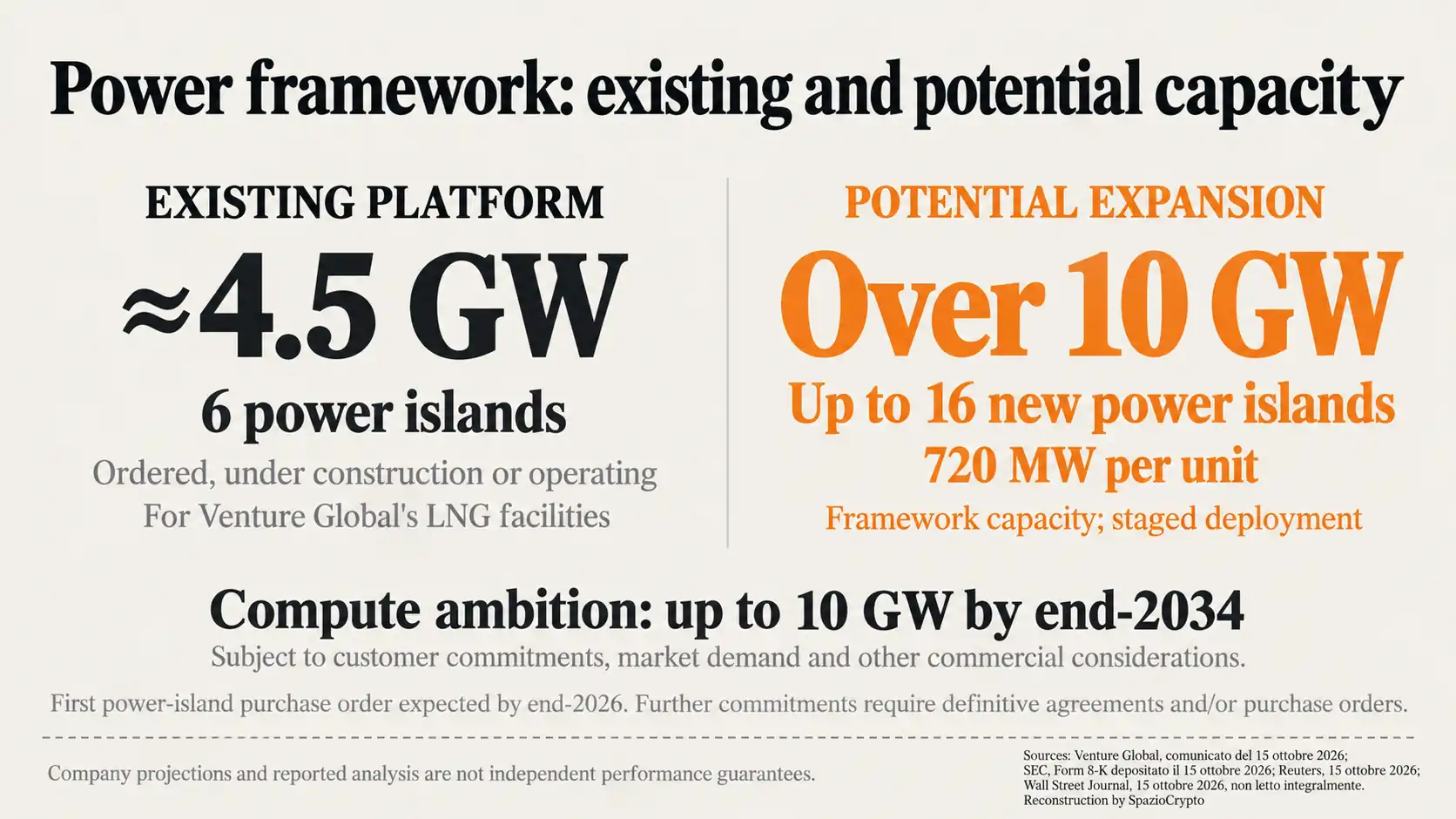
Venture Global entered a Power Frame Agreement with GE Vernova and Baker Hughes Energy Services, alongside a Grid Frame Agreement with GE Vernova. The scope covers up to sixteen “power islands,” each rated at 720 MW, plus associated transformer equipment. The SEC filing clarifies that industrial capacity reservation rights expire in phases and that the contracts will be attached to the next Form 10-Q filing. This is a framework to secure hard-to-source components, not an immediate order for all sixteen units.
Venture Global has an existing base to build on: six power islands ordered, under construction, or already operational at its LNG facilities, totaling roughly 4.5 GW. That existing footprint separates this announcement from a purely aspirational statement. As our AI infrastructure map shows, land, power, and connectivity have become industrial inputs as critical as chips themselves.
Ten Gigawatts Is a Ceiling, Not a Guarantee
The press release describes a pathway to making up to 10 GW of compute capacity available over time. Delivery depends on customer commitments, market demand, commercial assessments, and permitting. Venture Global says it plans to work with federal, state, and local authorities. No hyperscaler customers are named, no final data center sites are identified. No unit-by-unit construction timeline is published.
This distinction matters because the industry routinely uses potential power figures as shorthand for future scale. Our analysis of how much energy data centers consume shows global demand trending toward roughly 950 TWh by 2030, according to industry projections. Reserving equipment removes one supply-chain constraint, but financing, permitting, construction, and selling the capacity remain entirely separate problems.
Why Off-Grid Power
The new units would operate “behind the meter” in Island Mode, generating electricity at sites owned or controlled by the company without drawing from the public grid. Venture Global states that the expansion would not add demand to the public grid or public water systems. That is the company's own description of its design intent, not an independent assessment of overall impact.
The choice directly addresses the problem we detailed in our piece on the AI energy bottleneck: many projects wait years for grid interconnection. Building dedicated generation shortens the path to power, but it transfers responsibility for fuel supply, emissions, maintenance, and reliability entirely to the asset owner.
Gas Buys Time. It Doesn't Solve Everything.
The power islands will run on natural gas. Gas turbine technology is available and modular, while nuclear alternatives carry longer lead times. Our comparison of nuclear power for AI data centers highlights exactly this scheduling gap. Gas can cover the near-term window. It draws scrutiny on emissions profiles, fuel procurement, and variable operating costs.
The press release provides no emissions estimate for future AI workloads, announces no carbon capture systems, and does not quantify net electrical efficiency. Framing this initiative as “clean” infrastructure would be inaccurate. What's verified is autonomous generation capacity. Climate neutrality is a separate, unaddressed question.
 dualitystudiowebmaster
The headline capacity figure deserves one more caveat. Sixteen units at 720 MW each implies gross electrical output exceeding 10 GW, but the press release refers to compute capacity and does not publish the precise ratio between generation, auxiliary consumption, and IT load. Simply adding nameplate turbine ratings and calling the result “compute” is not accurate. Between the generator and the servers sit power transformation, redundancy systems, cooling, and operational margins.
The claim that local consumers face “no additional cost” also comes from the company itself. Avoiding grid draws removes one impact channel, but it doesn't answer questions about gas pipelines, industrial water use, permitting processes, or shared infrastructure. A complete assessment will require project-specific documents for each site and any conditions imposed by regulators.
From LNG Terminals to AI Utility
Venture Global's core business is building and operating terminals to export liquefied natural gas. The new industrial thesis is using that same execution capability to sell power and adjacent compute space. The pivot resembles the transition some Bitcoin miners have made: an energy operator monetizes land, plant, and expertise beyond its original business line.
That comparison doesn't imply Venture Global is converting crypto mines. The logic is commercial: whoever controls dispatchable energy can negotiate with AI customers. Our analysis of AI data center capital expenditure shows how long-term contracts increasingly shift leverage toward whoever can guarantee physical capacity.
Timing will also be a competitive variable. The SEC filing indicates deliveries scheduled through 2034, with reservation rights carrying intermediate expiration dates. If demand slows, the phased structure allows gradual ordering. If demand accelerates, the reserved availability could become a significant asset.
What This Means for Europe
These agreements cover U.S. sites and announce no investment in Europe. For European readers, the lesson isn't to automatically replicate the off-grid gas model, but to recognize that grid interconnection timelines directly shape the geography of compute. Google's project in Finland combining data centers and nuclear power offers a different template, one tied to existing grid infrastructure, local low-carbon energy, and territorial contracts.
Venture Global at a Glance
What is confirmed, and what is not
- Confirmed: framework agreements for up to 16 units at 720 MW each, with a potential trajectory toward 10 GW of compute capacity.
- Not disclosed: customers, final site locations, total capex, emissions figures, and a detailed unit-by-unit construction schedule.
- Watch for: actual orders exercised, permitting outcomes, contracts with data center operators, and first-power generation milestones.
The Bigger Picture
AI is converting electrical capacity into a digital commodity before the data center is even built. Reserving turbines and transformers is a way of optioning a share of future compute growth. Venture Global is trying to enter that value chain from the side it knows best: plant engineering, fuel supply, and large-scale construction.
The signals worth tracking are concrete: how many options get exercised, which customers sign long-term agreements, which permits get granted, and how much of the capacity the LNG business itself will actually need versus what gets sold to data center operators. Only when those variables resolve will the 10 GW figure move from a potential ceiling to a measurable industrial program.