

South Korea's most telling AI infrastructure moment in years happened not in a press release but on a construction site. On November 28, 2026, GS Group officially broke ground at Donghae, in Gangwon Province, on the first 1.2-gigawatt phase of a campus that could eventually reach 2.4 GW. The Donghae AI data center is the first gigawatt-class project in South Korea to enter the construction phase among the three mega-projects backed by the government. President Lee Jae-myung attended the groundbreaking ceremony. The servers, however, are nowhere near switched on.
This report draws on the Ministry of Science and ICT briefing of November 29, the South Korean presidential office's ceremony note, and reporting by Yonhap, Seoul Economic Daily, and Aju Press. Financial figures and the construction timeline reflect GS-sourced information as relayed by those outlets. No standalone corporate press release on the ceremony was located, and the draft implementing regulations cited below have not been verified in full.
A 1.2 GW Construction Site, Not an Operating Facility
The campus is being built within the second general industrial complex at Bukpyeong. According to the GS plan reported by Yonhap, the first phase allocates 700 MW across three zones, with an additional 500 MW earmarked for a separate area. The first individual center, rated at 100 MW, is targeted for completion in the second quarter of 2028. Successive installations are expected to bring the phase total to 1,200 MW, with the full first phase targeted for commissioning by 2029.
The timeline matters as much as the scale. Aju Press notes that an earlier planning target had aimed at 1.2 GW by 2028 and 2.4 GW by 2029. The more recent guidance pushes the 1.2 GW milestone to 2029 for the first phase alone. The groundbreaking ceremony confirms the project has started, not that future deadlines will be met. The announced gigawatt figures also do not translate directly into a count of installable GPUs: sources do not specify the split between IT loads and auxiliary services with enough detail to make that calculation.
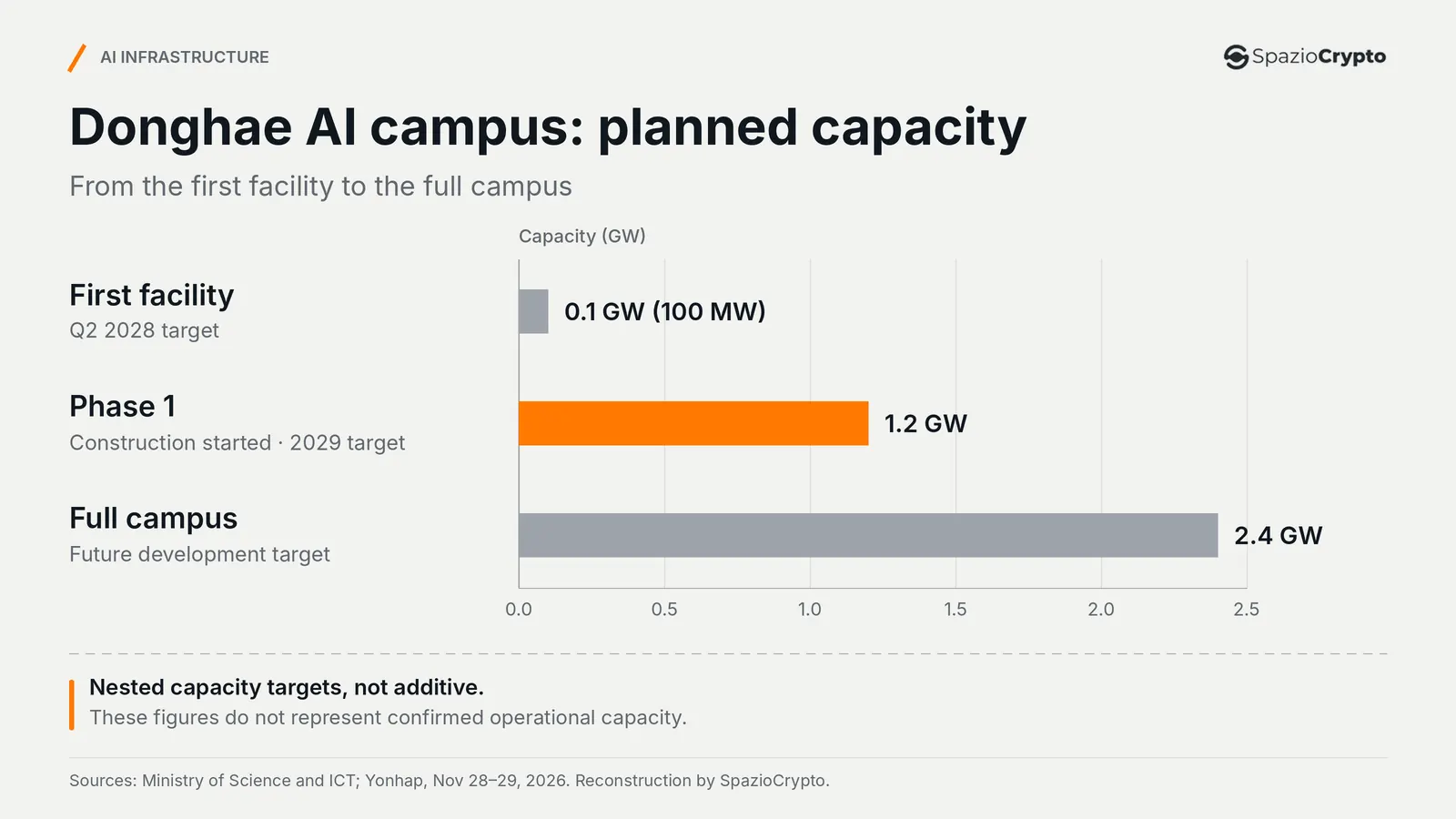
The same distinction applies here that we flagged when examining Venture Global's energy plans for data centers: a declared capacity is not the same as power already being delivered. For Donghae, the milestones worth tracking are building completions, live grid connections, and the actual arrival of computing hardware. Each of those steps can run on its own schedule, even within the same campus.
Three Investment Figures, Three Different Meanings
GS announced in September a plan worth 15 trillion won for the first phase. According to Yonhap and Seoul Economic Daily, completing the full 2.4 GW campus would require roughly 30 trillion won. The figure could rise to around 120 trillion won if GPUs and memory are included. That last number describes a potential total project value, not capital already deployed or financing already committed.
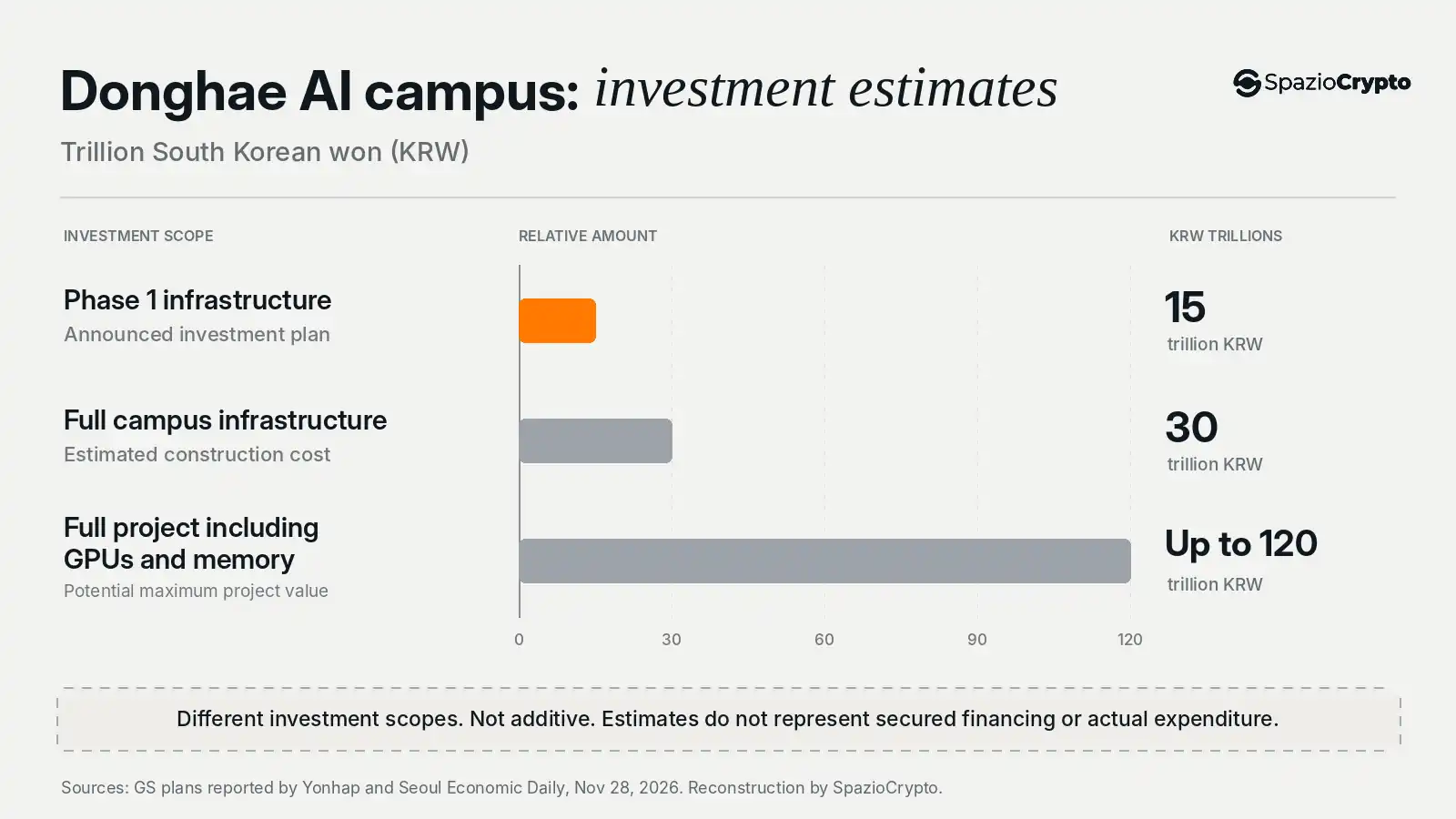
Conflating these figures means attributing to the site developer the entire future spend on computing equipment, without knowing how costs will be distributed among owners, operators, and tenants. Building a facility capable of housing servers does not mean the developer has already purchased all the chips that will eventually run inside it. This project is part of the global race for AI infrastructure, where sustained capital availability must run alongside energy supply and component procurement for years.
The East Coast Becomes an Industrial Asset
Donghae was not chosen for its proximity to major tech company headquarters. The ministry states that GS identified two specific advantages at Bukpyeong: the east coast's established electrical generation base, and the potential to study seawater cooling. Territorial availability of those resources is a potential advantage, not a guarantee that every required megawatt is already under contract. The seawater cooling system remains a possibility to be developed, not a live installation.
A campus at this scale demands infrastructure well beyond server racks: transformers, substations, internal power distribution, thermal management systems, and network connectivity. The parallel with Google's energy procurement approach in Finland is instructive, even if the contexts differ. Where computing capacity is physically located depends heavily on the contractual and physical conditions needed to keep it running. Donghae will also need to assess potential environmental impacts of its cooling solutions once those are finalized.
GS Is Building a Supply Chain, Not Just Buildings
The conglomerate established GS AI Infra in June 2026, pooling expertise from its energy and construction divisions. According to Seoul Economic Daily, the group has opened collaborations with LS Electric, POSCO, LG Uplus, and Honeywell for supply, design, and campus operations. The involvement of these partners does not reveal the value of individual contracts, nor does it confirm that all equipment has already been ordered.
Demand for electrical and thermal systems is a distinct market from that of generative AI models, as our analysis of Schneider Electric's data center results showed. South Korea also possesses an industrial technology ecosystem that is experimenting with new computing applications, from manufacturing to robotics. The earlier collaboration between NVIDIA and LG on physical AI belongs to this broader context, though it does not constitute evidence of a tenancy agreement at Donghae.
Local authorities and GS have outlined plans to support participation by regional businesses and professional training programs. The ministry points to pathways to be developed with regional universities and an estimated workforce demand of several hundred to around one thousand direct and indirect jobs during the operational phase. These are projections: the actual headcount will depend on how facilities are completed, how the campus is managed, and how much demand for services materializes.
Seoul Prepares New Rules for Data Centers
Industrial policy is moving alongside construction. The ministry announced a public consultation on the implementing regulations for a dedicated sector law set to take effect in March 2027. The public review is scheduled for December 9, 2026, with comments accepted through December 30. Aju Press reports that the draft includes a coordinated permitting procedure and an exemption from grid impact assessments for certain facilities below 50 MW outside the Seoul metropolitan area.
That threshold does not automatically cover the full 1.2 GW campus. The implementing text is still being drafted and should not be treated as settled regulation. Reducing administrative barriers can accelerate project starts, but it does not substitute for grid upgrades or community impact reviews. The issue echoes the regulatory and political risk we analyzed in the context of Blackstone's data center investments.
What This Means for Western AI Infrastructure Watchers
The question of industrial location is not confined to South Korea. In its network development plan, Terna reported roughly 30 GW of data center connection requests in Italy as of December 2024, alongside the need to build or upgrade significant electrical infrastructure. That figure reflects applications submitted, not capacity actually installed, and is not directly comparable to the Donghae project's scale. The Korean case suggests that announcements in Europe and the US should be read in light of permitting status, grid works, and supply contracts rather than raw gigawatt figures alone.
Donghae at a Glance
What is confirmed, and what is not
- Confirmed: formal construction start of the 1.2 GW first phase on November 28, 2026.
- Not specified: actual IT capacity, full financing commitment, end-customer contracts, and the final cooling configuration.
- To watch: the first 100 MW block in Q2 2028, the full first phase by 2029, and development of the second phase toward 2.4 GW.
The Bigger Picture
Donghae is, above all, a bet on the reinvention of industrial geography. If the project proceeds as planned, a region with strong electrical resources and industrial expertise could attract new digital activity without replicating the economic concentration of the capital. The ambition to claim Asian leadership in AI infrastructure, expressed by the presidential office, remains an institutional statement: no independent ranking built on consistent criteria currently exists to verify it.
The signals worth watching are verifiable: progress on the first building, live grid connections, contracts with end users, cooling system specifications, and financial commitments for the expansion to 2.4 GW. Only those markers will show whether Donghae becomes a complete production district or remains an ambitious construction site. For now, one concrete fact stands: the first gigawatt-class site in the government's national program has officially begun.
Sources
Groundbreaking and industrial policy: Ministry of Science and ICT, November 29, 2026; South Korean presidential office, ceremony note. Industrial plan and financial estimates: Yonhap, November 28; Seoul Economic Daily, November 28; Aju Press, GS plan. Regulations and timeline revision: Aju Press, November 28. Italy grid context: Terna, Network Development Plan.