

The Bank of Japan held rates steady in October, but its internal debate signals the pause may not last. The summary of opinions from the October 29-30 meeting, published on November 10, reveals a Bank of Japan rate hike board deeply divided over timing: some members want the policy rate at neutral “soon,” while others point to weak consumer spending and the lingering effects of previous hikes. The rate remains at 1.25%. The document announces no new decision and makes no commitment on December.
Our analysis draws directly from the BoJ summary of opinions published November 10. The October vote and ETF sales decision are cited via ANI. Market expectations reference a Reuters survey conducted October 13-19.
 ANI
What the BoJ Decided in October
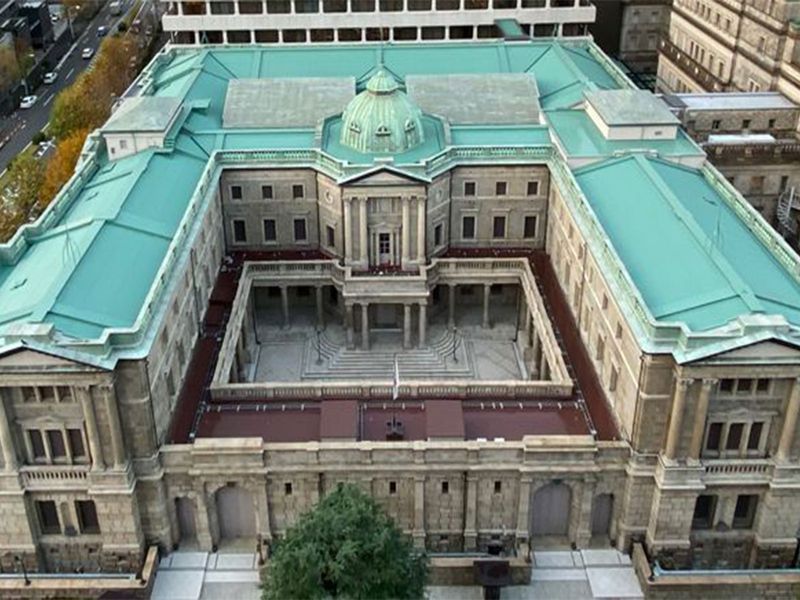
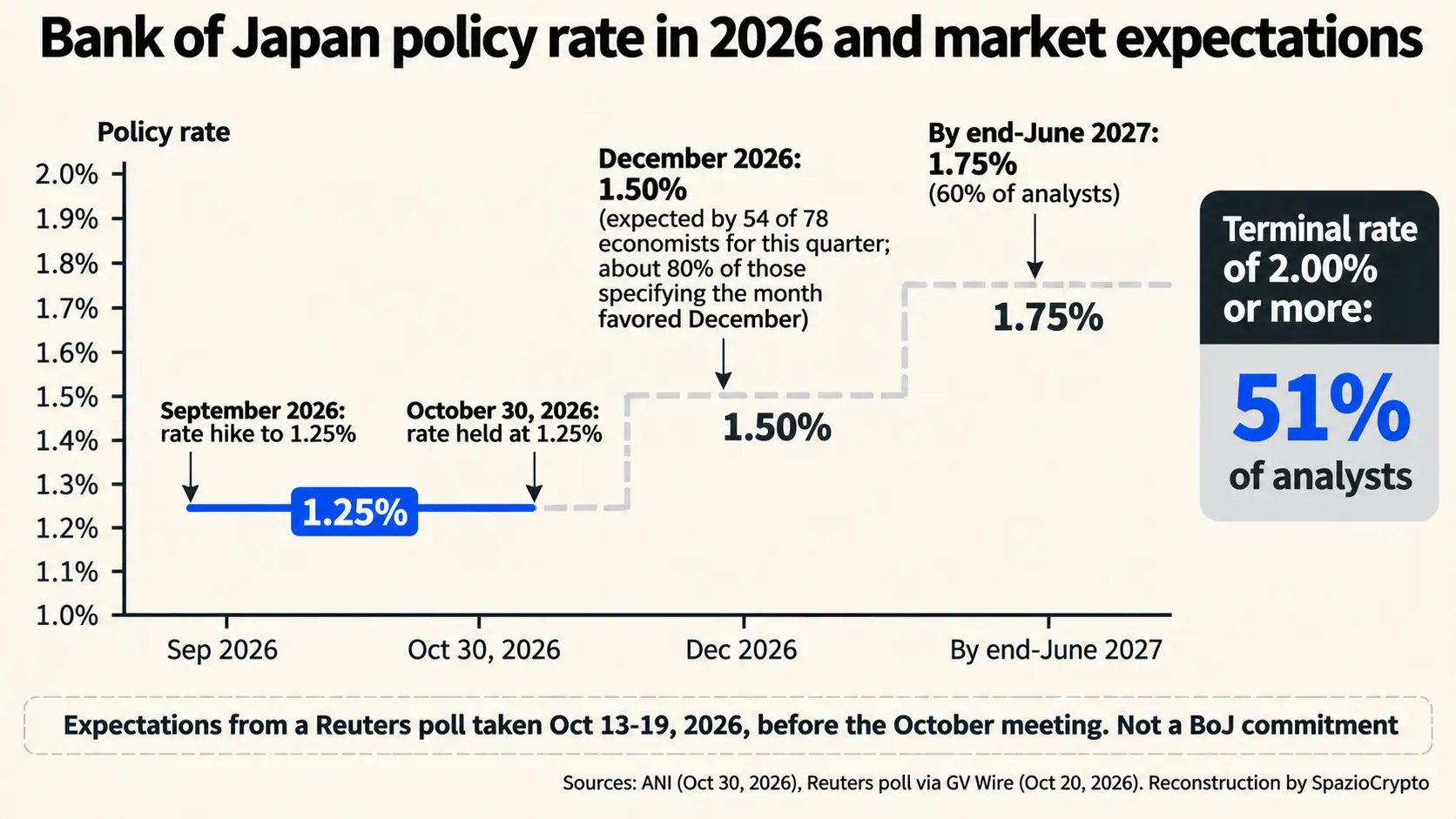
On October 30, the board held the benchmark rate at 1.25% by an 8-to-1 vote, according to ANI. Member Hajime Takata proposed raising the rate to 1.50%, arguing that underlying inflation had reached the 2% target. The proposal was voted down. In the same meeting, the BoJ accelerated sales of its equity ETF holdings: the annual pace rises from roughly 330 billion yen to around 860 billion yen starting January 2027, equivalent to about 0.1% of daily market turnover.
The October meeting followed two rate hikes in 2026, in June and September, which pushed the rate to its current 1.25% level. According to the Reuters survey of October 13-19, Japanese rates are now at their highest in 31 years.
What the Hawks Are Saying
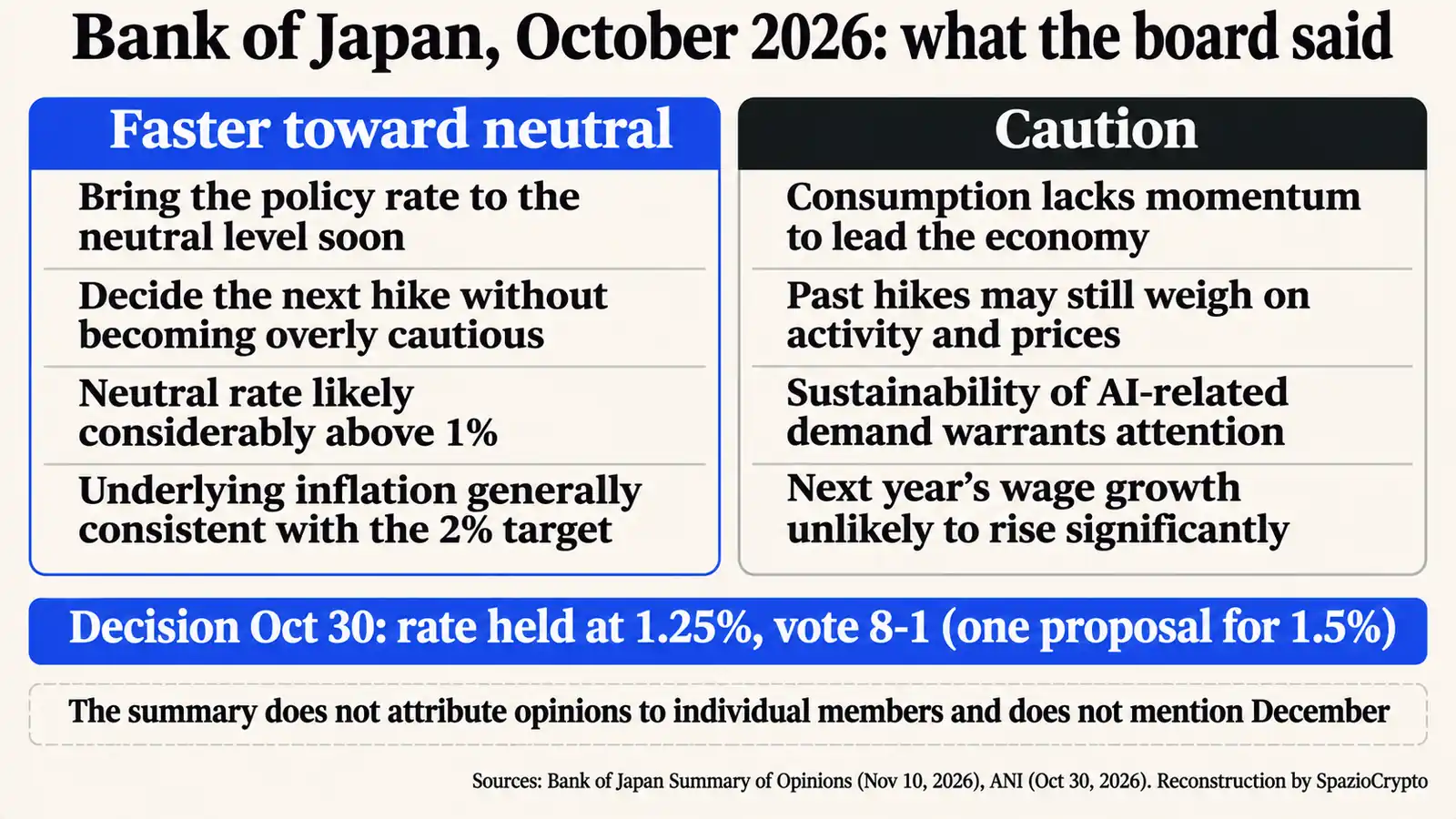
The summary does not attribute opinions to individual members. The direction from one side of the board is unambiguous. One opinion states the BoJ must bring the rate to neutral “soon.” Another calls for deciding the next hike when possible “without becoming excessively cautious.” A third estimates the neutral rate is probably “considerably above 1%.”
The underlying argument is about inflation. The summary concludes that underlying inflation is at a level “generally consistent” with the price stability objective, and anchoring it around 2% is now the priority. This is the same rationale Takata used when proposing his October hike.
What the Doves Are Saying
The other side of the board urges restraint, on three distinct grounds. First, consumer spending: one opinion holds that domestic consumption lacks the momentum to drive the broader economy. Second, the cumulative effect of past hikes: there is a risk that previous tightening is still feeding through to activity and prices, and another hike would add to that drag. Third, artificial intelligence: AI-related demand has supported growth, but the summary notes that the duration of its impact “warrants attention.”
Wages are also a live variable. The summary notes some firms expect to raise pay next year at a similar pace to this year, but significant acceleration in wage growth looks unlikely. Spring wage negotiations, the shunto, are flagged as a critical checkpoint. A phrase in the summary captures the middle ground: proceed with care, “making haste slowly” in unwinding monetary stimulus.
December Is Close, Not Confirmed
Markets are watching December closely. In the Reuters survey of mid-October, 54 out of 78 economists expected a hike to 1.50% by end of the quarter, with roughly 80% of those specifying a month choosing December. Per the same Reuters survey, 60% see 1.75% by end of June, and the share forecasting a terminal rate of 2% or above has risen to 51%.
The summary itself, though, does not name December. It reinforces the sense that action is approaching, without guaranteeing it. October's lone dissent and the hawks' language push in that direction, while the caution around consumption and AI keeps open the possibility of waiting.
Why This Matters Beyond Japan
For years, the near-zero yen served as the global carry trade currency of choice: borrow cheap in Japan, deploy elsewhere. Every step the BoJ takes toward higher rates makes that trade less attractive. This is our editorial reading; the summary does not address it directly. But when carry trades have unwound quickly in the past, riskier assets, including crypto, have felt the volatility. The relationship between interest rates and Bitcoin is not mechanical, as the Q3 2026 performance showed.
Japanese monetary policy also touches the country's fast-moving digital finance sector, from tokenized funds linked to the JPYSC stablecoin to Rakuten XRP payments. The debate over how central banks respond to new forms of money is equally open in Europe, as the Swiss National Bank's stablecoin warning illustrated. For macro-focused crypto investors, December joins an already crowded calendar of central bank decisions.
BoJ October: What Is Confirmed, What Is Not
What is confirmed, what is not
- Confirmed: rate held at 1.25% with one dissenting vote; the summary includes opinions calling for reaching neutral soon, alongside calls for caution on consumption, the effects of past hikes, and AI demand.
- Not stated: who expressed which opinion, a date for the next hike, a precise level for the neutral rate.
- To watch: the December meeting, incoming data on consumption and inflation, and early signals from spring wage negotiations.
The Bigger Picture
Our reading, stated as such, is that the Bank of Japan has reached the most delicate phase of its normalization. For the first time in decades, the board considers underlying inflation consistent with its target, and the debate has shifted from whether to hike to how fast. The irony is that just as inflation appears to be settling, the brakes are coming from the real economy: weak consumption, wages that show no sign of accelerating, and an AI-driven demand boost whose staying power nobody can call.
Three signals are worth tracking. First, the December meeting and whether the board moves to 1.50%. Second, the vote count, which will indicate how much weight the hawks actually carry. Third, early signals on 2027 wage trends, which the board itself identifies as the decisive input for the pace of subsequent hikes.