


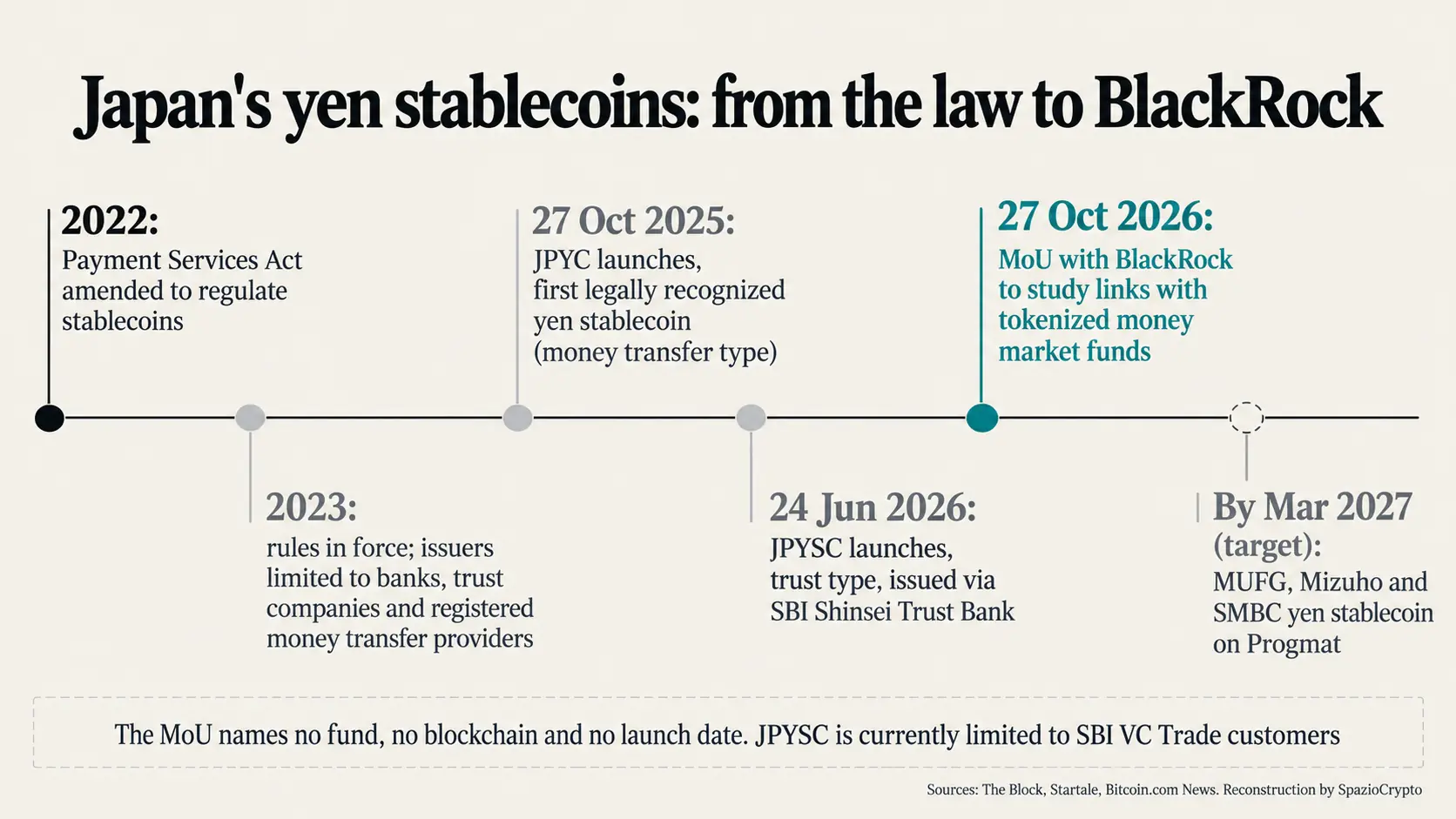
BlackRock has joined a Japanese initiative to connect tokenized money market funds with a yen-denominated stablecoin. On October 27, BlackRock Financial Management and BlackRock Japan signed a memorandum of understanding with SBI Holdings and Startale Group to explore linking tokenized money market funds with JPYSC, SBI's yen stablecoin. The MOU on BlackRock, JPYSC, and tokenized funds covers three work streams: technology and infrastructure, business models and distribution, and regulatory requirements. What it does not specify: which fund, which blockchain, or any launch date. This is a study agreement, not a product announcement.
This article draws on the Startale press release, SBI Holdings' published summary, and The Block's reconstruction of events, along with earlier coverage of JPYSC's June launch. The full SBI press release was not accessible with our tools, and Startale CEO Sota Watanabe's post on X appears to have relayed the official announcement.
The Four Signatories and Their Roles
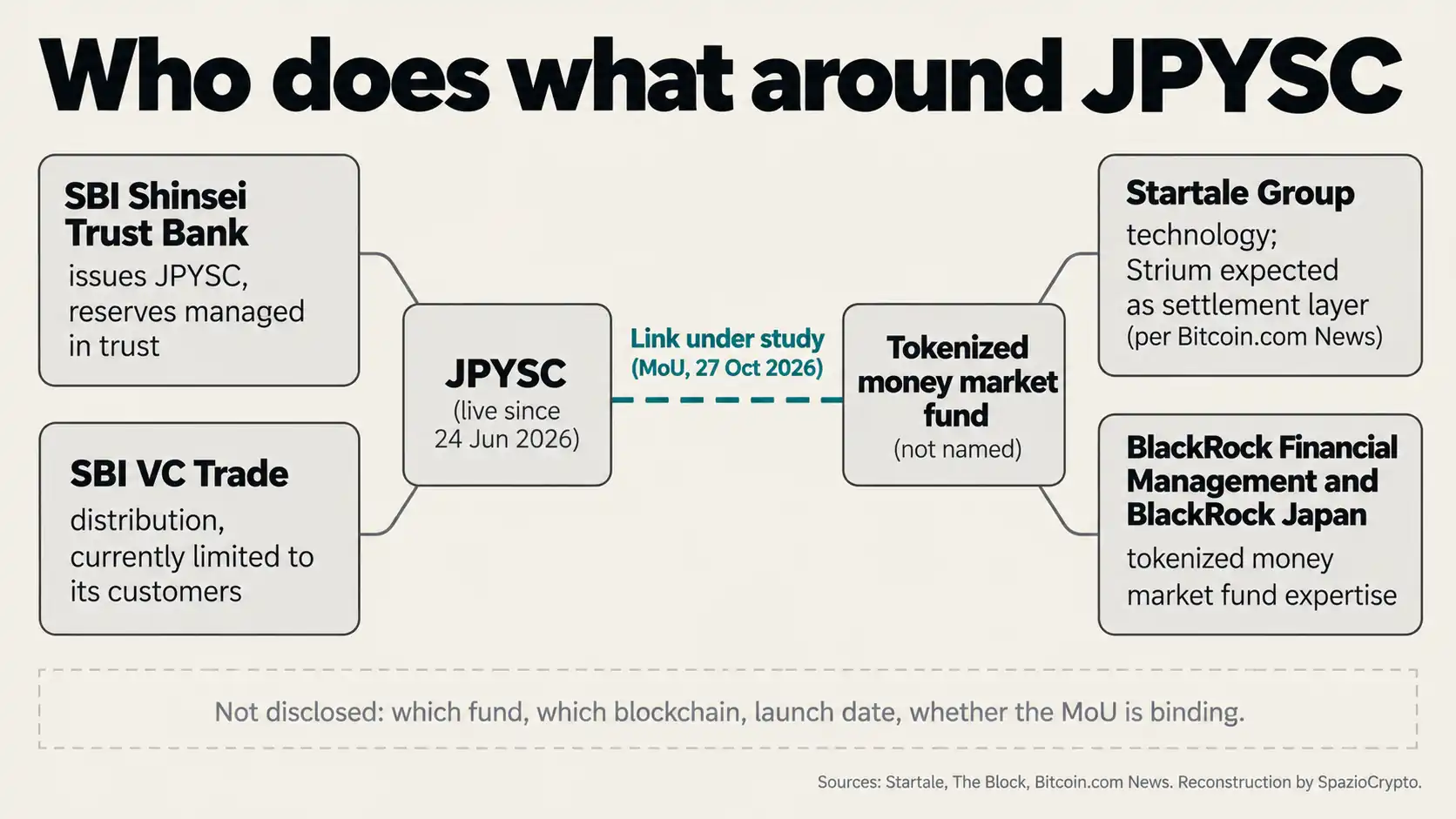
Four entities from three groups signed the MOU. SBI Holdings is the parent company that issued JPYSC through its subsidiaries. Startale Group, headquartered in Singapore, is the technology partner that co-launched JPYSC alongside SBI. According to Bitcoin.com News, Startale closed a $63 million funding round in March 2026, with SBI contributing $50 million and Sony the remaining $13 million. BlackRock's side of the agreement includes BlackRock Financial Management, the U.S. parent entity, and BlackRock Japan, its local subsidiary.
The press release does not assign specific responsibilities to each party. It does note that the initiative will remain open to additional participants, both in Japan and internationally. Executive statements set the tone: SBI Holdings President Yoshitaka Kitao described the shift to on-chain finance as “an inevitable global trend,” while BlackRock Japan President Yukiko Hashimoto framed the collaboration as bringing BlackRock's global experience to the Japanese market (our translation).
Three Study Areas, Zero Operational Commitment
The memorandum outlines three parallel tracks. The first covers technology and infrastructure, specifically the technical requirements for linking tokenized money market funds with JPYSC. The second addresses business and distribution, evaluating potential commercial models and the distribution channels of the three organizations. The third focuses on regulation and market development, examining regulatory requirements and supporting the Japanese market for tokenized assets and stablecoins.
All three tracks are framed as evaluation activities. As reported by The Block, the companies identified developing infrastructure, distribution channels, and regulatory frameworks as next steps, without specifying timelines. It is not clear whether the MOU is legally binding or involves any financial commitments. The idea of pairing a fund with a stablecoin is not new: Tether, for example, has brought USDT into a $400 million private credit fund.
JPYSC: What Is Already Live
Unlike the fund linkage, the stablecoin itself already exists. JPYSC launched on June 24, 2026: according to The Block, issuance is managed by SBI Shinsei Trust Bank, with distribution handled by SBI VC Trade, the group's crypto exchange. SBI describes JPYSC as a trust-type stablecoin, meaning its reserves are managed by a trust bank. The group also positions it as the first yen-denominated stablecoin of this type classified as an electronic payment instrument under Japan's Payment Services Act. That classification matters: it exempts JPYSC from the 1 million yen per-transaction and per-balance cap that applies to stablecoins issued by fund transfer service providers.

Distribution remains limited. At launch, JPYSC was available only to SBI VC Trade clients, pending clarification on tax and regulatory treatment. No source has reported circulation figures. According to Bitcoin.com News, the expected settlement network is Strium, the institutional blockchain Startale presented in February 2026. The MOU with BlackRock, however, does not name any network, and that choice carries more weight than it might seem: the case of Coinbase discontinuing USDC on Noble illustrates how consequential blockchain selection can be.
Japan's Regulatory Framework for Stablecoins
Japan regulated stablecoins ahead of most other jurisdictions. Amendments to the Payment Services Act passed in 2022 entered into force one year later, according to The Block. Fiat-backed stablecoins are defined as electronic payment instruments, and only banks, trust companies, and registered fund transfer service providers may issue them. The first legally recognized yen stablecoin, JPYC, launched on October 27, 2025, after registering as a fund transfer service provider. JPYSC chose the trust bank route. According to Bitcoin.com News, MUFG, Mizuho, and SMBC are developing their own yen stablecoin on the Progmat platform, with an interbank launch target of March 2027.
Connecting a fund to the stablecoin introduces a second regulatory layer. This is our own framing: shares in a money market fund, even when tokenized, remain financial products subject to securities and fund regulations, while the stablecoin is a payment instrument. Making the two work together requires decisions on who can subscribe, under what controls, and who holds custody of what. That is precisely the unfinished work assigned to the MOU's third track.
What Is Still Missing: Fund, Network, and Calendar
The elements the MOU omits are exactly those that would turn a study into a product. No fund is named. BlackRock has managed BUIDL, its tokenized fund invested in U.S. Treasuries, repo agreements, and cash, since 2024. According to The Block, BUIDL holds approximately $2.17 billion in assets under management. The MOU does not reference BUIDL, and there is no guarantee it would be the vehicle involved. Also absent: the blockchain, a launch date, required regulatory approvals, and projected volumes.
 Startale

Read for what it is, the agreement signals something specific: three groups with complementary roles (the stablecoin issuer, the network builder, the fund manager) have decided to study together how to make those roles interact. The news value lies in the third name at the table, not yet in the numbers.
The European Parallel
In Europe, the governing framework is MiCA, and the closest comparison involves bank-backed stablecoin projects. Qivalis is a euro stablecoin initiative backed by 37 European banks, including UniCredit, Intesa Sanpaolo, and Banca Sella. According to Ledger Insights, it obtained an electronic money institution license from the Dutch central bank on October 14, but has yet to issue a token. On the deposit side, UK banks have completed the first interbank payments using tokenized deposits. Our reading is that Japan is ahead on one specific point: a trust-bank stablecoin is already in circulation and is now seeking a fund linkage, while European equivalents are still working toward initial issuance.
BlackRock and JPYSC: Summary
What is confirmed, what is not.
- Confirmed: October 27 MOU between SBI Holdings, Startale Group, BlackRock Financial Management, and BlackRock Japan; three study tracks covering technology, business, and regulation; JPYSC in circulation since June 24, issued through SBI Shinsei Trust Bank.
- Not specified: the fund involved, the blockchain, a launch date, the binding nature of the agreement, any financial commitments, required approvals, or JPYSC's current circulation figures.
- To watch: the choice of fund and network, the tax clarifications currently limiting JPYSC to SBI VC Trade clients, the arrival of additional participants (anticipated in the press release), and the major Japanese banks' rival stablecoin on Progmat.
The Bigger Picture
Our read on this MOU is that it points to where tokenization is heading: away from standalone products and toward a pairing of a yield-bearing asset with a digital currency for subscribing and redeeming it. A tokenized money market fund needs reliable on-chain cash, and a stablecoin needs use cases beyond exchange settlement. In the United States, this pairing has formed around the dollar, with asset managers like Fidelity moving directly into stablecoins and issuers like Circle expanding USDC into 40 new markets. Japan is attempting to build the same pairing around the yen, starting from a regulatory framework that is already largely in place.
Four signals are worth tracking from here: the name of the fund and the network, which will show how close the project is to a real product; the tax guidance that currently restricts JPYSC to SBI VC Trade clients; the arrival of new participants, which the press release explicitly anticipates; and competitive pressure from Japan's three largest banks developing their own yen stablecoin on Progmat by March 2027. For anyone mapping the stablecoin landscape today, the foundational comparison remains Tether versus USDC, both dollar-denominated and both shaping the rails that yen-based alternatives will need to compete with.