Polymarket has entered the courtroom in a very real sense: according to a Wall Street Journal investigation published October 11, the platform is hosting contracts tied to the outcomes of active U.S. criminal trials, with hundreds of thousands of dollars in trading volume across two cases, Lindsay Clancy and Tyler Robinson. These figures represent trading volume, not winnings, and no source reviewed for this article has demonstrated jury tampering or the use of confidential judicial information. The legal and oversight questions, though, are very much open.
The Wall Street Journal article itself was inaccessible to our tools due to a paywall, so the figures attributed to it could not be verified against the original text. We cross-referenced those figures with the two Polymarket market pages, read on October 12, and with reporting from Salt Lake Tribune, NewsNation (via NetInfluencer), KUTV, and Boston Globe. None of those outlets carries a statement from Polymarket. The PBS NewsHour video featuring Kalshi CEO Tarek Mansour addresses prediction market regulation broadly and does not mention either criminal case, so it is not used here as a source for these two markets.


What Is Confirmed: Two Markets, Two Trials
A prediction market is a platform where participants trade contracts whose value depends on the outcome of a real-world event, as we explain in our guide to prediction markets. Both contracts are currently live on Polymarket: “Lindsay Clancy convicted of murder by...?”, opened August 18, with resolution dates of December 31, 2026 and December 31, 2027, and “Tyler Robinson convicted of homicide?”, opened June 16. For the Clancy market, the full rules text was not available on the page. For the Robinson market, the rules specify a positive outcome if Robinson is convicted of a homicide offense in the Utah proceeding by July 31, 2027, and a negative outcome in the event of dismissal or a no-contest plea. Only the initial verdict counts, not any appeal (this summary is ours).
 Polymarket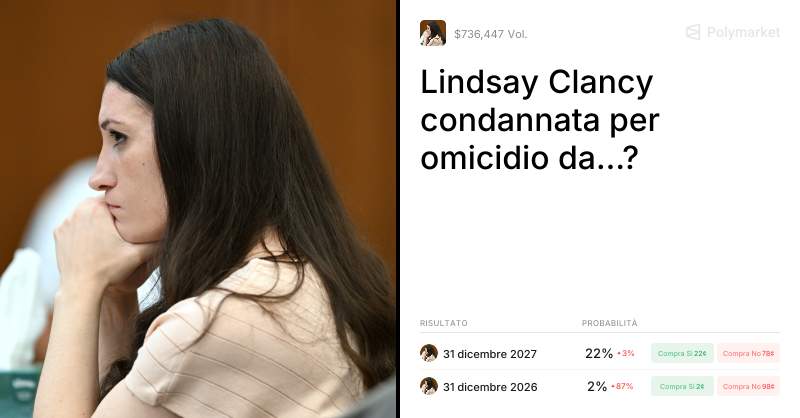
According to the Wall Street Journal, more than $100,000 in contracts were traded on the Clancy market while the trial was ongoing and, after the September mistrial, over $500,000 more on the possibility of a future conviction. The Robinson market showed over $300,000 traded before his formal not-guilty plea. Independent sources point in the same direction: GamblingHarm.org reported approximately $53,000 on the Clancy market as of August 28; NewsNation, as cited by NetInfluencer, reported over $161,000 wagered before the mistrial; and the Salt Lake Tribune put the Robinson market at roughly $317,000 as of September 1. By October 12, the Polymarket pages showed total volumes of $736,447 for Clancy and $388,624 for Robinson. Both figures change continuously.
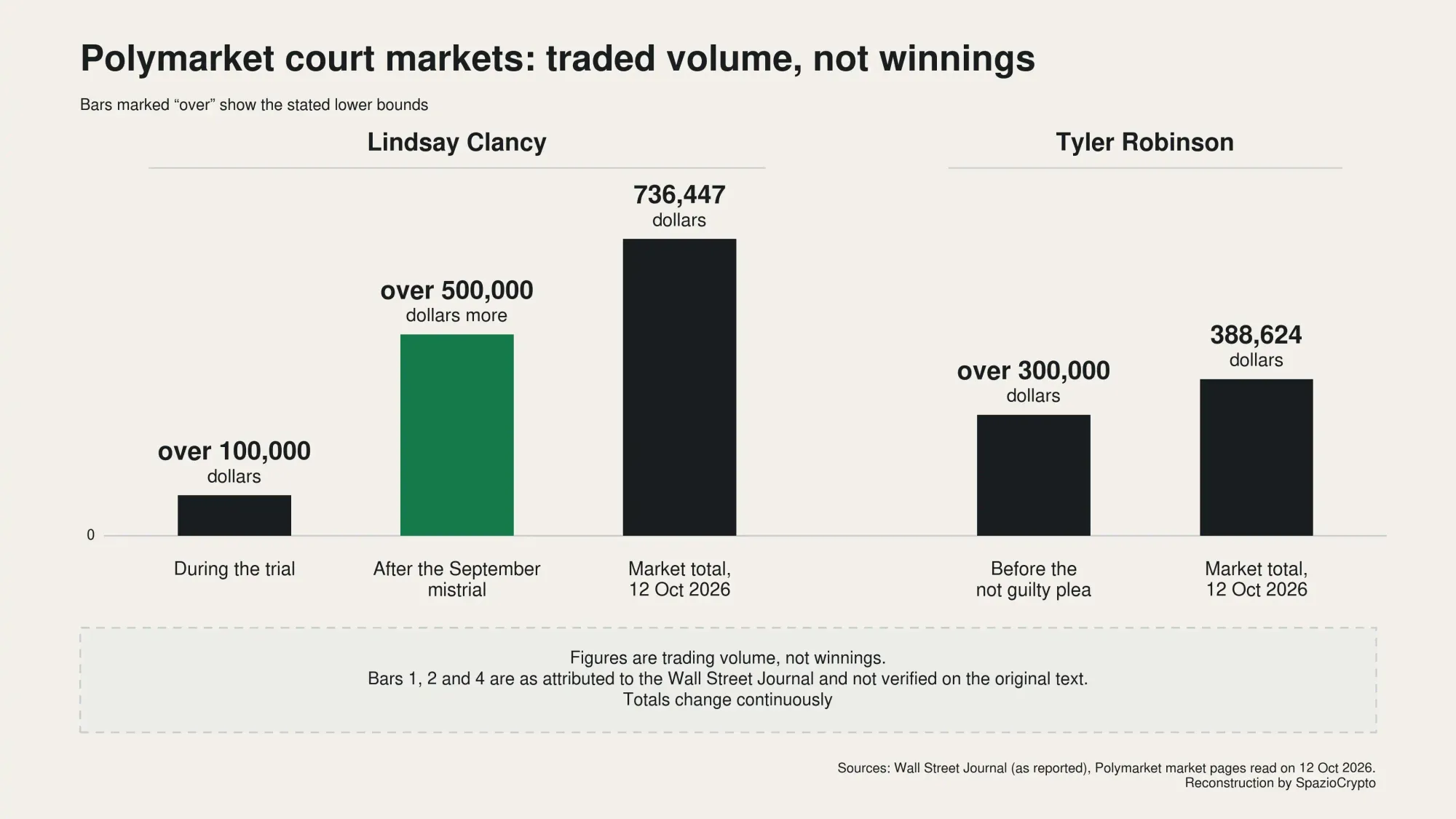
Trading volume measures the total value of contracts exchanged. It does not reveal how much any individual earned, how many people participated, or whether the sums come from a small number of traders buying and selling repeatedly (this explanation is ours, not derived from the sources). On individual stakes, GamblingHarm.org reported that some users stood to win or lose four-figure sums, with one position worth approximately $5,500 in the event of a Clancy conviction.
Where the Two Cases Stand
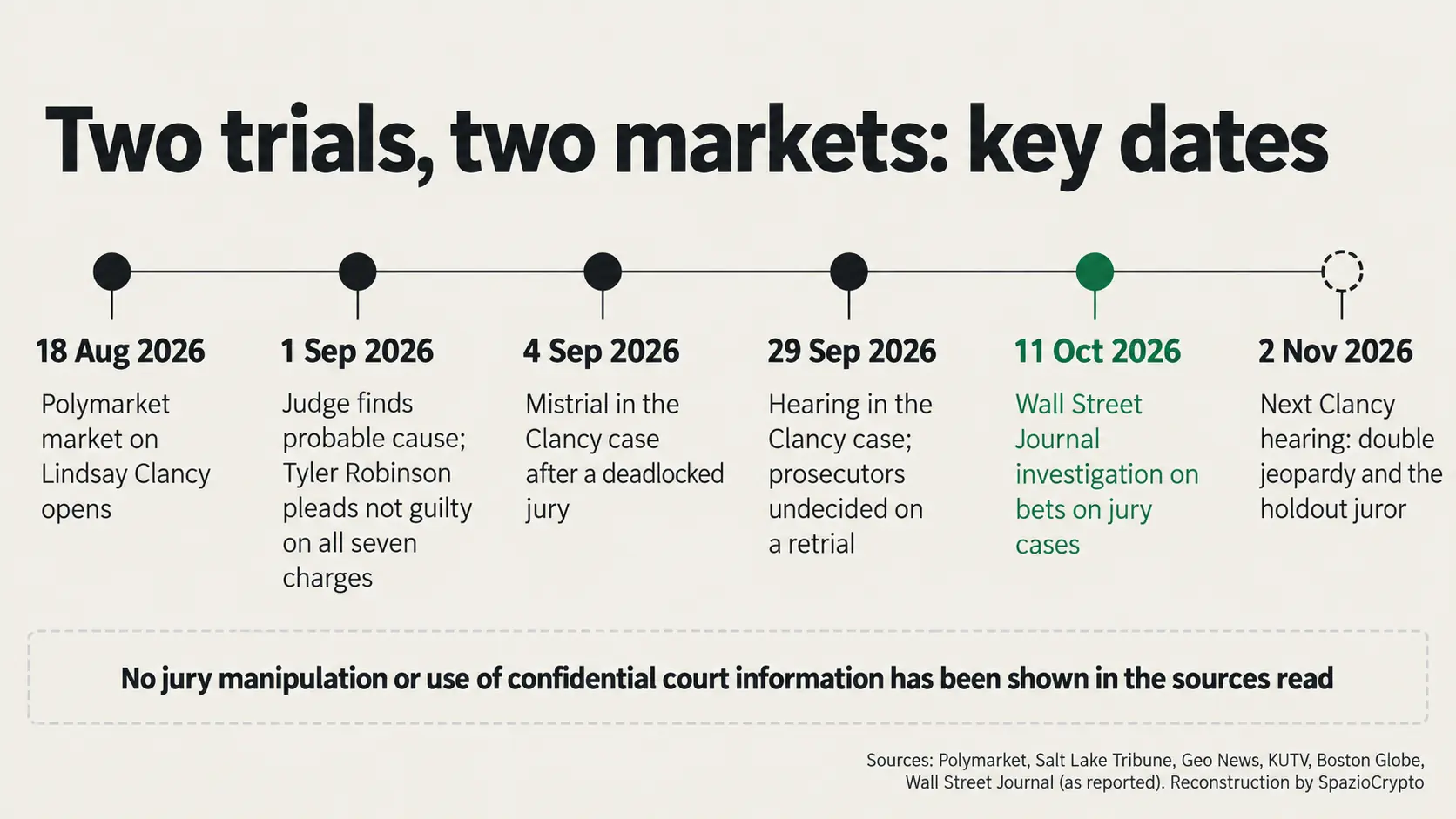
Lindsay Clancy is charged with the deaths of her three children in 2023. Her defense has centered on a mental illness argument. On September 4, the judge declared a mistrial after the jury failed to reach a unanimous verdict; according to KUTV, jurors had split 11 to 1 in favor of acquittal. A mistrial does not end the case. District Attorney Timothy Cruz had not decided, as of September 29, whether to seek a retrial. As reported by the Boston Globe, November 2 is the scheduled date for two hearings: one on the defense motion to dismiss the murder charges on double-jeopardy grounds, and one on a limited inquiry into the lone dissenting juror. The judge hopes to set a potential retrial date at that same hearing.
Tyler Robinson is accused of killing Charlie Kirk on September 10, 2025 at Utah Valley University. On September 1, Judge Tony Graf found probable cause to proceed with the case, and Robinson pleaded not guilty to all seven counts, including aggravated homicide, according to Geo News. No trial date has been set in the sources reviewed. Both defendants are presumed innocent unless and until a final verdict establishes otherwise, and this article takes no position on the underlying charges.
The Core Question: Jurors and Confidential Information
Two risks emerge from the investigation summary we started with: that a juror might learn the conviction probability implied by prediction markets and have their perception of the case shaped by it, and that anyone with access to confidential judicial information could gain an unfair edge over other participants. These are risks, not established facts. The issue has already reached the courtroom, though. According to the Salt Lake Tribune, Robinson's defense argued, as noted by the judge, that courtroom cameras fuel prediction market betting and that hearing arguments could “move the markets.” Judge Graf rejected both the request to ban cameras and the request to seal the arguments about Polymarket.
Outside assessments diverge sharply. Prediction News, a sector outlet, describes trial contracts as a “surveillance challenge” because jurors, clerks, and attorneys hold information that other participants simply don't have, and writes that Polymarket “has no precedent monitoring courtrooms” — that is the author's editorial judgment, not a verified fact. GamblingHarm.org, for its part, writes that insider trading is “always a possibility” but “seems unlikely” in the Clancy case, citing a journalist's post. That too is an opinion, not an investigation, written while the jury was still deliberating.
Who can actually participate remains unclear. NewsNation, as reported by NetInfluencer, clarified that the Clancy market was not available to U.S.-based users. We have not verified whether that restriction applies today to the two active contracts, or whether they appear on Polymarket's U.S. platform.
The Rules: What Exists and What's Missing
In a March 23 announcement, Polymarket updated its market integrity rules to prohibit trading on stolen confidential information, unlawful tips, and participation by anyone holding “a position of authority or influence” capable of affecting the outcome, per SBC Americas. Court-related markets do not appear explicitly in the text we reviewed. Whether those rules cover jurors and judicial staff is plausible, but that is our own reading and no source we found confirms it. At the federal level, a CFTC staff advisory from March 12, reported by Venable, reminds exchanges to avoid contracts susceptible to easy manipulation, states that insider trading is prohibited under existing anti-fraud provisions, and notes that the CFTC can block contracts contrary to the public interest, such as those tied to assassinations, wars, or terrorism. No source we reviewed indicates any specific regulatory action targeting criminal trial contracts. In April, Polymarket asked the CFTC for approval to bring its main exchange back to the United States, according to Bloomberg as reported by The Defiant, as we covered separately. We have not verified the current status of that application.
On the judicial side, Fix the Court submitted a request on May 1 to the Supreme Court and the Administrative Office of the U.S. Courts asking them to ban judges and court personnel from using prediction markets, according to Courthouse News. On July 7, House Judiciary Democrats Jamie Raskin and Hank Johnson wrote to the office director urging the Judicial Conference to impose a prohibition on judges, clerks, and staff, citing markets on case outcomes among the examples available.
Insider trading on prediction markets is not a purely abstract concern, but the known cases do not involve courtroom verdicts. Courthouse News notes that a U.S. Army sergeant was indicted on five federal counts after placing bets on Polymarket tied to a military operation and pleaded not guilty, a case we reconstructed separately. On Kalshi, according to our article on Trump's speeches, the CFTC ordered a former White House teleprompter operator to return profits earned by betting with advance knowledge of speech content. Those are distinct episodes and say nothing specific about juries.
Polymarket and Trial Verdicts: A Summary
What is confirmed, what is not
- Confirmed: two active markets on Clancy and Robinson, with total volumes of $736,447 and $388,624 as of October 12; a mistrial on September 4 and a November 2 hearing in the Clancy case; figures refer to trading volume, not winnings.
- Not established: evidence of jury manipulation or use of confidential information; statements from Polymarket; accessibility of the contracts to U.S. users; the full WSJ investigation text, which we did not read.
- To watch: the November 2 hearing and retrial decision in Clancy, any judicial orders to jurors on market exposure, Polymarket's response on rules for court-related contracts, and moves by the CFTC and the Judicial Conference.
What About Italy?
This case involves U.S. courts and U.S. regulations. In Italy, Polymarket has been blocked by the ADM since early July. Per our August 26 article, the company's appeal is continuing on the merits after the urgent injunction request was withdrawn: Polymarket remains blocked in Italy. We have not verified whether the two markets are accessible to Italian residents.
The Bigger Picture
The underlying question is whether market probabilities can influence the very event they aim to predict. A prediction market works as collective forecasting when participants bring dispersed information and no single actor can alter the outcome: the price aggregates what many people know. Criminal trials break both conditions. The outcome rests with a small group of people who could conceivably see the price, and some relevant information is confidential and held by very few. Add a financial incentive to that mix. Forecasting, incentive, and manipulation are distinct things, but the courtroom setting puts all three in the same place. That is our own reading, and it has not been proven to have occurred.
That's why the question doesn't end with classifying prediction markets as financial instruments or gambling, the issue that surfaced in the Kalshi and NCPG case. Even within the most rigorous regulatory framework, a fundamental question remains: should a contract on a trial verdict exist at all, under what conditions, and with what controls? The signals worth tracking are concrete: the November 2 hearing and the retrial decision in Clancy, any judicial orders to jurors about market exposure, a formal Polymarket response on rules for court contracts, and the next steps from the CFTC and the Judicial Conference. Until evidence of abuse emerges, this story is a structural risk and an open debate, not a proven violation.