The Plan Across 40 Markets
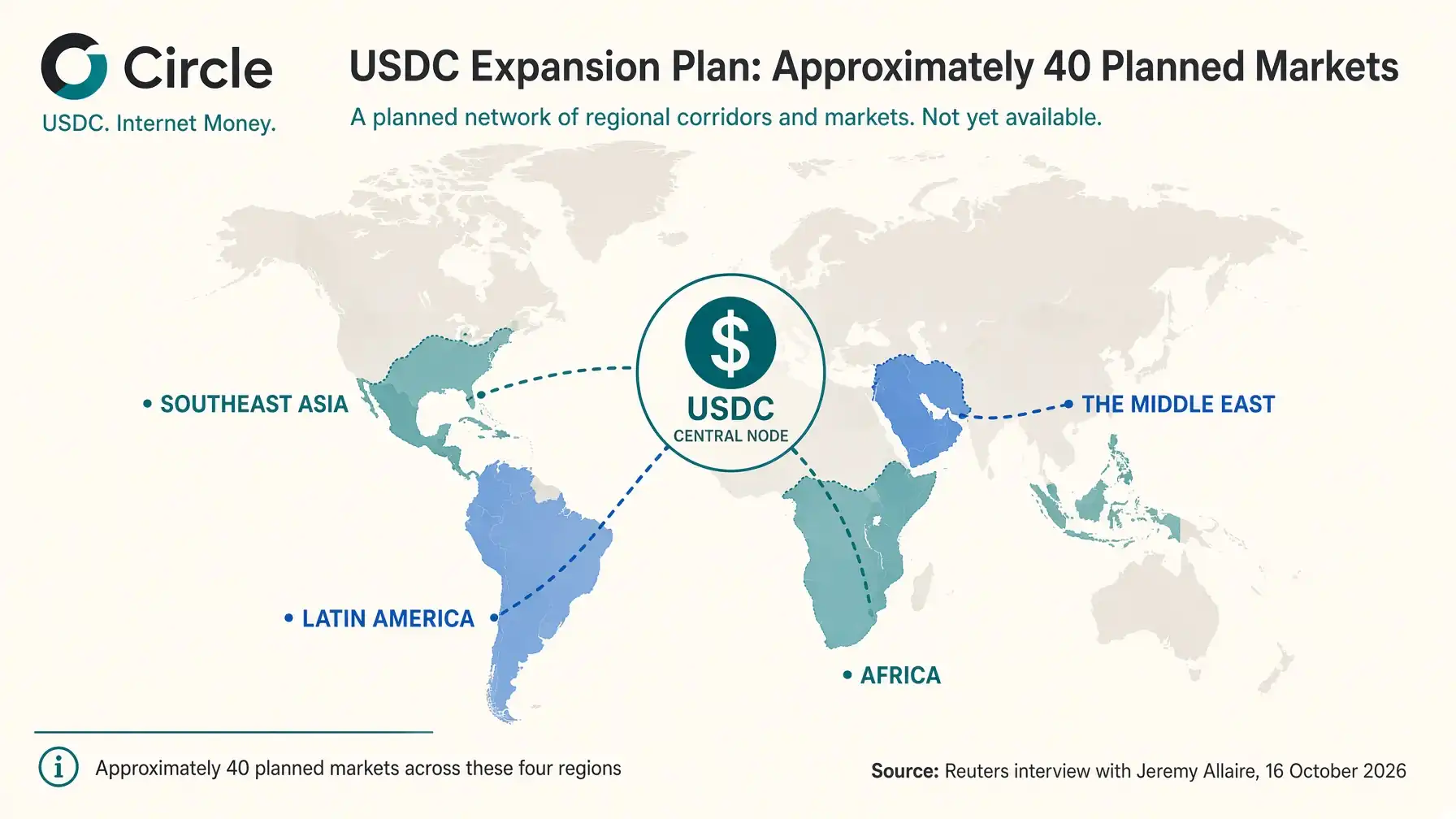
Circle CEO Jeremy Allaire has linked USDC's expansion to markets where businesses and consumers routinely move value across currencies, banks, and payment systems at high cost. A dollar-denominated stablecoin can reduce certain technical steps, but it doesn't eliminate local obligations: account access, domestic currency conversion, customer identification, and licensing all remain essential hurdles.
Circle's aim is to bring USDC closer to the points where money enters and exits the digital network. This is a different strategy from simply listing a token on an exchange. It requires a partner network capable of collecting funds, executing local payouts, and connecting businesses, fintechs, and banks.
The push follows Binance's $100 million investment in Circle, which SpazioCrypto covered on September 23. The October 16 announcement adds an operational dimension: an indicative count of roughly 40 markets across four regions where Circle intends to focus. That's the genuinely new element here.
Why Tazapay Is the Operational Piece
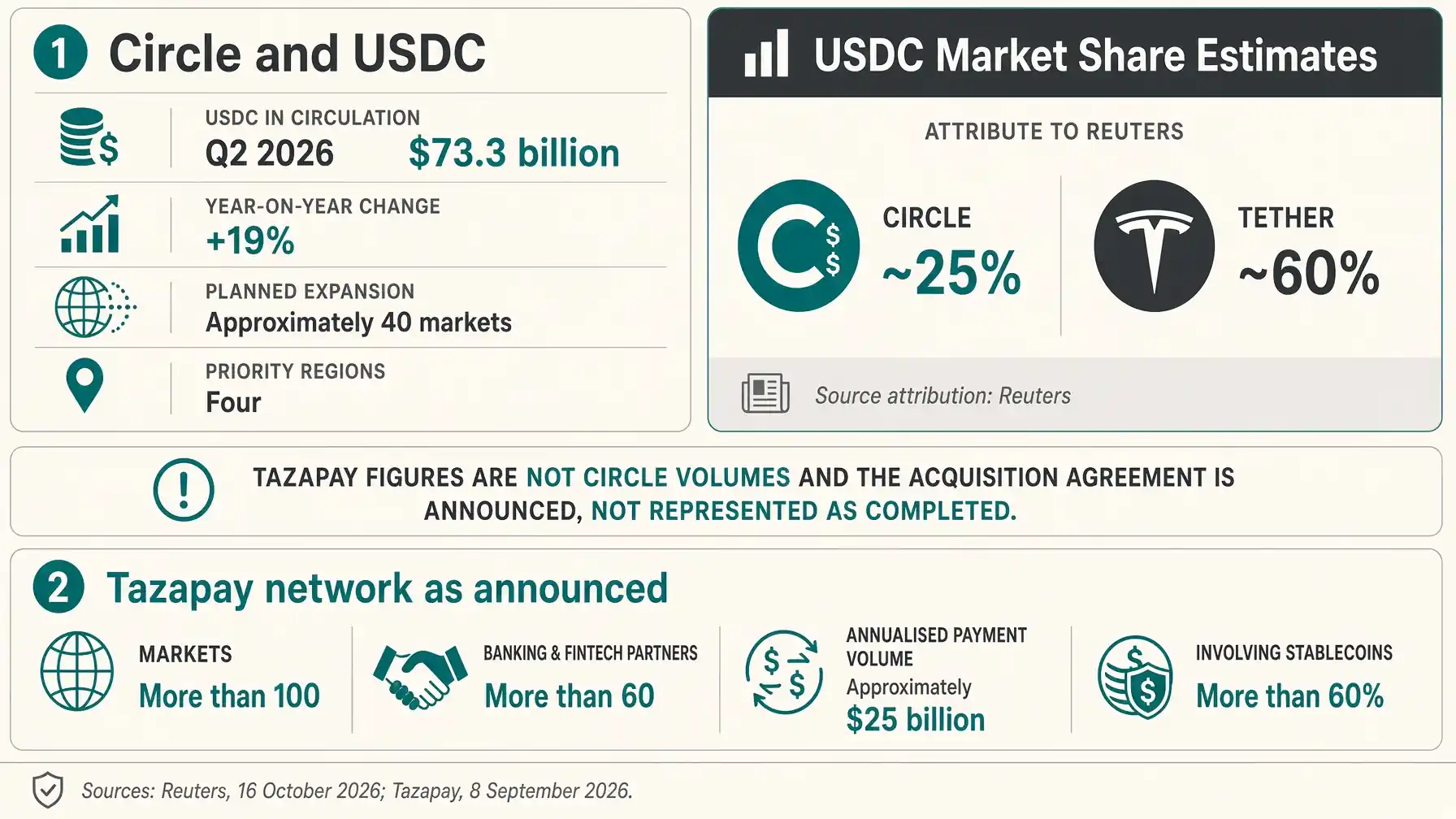
Tazapay announced on September 8 that it had signed an agreement to be acquired by Circle. According to the company, its network reaches more than 100 markets through over 60 banking and fintech partners, with an annualized volume of close to $25 billion, per Tazapay's own disclosures. More than 60% of that volume reportedly involves stablecoins.
Those figures describe Tazapay as it stands today, not the future perimeter of Circle's operations. They should not be added automatically to USDC figures or presented as revenues already transferred to the acquirer. The deal remains subject to regulatory approvals and closing conditions. Tazapay has also stated that existing contracts remain unchanged and that any new payment corridors will be communicated separately.

The strategic value is clear regardless. A local payment network reduces the work required to integrate banks, payment methods, and country-by-country payouts one jurisdiction at a time. For Circle, it means combining USDC issuance with a distribution layer closer to the businesses that pay suppliers, marketplace sellers, or cross-border workers.
USDC Numbers and the Tether Gap
According to Reuters, USDC had $73.3 billion in circulation in Q2 2026, up 19% year-over-year. The same source credits Circle with roughly one-quarter of the stablecoin market, compared with close to 60% for Tether. Those shares shift with methodology and date, so treat them as a journalistic snapshot rather than fixed benchmarks.
The record USDC volumes in Q1 2026 had already shown a divergence between rising usage and issuer profitability. More tokens in circulation can lift interest income on reserves, but commercial expansion, distribution incentives, and partner fees carry their own costs.
Tether holds a liquidity and name-recognition advantage in many of the markets Circle is targeting. Circle's response relies on a stronger regulatory profile, enterprise integrations, and new local payment corridors. The contest isn't about swapping one ticker for another on an exchange. It's about making USDC usable for everyday business payments in dozens of jurisdictions.
International Payments and AI Agents
Circle positions USDC as infrastructure for programmable transfers. In payments, the potential advantage is continuous availability and the ability to settle digital transactions without waiting for banking windows. The analysis of USDC as a competitor in international payments details this shift toward real-world use cases, beyond trading.
Allaire has also connected future growth to AI agents. Software capable of purchasing services, data, or compute capacity can generate large numbers of low-value transactions. Stablecoins are one of the candidate infrastructures for these micropayments, since they can be embedded in code and operate on always-on networks.
That same automation, though, widens the risk surface. A compromised agent can dispatch payments in seconds, multiply erroneous transactions, or bypass controls designed for a human user. Spending limits, granular permissions, verifiable identities, and the ability to freeze funds become product requirements, not optional extras.
What Is Still Missing Before Launch
The first obvious gap is a list of actual markets. The four target regions cover dozens of jurisdictions with very different rules on stablecoins, foreign exchange, and payments. Without named countries, it's impossible to assess the regulatory coverage or the commercial weight of each entry.
There's also no published timeline, no named local partners, no initial product lineup, and no availability criteria. “Entering” a market can mean opening a payout corridor, distributing USDC through a platform, integrating a corporate client, or obtaining a license. These are not equivalent steps.
Costs, volume targets, and break-even horizons haven't been disclosed either. Expansion can improve distribution, but it requires compliance infrastructure, local liquidity, and operational support. Translating this plan into a forecast for Circle's financial results would be premature.
Europe and the MiCA Filter
Europe offers Circle a very different framework from most emerging markets. MiCA governs the issuance and distribution of stablecoins and requires authorized providers to verify which tokens they can offer. The debate around stablecoins, bank deposits, and competition policy under MiCA shows how reserve requirements have become a live financial policy question across the EU.
In the United States, the GENIUS Act and the ruleset assigned to the OCC, FDIC, and FinCEN draw a parallel perimeter. Circle can draw on its experience navigating both frameworks, but that expertise doesn't transfer automatically to Africa, Latin America, the Middle East, or Asia.
For European businesses, Circle's plan has no direct product launch attached to it. The more concrete effect is indirect: additional local corridors could make USDC more useful for European companies paying or collecting in those target markets. Any service offered inside the EU remains subject to MiCA and the oversight of licensed crypto-asset service providers (CASPs).
The Bigger Picture
Here is an editorial read: the next phase of stablecoin competition will be decided less by issuance volume and more by distribution depth. A token has to reach bank accounts, corporate wallets, and payout systems, then return to local currency at predictable costs and timelines. That's a logistics and compliance problem as much as a technology one.
Circle is building that network through Tazapay, Binance, and enterprise integrations. Tether starts from a broader base and an entrenched presence across many of the same markets. The roughly 40-market plan signals that competition is shifting toward local infrastructure, regulatory reliability, and operational depth. Until Circle publishes a country list and a timeline, this remains a declared strategy rather than an established presence.