


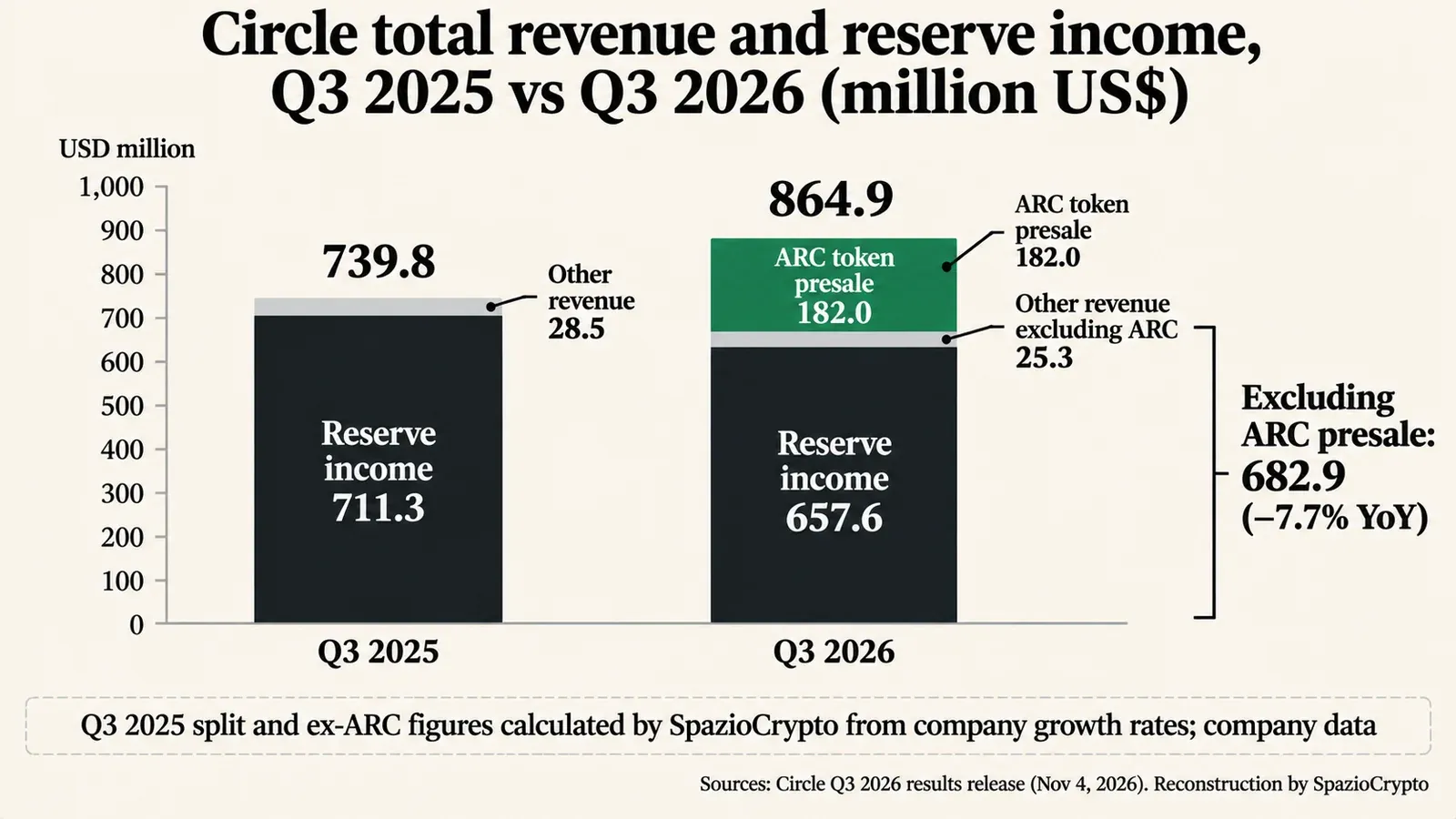
Circle's Q3 2026 results, published on November 4, showed revenue up 17%, net income up 5%, and adjusted EBITDA nearly doubling. Those are the headline numbers. But strip out the $182 million from the ARC token presale, and revenue would have fallen roughly 7.7% year-over-year. That's our calculation, based on figures in the company's press release, and it changes how the quarter reads.
We read Circle's full press release and cross-referenced it with the reconstruction by Bitcoin.com News. The Wall Street Journal's coverage was not accessible to our tools and the earnings webcast was not reviewed, so we have not included analyst estimates. All figures below are company-disclosed.


The 17% That Came From a Token
According to Circle's press release, total revenue and reserve income reached $864.9 million in Q3 2026, up from $739.8 million a year earlier. The core line, interest income on USDC reserves, fell 8% to $657.6 million. The growth came entirely from “other revenue,” which surged 627% to $207.3 million. Within that figure, $182 million came from the ARC token presale. Subscriptions and services revenue declined.
Excluding the presale, our indicative calculation puts Q3 revenue at $682.9 million, down 7.7% year-over-year, with other revenue at roughly $25 million, down about 11%. Circle's adjusted EBITDA of $316.7 million, up 85% and a non-GAAP metric constructed by the company, also incorporates that presale. Net income from continuing operations rose 5% to $226 million, though the net margin slipped from roughly 29% to 26%.
The Core Engine Slows With Rates
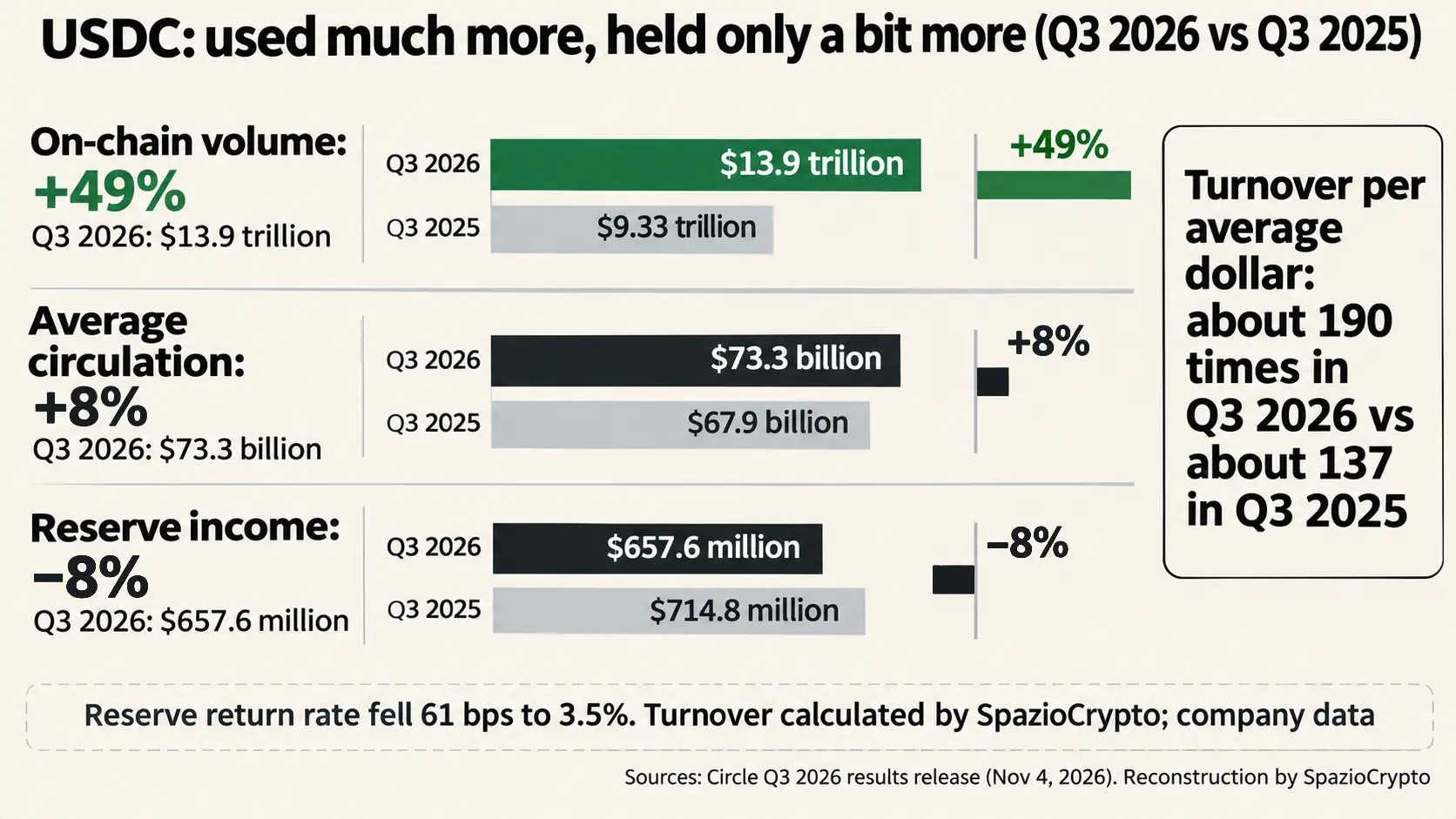
Circle's business model is straightforward: USDC holders receive no yield. Circle earns interest on the reserves backing those tokens. We've explained the mechanics previously in how Tether and Circle earn billions. In Q3, the average reserve yield fell to 3.5%, a drop of 61 basis points year-over-year, according to Circle's press release. Average USDC in circulation grew 8% to $73.3 billion, but that wasn't enough to offset the lower rate environment.
End-of-September USDC circulation stood at $73.9 billion, essentially flat year-over-year. Circle's share of the stablecoin market fell to 27%, down 183 basis points, per company disclosure. The gap with Tether is stark: in the same quarter, Tether reported $1.5 billion in profit with roughly $184 billion of tokens outstanding, as we detailed in our piece on Tether's September 30 reserves.
 Investing News Network

The Paradox of $13.9 Trillion
The most striking figure in Circle's press release is on-chain volume: $13.9 trillion of USDC transferred in three months, up 49%. Divided by average circulation, our indicative calculation suggests each dollar of USDC changed hands roughly 190 times in the quarter, compared to around 137 times a year earlier. USDC is being used far more intensively. It's just not being held much longer.
That's a genuine tension for Circle. Its revenue model rewards USDC sitting in reserves, not USDC moving through the network. A dollar that turns over 190 times earns Circle the same as one that never moves. We flagged the same dynamic in Q1 2026, when record volumes coexisted with declining earnings.
Who Takes the Biggest Slice
Distribution and transaction costs, primarily payments to the partners who bring USDC to end users, totaled $409.2 million in Q3, down 8% year-over-year per Circle's press release. By our calculation, that figure represents roughly 62% of reserve income. It's the structural cost of distribution: Circle shares its interest earnings with exchanges and platforms to put USDC into circulation. In September, Binance invested $100 million in Circle, a deal we covered in our piece on the Binance-Circle partnership.
The distribution-adjusted margin rose to 52%, up nearly 13 percentage points, with net distribution revenue reaching $453 million, up 55%. The ARC presale lifts that figure too, since presale revenue carries no distribution costs. Operating expenses grew 16%, and Circle reduced headcount by roughly 5%, booking $9.1 million in restructuring charges.
The Bet Beyond Interest Income
Circle is trying to build revenue that doesn't depend on U.S. interest rates. The Arc blockchain launched on mainnet on September 16, with 10 billion ARC tokens at genesis and a planned transition to proof-of-stake in 2027. Circle's payment network, introduced in April as a tool to let banks use stablecoins without handling crypto directly (we covered it in our piece on Circle's managed payment network), now carries an annualized volume of $41.3 billion. Circle also signed the acquisition of Tazapay, a Singapore-based B2B payments company, with closing expected in 2027.
Founder and CEO Jeremy Allaire wrote that Q3 showed proof that institutions are building on USDC. For full-year 2026, Circle confirmed its guidance: other revenue between $310 million and $330 million, including the ARC presale, and a distribution-adjusted margin between 41.7% and 43.7%. The stock closed November 4 up 4.36% at $75.22, according to Blockonomi.
What This Means for European and UK Investors
USDC is MiCA-compliant and available to European users, unlike USDT. The European Central Bank and several national central banks have been evaluating compliant stablecoins for payments infrastructure, while the Bank of Italy has used USDC in a pilot examining remittance costs, as we reported in our piece on the Bank of Italy's USDC test. But this quarter is a reminder that Circle's economics are set in Washington, not Brussels: when the Federal Reserve cuts rates, the issuer's income falls regardless of how much USDC European users hold or transact.
Circle Q3 in Brief
What is confirmed, what is not
- Confirmed: per Circle's press release, total revenue and reserve income of $864.9 million (+17%), including $182 million from the ARC presale; reserve income of $657.6 million (-8%); net income from continuing operations of $226 million (+5%); USDC on-chain transaction volume of $13.9 trillion (+49%).
- Not disclosed: the breakdown of other revenue beyond ARC, the precise effect of the presale on adjusted EBITDA, and the direct costs associated with the presale.
- To watch: U.S. interest rates, end-of-year USDC circulation, Arc network growth after launch, and the closing of the Tazapay acquisition.
The Bigger Picture
Our read, stated as such: Circle has a structural problem that volume growth alone won't fix. USDC is being used more than ever. Circle earns on how much USDC is held, then splits those earnings with distributors. With rates falling, Circle needs meaningfully more circulation each quarter just to keep revenue flat. The ARC presale filled the gap this time. A presale doesn't repeat every three months.
The concrete signals to track are four. Reserve income in Q4, stripped of one-off items. Market share, now at 27%. The ratio of distribution costs to reserve income, running at roughly 62% in Q3. And the first quarter in which Arc or the payment network appears in a press release with its own recurring revenue line, not just volume figures.