


India has quietly pulled off what many Western financial institutions are still treating as a theoretical goal: corporate bonds issued as native digital tokens and settled instantly using central bank digital currency. The Securities and Exchange Board of India (SEBI) launched Demat 2.0, a live pilot that has already seen three companies raise a combined total exceeding $107 million, according to SEBI and the Reserve Bank of India (RBI). SEBI has described India as the first country in the world to combine these elements inside a fully regulated market infrastructure.
This isn't a whitepaper or a proof-of-concept. The transactions are done. Real money changed hands.
Three Live Deals Already Closed
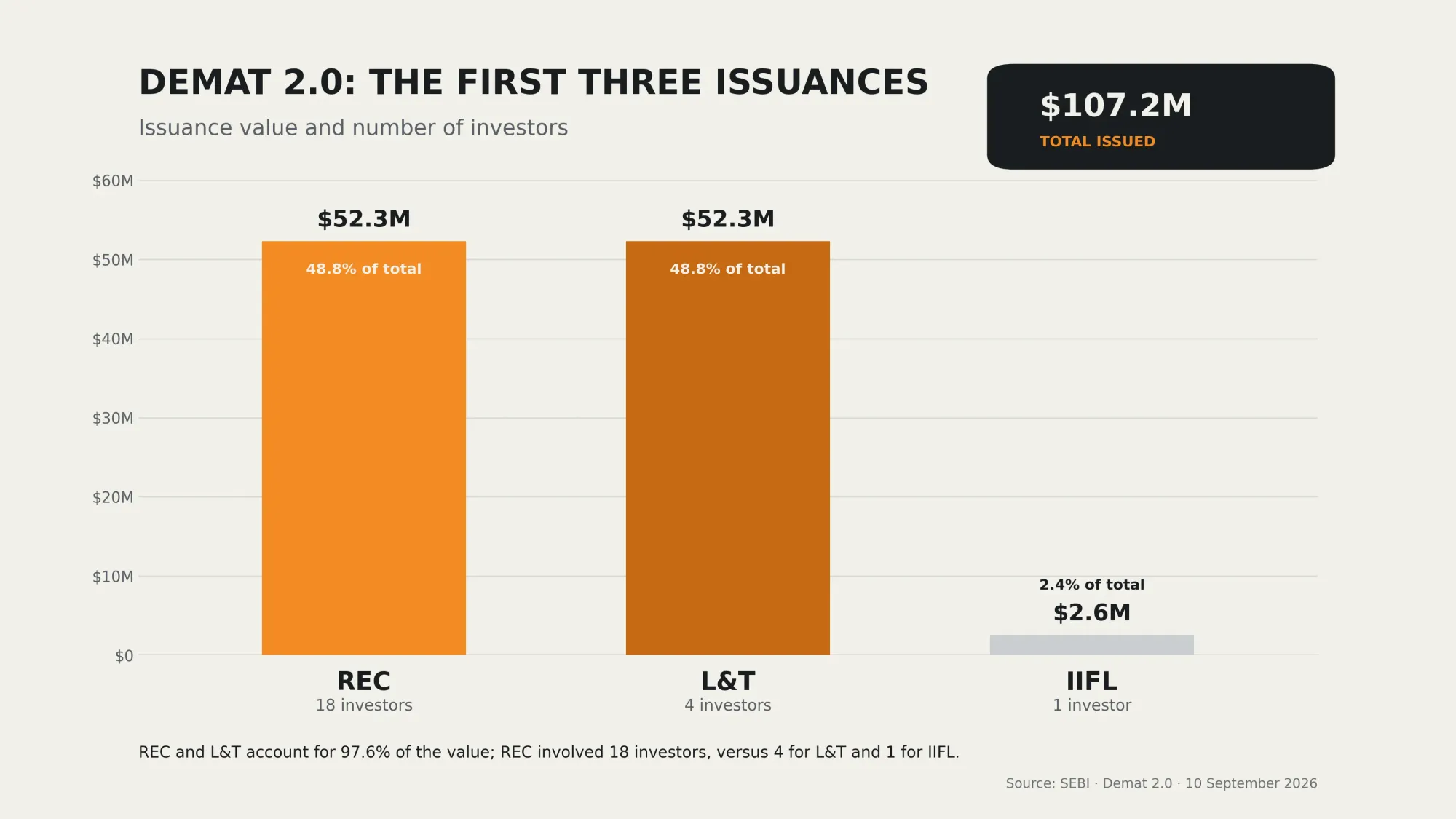
SEBI and the RBI announced Demat 2.0 jointly at an event held in Mumbai, with senior officials from both institutions present. Concrete transactions followed almost immediately. On September 7, a state-owned energy credit company raised the equivalent of roughly $52 million from 18 institutional investors. Two days later, a large industrial engineering conglomerate raised a comparable sum from four investors. A non-banking financial company then completed a third, smaller issuance. The combined total of all three exceeded $107 million, more than double what had originally been projected for the first issuance alone, per SEBI figures.
One point SEBI clarified explicitly: these are not a new legal category of debt instrument. The ISIN code, coupon rate, maturity date, protective covenants, and investor rights remain identical to those of conventional corporate bonds. What changes, substantially, is how those securities are represented on a ledger and how settlement works.
Atomic Settlement: The Technical Core
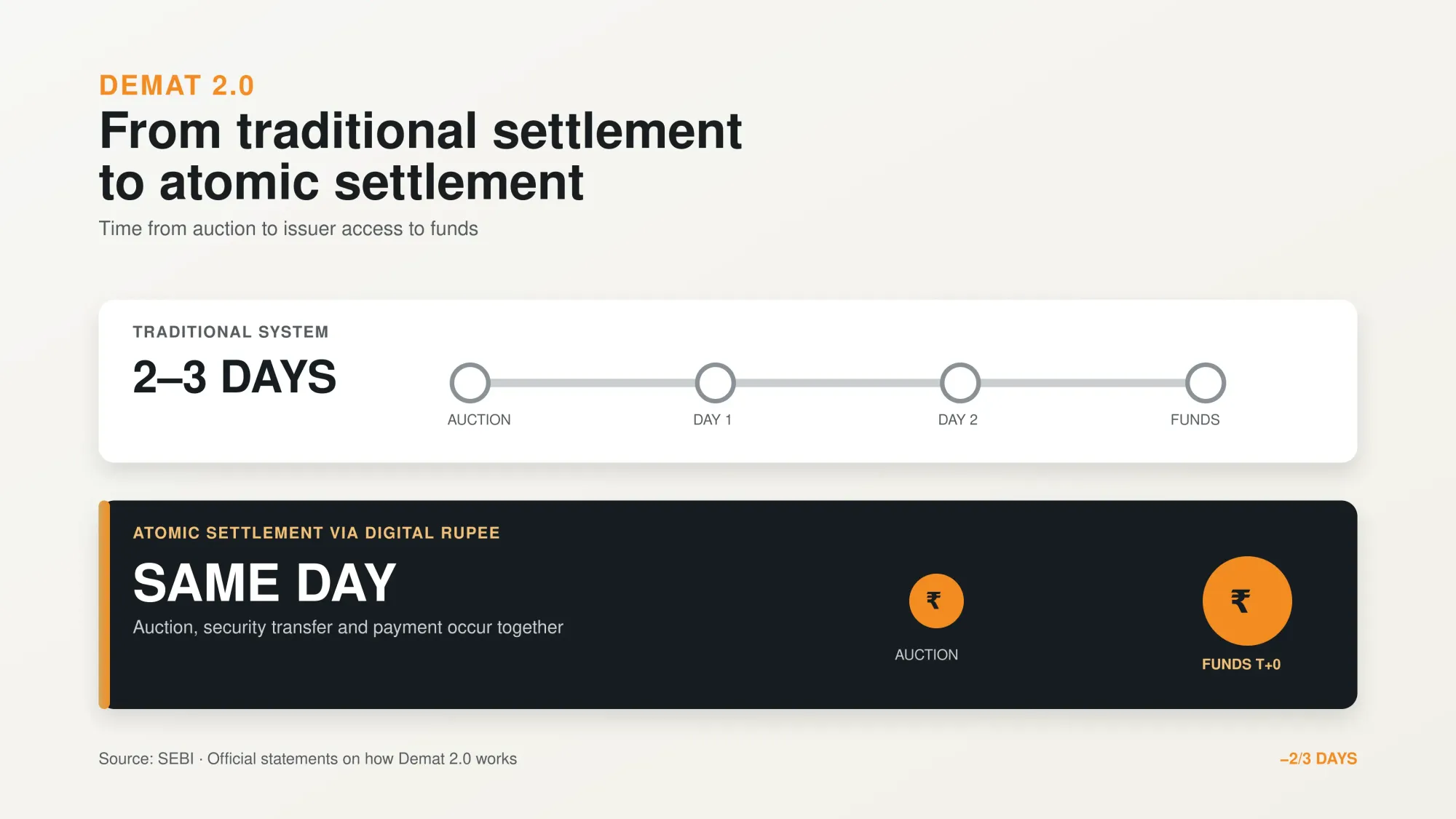
The feature that distinguishes Demat 2.0 from most other tokenization experiments globally is what specialists call “atomic settlement.” Securities are registered as native tokens on a distributed ledger managed by India's official central depositories. That ledger is connected directly to the RBI's wholesale CBDC, the digital rupee in its interbank variant, via a dedicated infrastructure layer.
The connection means the bond token transfer and the digital rupee payment occur at exactly the same moment, as a single indivisible operation. There is no window, not even a few hours, during which one side of the trade has moved and the other hasn't. That window is exactly where settlement risk lives in traditional finance. Issuers now also receive proceeds on auction day itself, rather than waiting the conventional two to three business days. Smart contracts handle coupon payments and principal repayment automatically at maturity.
Demat 2.0 by the Numbers
First three issuances. Source: SEBI, RBI, 2026
- Total raised: over $107 million from three issuers in three days.
- The mechanism: bond token and digital rupee payment settle simultaneously in one indivisible step.
- The claim: per SEBI, the first country to combine all three elements inside a live, fully regulated market infrastructure.
Eleven Days Ahead of Europe
SEBI stated explicitly that India is the first country in the world to bring together, inside a fully regulated market infrastructure, three distinct elements: bonds issued natively on a distributed digital ledger, ownership records maintained by legally recognized official depositories, and settlement in central bank digital money. That claim deserves to be taken seriously.
The timing carries a certain irony. Just days before the Demat 2.0 issuances closed, SpazioCrypto reported on how the European Central Bank was preparing to launch Pontes, its infrastructure for connecting private blockchain platforms to central bank money settlement, with a debut set for late September. India got there eleven days first, with real money already exchanged. A related principle, built on a different architecture using a public blockchain rather than a permissioned ledger, is also visible in the European project by a consortium of banks developing a euro stablecoin on Ethereum.


What This Means for Western Markets
For US and UK investors watching institutional tokenization, the India story has a pointed relevance. The UK's Digital Securities Sandbox, the SEC's ongoing engagement with tokenized Treasury experiments, and the EU's DLT Pilot Regime are all moving in the same direction. None has yet produced a combined bond-plus-CBDC settlement system at market scale with multiple issuers. India just did.
The scale gap and the degree of institutional coordination are worth noting. In Western markets, tokenization has largely advanced through isolated pilot transactions run by private operators. India's approach was different: SEBI and the RBI jointly led the entire process from the outset, coordinating both the security side and the payment side simultaneously. The result is an infrastructure that works at market scale, not just in the lab.
 European Central Bank
The Bigger Picture
This episode moves the tokenization conversation from theoretical to measurable. For years, the combination of digital securities and central bank money has been discussed as the ideal architecture for safe, efficient tokenized finance. Now there's a live case, with money actually exchanged, showing that the model works in practice on a non-trivial market, India's corporate bond segment.
The lesson is twofold. Asian markets are demonstrating an ability to execute quickly and in a coordinated fashion that often outpaces Western incumbents. And the success of this first step, still limited to the institutional issuance phase, opens the door to potentially significant next stages: secondary trading of these tokenized instruments and, further out, broader retail investor access. If the model proves robust and scales, it may represent one of the most consequential structural shifts in how traditional finance handles corporate debt issuance and exchange. For a foundational understanding of the technologies driving all of this, SpazioCrypto's guide to cryptocurrencies and blockchain is a useful starting point.