


Starting June 2027, a bank borrowing liquidity from the Eurosystem will be able to pledge a bond issued on an authorised distributed-ledger platform as collateral. The ECB’s Governing Council decided on November 23 to extend eligible Eurosystem collateral to securities issued on EU DLT pilot-regime platforms, provided they connect to a recognised central securities depository and settle through TARGET2-Securities. It is the step that brings tokenised bonds inside the machinery of monetary policy.
In brief
- On November 23, the ECB decided to accept as collateral marketable securities issued on platforms authorised under the EU DLT pilot regime.
- Securities must meet all standard eligibility criteria, pass through an eligible central securities depository, and be settleable on TARGET2-Securities.
- Detailed platform requirements will be published in spring 2027; full implementation is set for June 2027.
- Securities issued and settled entirely on DLT networks, without passing through a CSD or TARGET2-Securities, remain excluded for now.
What did the ECB actually decide?
The ECB press release of November 23 covers marketable instruments, primarily bonds, issued on DLT platforms authorised under the EU DLT Pilot Regime regulation. Those instruments will be eligible as collateral in Eurosystem credit operations, subject to strict conditions. The ECB frames the move as a further step toward a collateral framework suited to a tokenised European capital market.
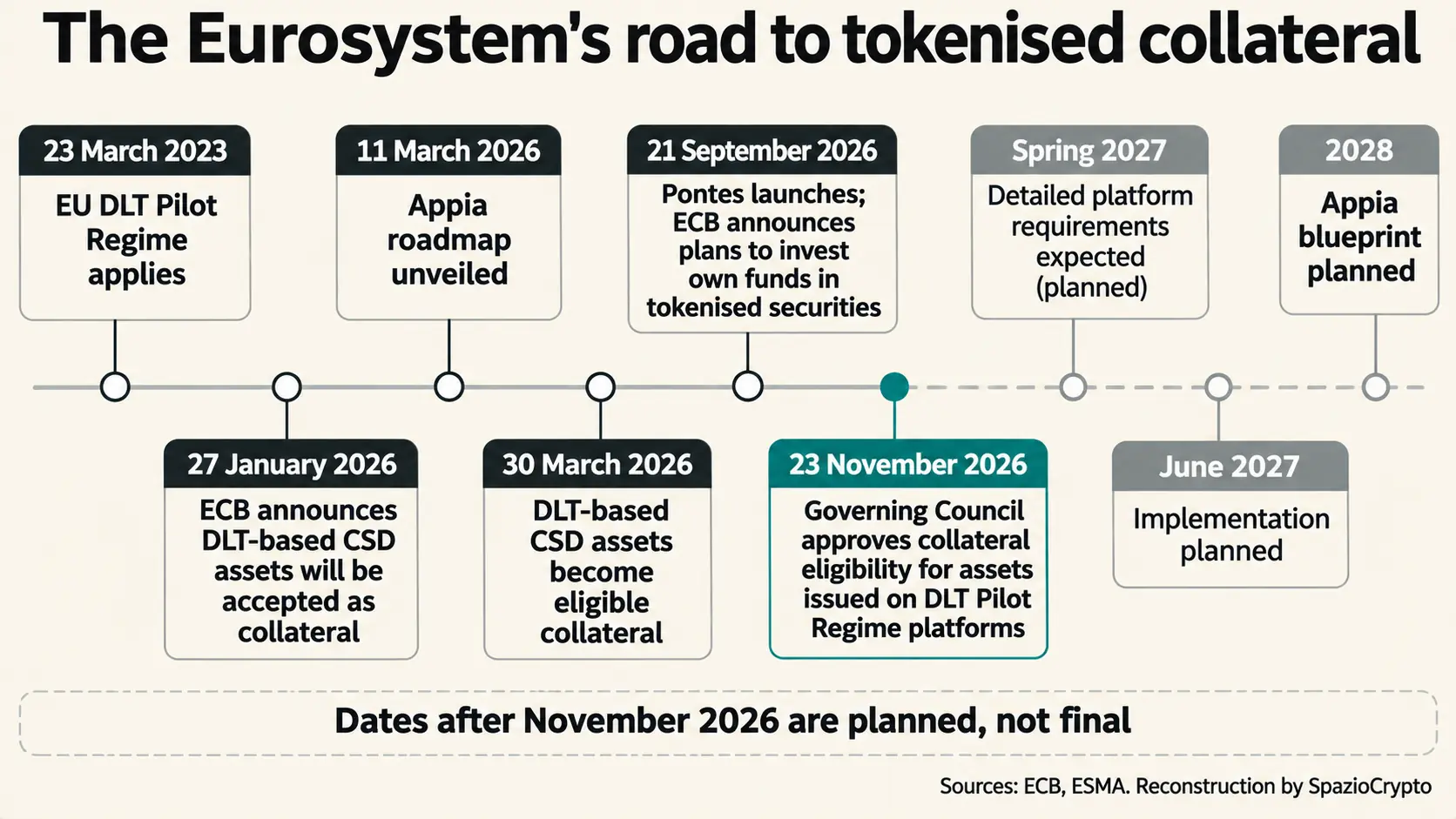
The decision builds on a previous step announced on January 27 and in force from March 30, which admitted securities issued by central securities depositories using DLT-based services. “We support innovation without lowering our standards,” ECB Executive Board member Isabel Schnabel said. Fellow Board member Piero Cipollone has described the Pontes and Appia initiatives as turning the European vision of tokenised finance into reality.
What is collateral and why does it matter?
Collateral works like a pledge. When a bank requests liquidity from the Eurosystem, it hands over securities as security: if the loan is not repaid, the central bank can seize those assets. The rules are strict by design. An ECB document gives the example of a government or corporate bond rated at least BBB-, meeting all other eligibility criteria.
Being added to the eligible collateral list changes the practical value of a security considerably. A bank that buys a tokenised bond will be able to use it to fund itself at the central bank, exactly as it does today with a German Bund or a French OAT. The ECB document states this plainly: making DLT securities usable as collateral will support the growth and integration of the DLT-based ecosystem across Europe.
What conditions must the securities meet?
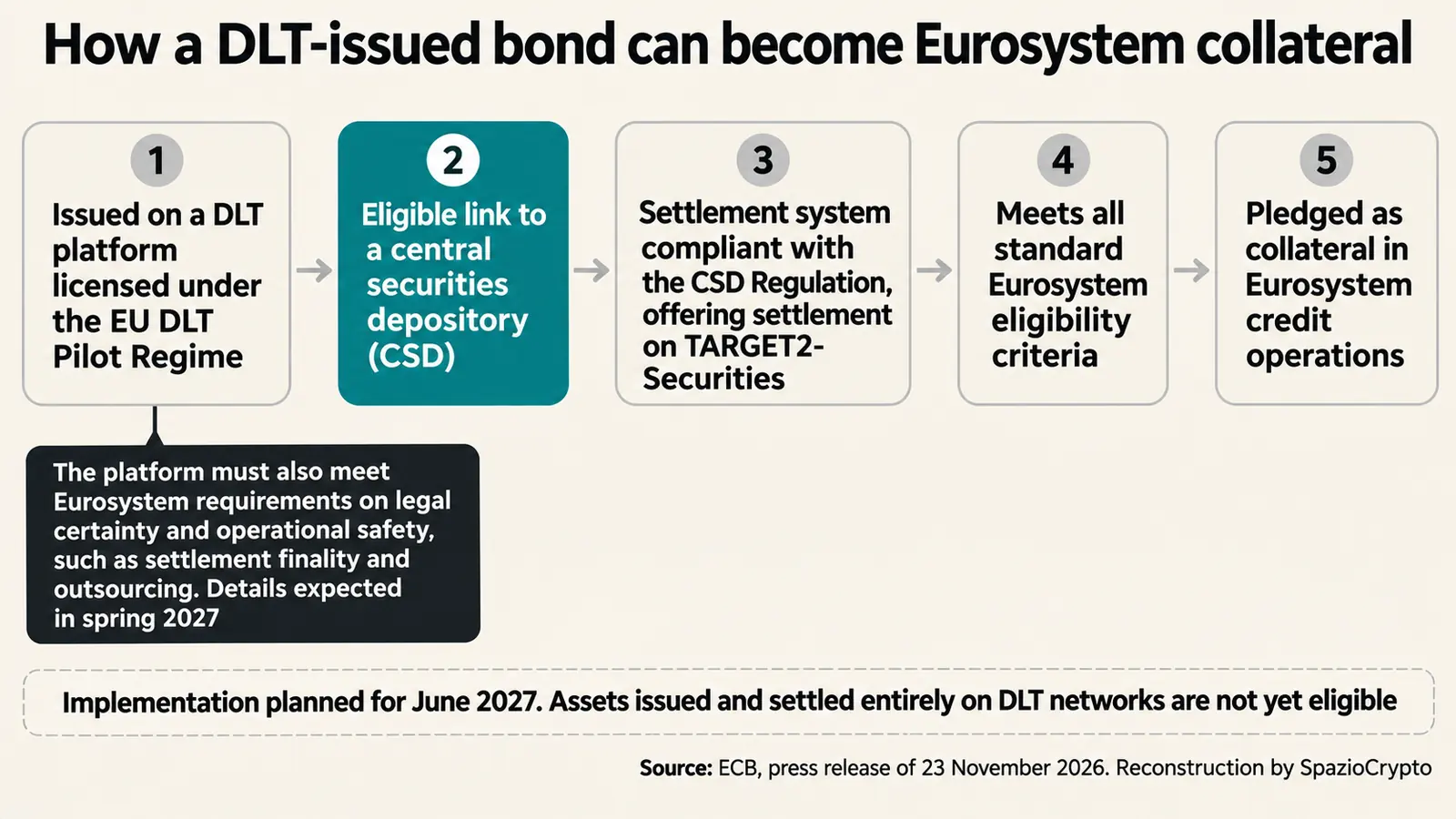
The ECB is not creating a fast lane. According to the November 23 press release, securities issued on DLT pilot-regime platforms must satisfy four conditions:
- Meet all standard Eurosystem collateral eligibility criteria.
- Be available through an eligible link with a central securities depository operating an accepted settlement system.
- Pass through settlement systems compliant with the EU Central Securities Depositories Regulation and connected to TARGET2-Securities.
- Use platforms that, beyond their DLT pilot-regime licence, satisfy Eurosystem requirements on legal certainty and operational security.
Among those requirements, the ECB specifically mentions designation for settlement finality (the guarantee that a completed transfer cannot be reversed) and rules on outsourcing of critical functions. Full details will be published in spring 2027, with implementation in June 2027.
What is still excluded, for now?
The decision does not open the door to everything tokenised. Securities issued and settled entirely on DLT networks, bypassing a central securities depository and TARGET2-Securities, remain ineligible. The Eurosystem’s roadmap envisages studying their inclusion through a gradual approach tied to market evolution and the development of the European regulatory framework.
| Security type | Collateral status |
|---|---|
| Issued by a CSD using DLT-based services | Eligible from March 30, 2026 |
| Issued on a DLT pilot-regime platform, linked to an eligible CSD and settleable on TARGET2-Securities | Decided November 23, 2026; implementation June 2027 |
| Issued and settled entirely on DLT networks | Not eligible; under study in the Eurosystem roadmap |
The DLT pilot regime itself has tight boundaries. It has applied since March 23, 2023, with a cap of 1 billion euros per individual bond issuance and 6 billion euros on the total value of instruments. According to the ESMA report of June 2025, three infrastructures were authorised as of end-May: CSD Prague, 21X, and 360X. ESMA has repeatedly flagged the risks of tokenisation in its public assessments.
What are Pontes and Appia?
Collateral eligibility is one piece of a larger design. Pontes, launched on September 21, connects DLT platforms to TARGET services and enables tokenised transactions to settle in central bank money. According to The Paypers, the 2024 trials involved 64 operators running more than fifty experiments, with transactions exceeding 1.5 billion euros in value. Outside the eurozone, momentum is coming from the private sector, as seen with the tokenised deposit projects of major UK banks including Lloyds, Barclays, NatWest, and HSBC.
Appia looks further ahead. The Eurosystem aims to publish a blueprint in 2028 for a tokenised financial ecosystem in which central bank money remains the anchor. On the same September 21 date, the ECB announced it would invest a small portion of its own funds in tokenised securities settled via Pontes. Pontes is not the digital euro for retail citizens: it is a wholesale infrastructure for banks and market operators.
The broader market context
For US and UK investors watching from outside the eurozone, the ECB’s move matters as a regulatory benchmark. MiCA and the DLT Pilot Regime together form a framework that no other major jurisdiction has yet matched in legislative completeness. The Bank of England’s Digital Securities Sandbox and the SEC’s ongoing review of tokenised securities both run on slower timetables. What the Eurosystem decides about eligible collateral shapes global expectations for how tokenised bonds will eventually be treated in repo and secured lending markets worldwide.
The EU DLT Pilot Regime currently covers only three authorised infrastructures, according to the ESMA June 2025 report: CSD Prague, 21X, and 360X. None of them is based in the United States or United Kingdom. That may change as the regime evolves, and as the June 2027 implementation date approaches, more platforms will face the question of whether to seek DLT pilot authorisation specifically to gain Eurosystem collateral eligibility.
ECB DLT collateral: confirmed, unconfirmed, to watch
What is confirmed, what is not
- Confirmed: Governing Council decision of November 23; eligibility for securities issued on DLT pilot-regime platforms linked to an eligible CSD with TARGET2-Securities settlement; platform requirements expected spring 2027; implementation June 2027.
- Not yet specified: the detailed content of platform requirements; how many already-issued securities would qualify; the timeline for natively DLT-settled instruments.
- To watch: publication of requirements in spring 2027; Pontes expansion; review of the DLT pilot regime and its caps; the Appia blueprint expected in 2028.
The bigger picture
Our reading, stated as such: the ECB is building a bridge, not a shortcut. A tokenised security enters the collateral framework only by passing through the existing infrastructure of central securities depositories and TARGET2-Securities. It is a deliberately cautious choice, one that makes tokenisation useful to bank balance sheets without touching risk criteria.
The real contest is over the money used to settle those securities. Through Pontes, the new collateral rules, and direct investment in tokenised bonds, the Eurosystem is anchoring European tokenised finance to central bank money. The institution does not want to cede that ground to private alternatives like euro-denominated bank stablecoins. That is the same line behind the ECB’s push to revise MiCA on stablecoins.
Investors and issuers in the US, UK, and beyond now have a concrete date to plan around. June 2027 is when a tokenised bond issued under the EU DLT Pilot Regime can, for the first time, serve as collateral at the European Central Bank, with the same practical utility as a German Bund or a French OAT. Whether enough eligible securities will exist by that date depends on how quickly the market adapts and whether ESMA’s forthcoming pilot-regime review raises or lowers the current issuance caps.
Sources
- Decision: ECB, ECB expands acceptance of DLT-based assets as eligible Eurosystem collateral (November 23, 2026) and ECB paves way for acceptance of DLT-based assets as eligible Eurosystem collateral (January 27, 2026).
- Collateral framework: ECB, DLT-related initiatives in the Eurosystem collateral framework (March 2026).
- Pontes and Appia: ECB, Appia roadmap (March 11, 2026) and investment in tokenised securities settled via Pontes (September 21, 2026); The Paypers (September 21, 2026).
- DLT Pilot Regime: ESMA, Report on the functioning and review of the DLT Pilot Regime (June 25, 2025).