Qivalis received authorization from De Nederlandsche Bank on October 14, 2026 to operate as an electronic money institution, marking a regulatory milestone for the 37-bank European consortium. UniCredit, Intesa Sanpaolo, BPER, and Banca Sella are among the consortium members, but the euro-pegged token has not been issued yet. The gap between licensing the issuer and launching the product is the central fact readers need to understand.
This reconstruction draws on Qivalis's own press materials, institutional web pages, and specialist reporting. The license is declared by Qivalis; the named entry in the DNB register has not been independently verified, and no unpublished regulatory statements are attributed to the Dutch central bank.


The License Changes the Project's Status, Not Its Public Offering
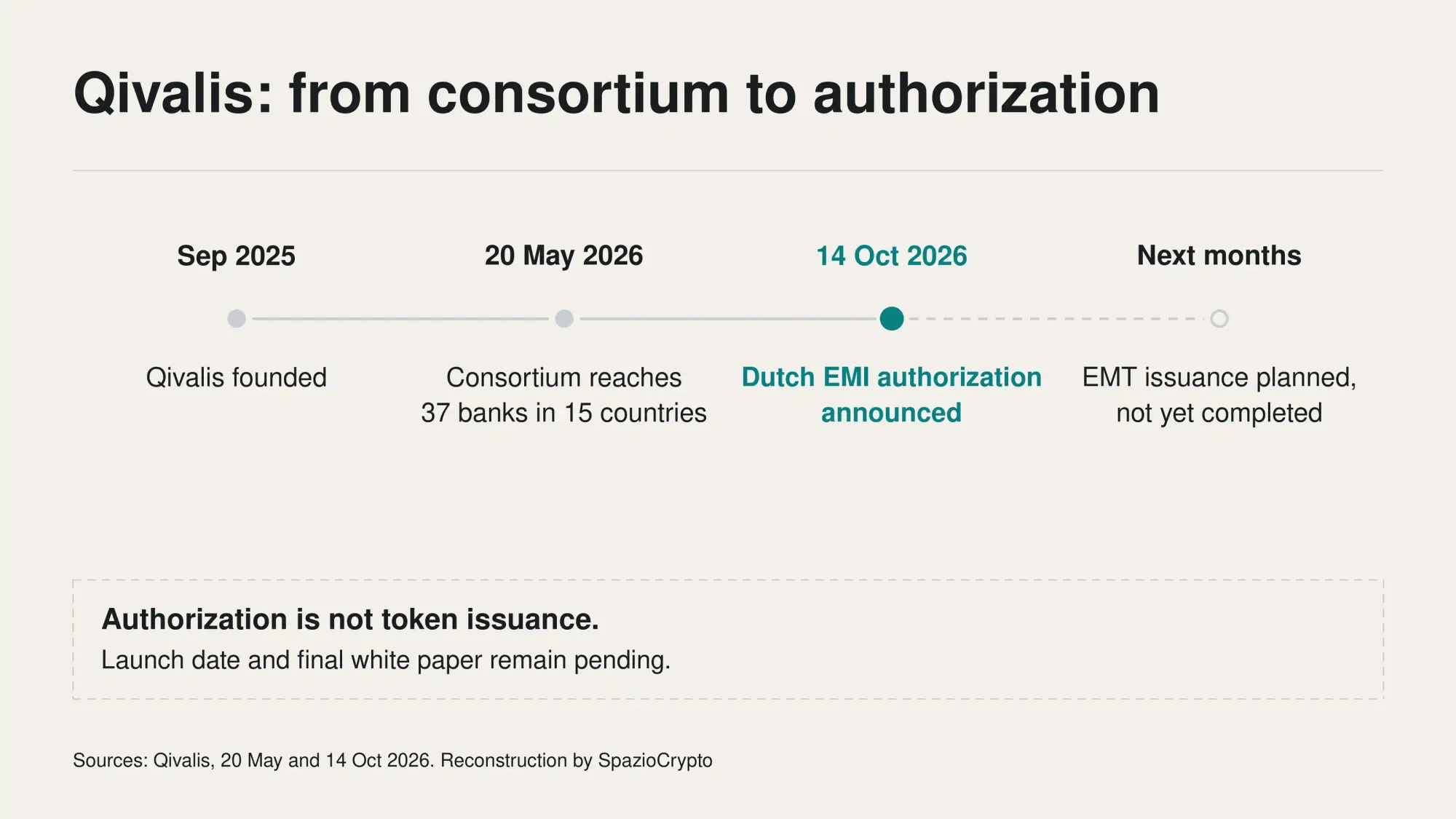
On October 14, 2026, Qivalis B.V., an Amsterdam-based company, announced it had received authorization from De Nederlandsche Bank to operate as an electronic money institution. The consortium groups 37 banks from 15 European countries and aims to issue an electronic money token pegged to the euro. This is a verifiable regulatory step: the press release specifies that the license satisfies an essential condition for issuance. Places the token's debut in the months ahead. It does not describe a stablecoin already available for purchase, an open retail service, or a payment system already in production.
The official Qivalis website includes an even sharper clarification: as of October 14, Qivalis is authorized as an electronic money institution but does not yet issue electronic money or offer payment services to the public. For anyone following Qivalis's development, that distinction is the day's central fact. Authorization of the institution does not equal completion of all steps required to distribute the EMT. The MiCA-required white paper has not yet been published, and the press release does not specify an exact issuance date.
What the Dutch Central Bank Actually Authorized
The IMEL license concerns the company's legal capacity to operate as an electronic money issuer under Dutch supervision. Qivalis intends to use this foundation for an electronic money token (EMT): a stablecoin whose reference value is a single official currency. The press release refers to full reserve backing and distribution through qualified intermediaries. It does not, however, publish a definitive offering document, a fee schedule, a list of supported wallets, or the contractual terms applicable to end users.


The step fits within the MiCA framework, which governs issuance, redemption, and disclosure requirements for EMTs across the European Union. Reserve management choices are particularly sensitive: in September, the European System of Central Banks proposed revisiting certain constraints on bank deposits held as EMT reserves. SpazioCrypto has already covered the central banks' proposal on MiCA reserve rules. That remains an open debate, not a regulatory change already in force.
Four Italian Banks Are In, But They Won't Issue the Token
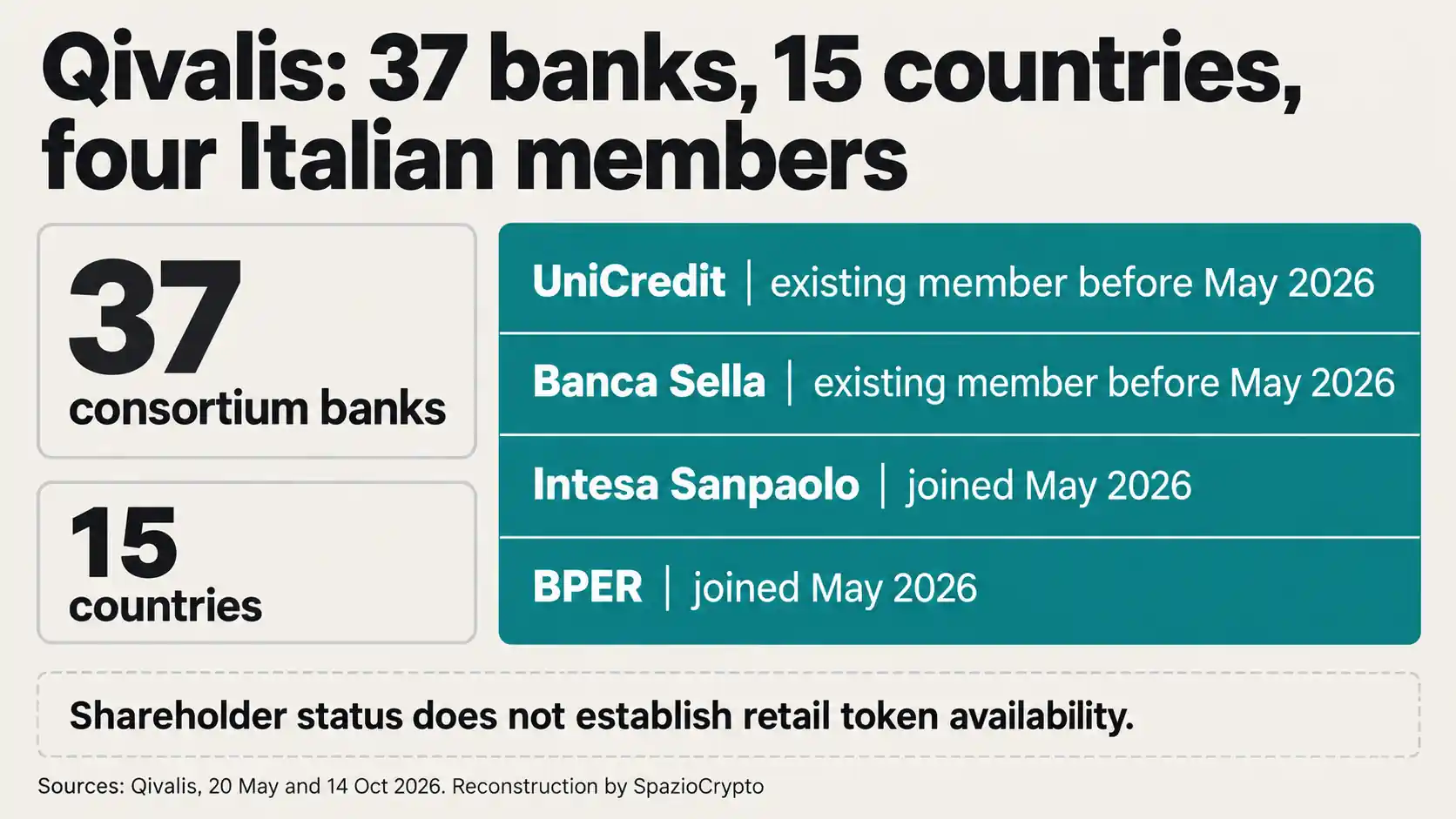
Italy's involvement in the consortium is far from marginal. The official list published by Qivalis on May 20 identifies UniCredit and Banca Sella as founding members, while Intesa Sanpaolo and BPER joined through the consortium's expansion. Four of Italy's most prominent lenders are therefore stakeholders in a European infrastructure project. That does not mean each bank has obtained an independent license to issue the token, nor that Italian retail customers will find it in their banking apps anytime soon.
This announcement adds a concrete step to the earlier report on Qivalis's choice of Ethereum, published by SpazioCrypto in September. At that point, the authorization was still pending; now the company declares it has been obtained. The connection between the two stories is a substantive update, not a repetition. The October 14 communication does not, however, confirm a network activation date, a token contract, or distribution through the four Italian banks.
The B2B2X Model Shifts Distribution to Intermediaries
Qivalis describes its commercial model as B2B2X: the issuer works with qualified counterparties who can distribute the token and build services for other businesses or end users. Those counterparties include banks, exchanges, payment service providers, and financial infrastructure operators. The proposed advantage is separating the issuer's role from the entities that manage direct customer relationships. What remains unknown are the actual access conditions, the markets served first, and the compliance checks required of intermediaries.
A euro-denominated stablecoin could be used to settle business-to-business payments or transactions in tokenized financial instruments without routing through a dollar-denominated digital currency each time. These are uses envisioned by the consortium, not volumes already observed. To understand why this question cannot be resolved within a single jurisdiction, the FSB's analysis of cross-border risks is instructive: issuance, reserves, transfers, and redemptions can involve multiple jurisdictions, with real consequences for regulatory oversight.
Competition Goes Beyond Dollar Stablecoins
The project positions itself as European infrastructure for bringing the euro on-chain. The political dimension is explicit in remarks by CEO Jan-Oliver Sell, who links European rules to payment sovereignty. The competition, though, extends well beyond dollar-denominated tokens like USDC and USDT. Banks and the Eurosystem are also developing settlement instruments based on central bank money and tokenized deposits. These are distinct architectures, serving different counterparties and carrying different legal rights.
For the UK and US investor watching this space, the Italian angle is particularly instructive: Italy's digital euro pilot project explores a potential form of public money for retail payments, while Qivalis intends to issue a private token under EU rules. Neither project authorizes treating them as equivalent. Qivalis's license is an issuer achievement; the digital euro's trajectory depends on separate legislative decisions and a distinct experimental process.
Risks the License Does Not Remove
Qivalis's announced full-reserve model does not automatically eliminate operational risk, liquidity risk, or counterparty risk from the distributors who will handle the token. Specifics on reserve custody, redemption procedures, technical outages, blocking protocols, and user access remain unpublished as of the October 14 press release. It's accurate to avoid both calling this a live product and claiming that a bank-backed stablecoin carries no risk.
The regulatory treatment of foreign stablecoins is a separate, ongoing debate among EU authorities. SpazioCrypto has covered the Italian and German debate over foreign stablecoins, which centers on reserve portability across affiliated entities and supervisory coordination. That context informs the broader landscape rather than pointing to a specific Qivalis problem. The USDT vs. USDC comparison also illustrates why regulatory compliance, liquidity, and redemption rights are three distinct variables.
Qivalis at a Glance
What is confirmed, and what is not
- Confirmed: Qivalis announced a Dutch IMEL license on October 14, 2026; the consortium includes 37 banks across 15 countries, among them four Italian institutions. The token has not yet been issued.
- Not disclosed: Exact launch date, final white paper, fee structure, token contracts, and availability to customers of the Italian member banks.
- To watch: Publication of the MiCA white paper, issuance timeline, distribution partners, and redemption terms.
The Bigger Picture
Our reading, stated as such, is that the license moves Qivalis from an industry promise into a more advanced regulatory phase without yet turning it into an operational payment infrastructure. The significance of this news lies not in the birth of a new circulating currency, but in the fact that an issuer backed by dozens of European banks has completed a precise institutional step. For Italy, the participation of four banking members makes this directly relevant, even as the question of actual availability to retail customers stays open.
The signals worth tracking are the white paper, the date of first issuance, the distributor list, the networks that go live, and the redemption conditions. Only those documents will allow a comparison between the announced architecture and the actual service. The license is a necessary step on the path Qivalis has described, not proof that every subsequent step has already been taken.