Amazon is reportedly in acquisition talks with Decart, an AI startup founded in 2023, at a valuation of around $7 billion, according to the Wall Street Journal. No deal has been signed or confirmed by either company: per Reuters, Amazon declined to comment outside business hours and Decart did not respond to requests. Decart's core software moves AI workloads across different chip architectures, and that capability sits at the center of why this story matters for anyone tracking the global compute race.
A note on sourcing: neither the Wall Street Journal nor Reuters pages were directly accessible to our tools. Details in this article are drawn from secondary coverage citing those outlets, including SiliconANGLE, PYMNTS, Investing.com, and Business Standard. Where this is the case, we note it. The final section is SpazioCrypto's own editorial reading on why chip portability may matter strategically; it is kept clearly separate from reported facts and from Amazon's motivations, which no source has confirmed.

What Is Reported: The Talks
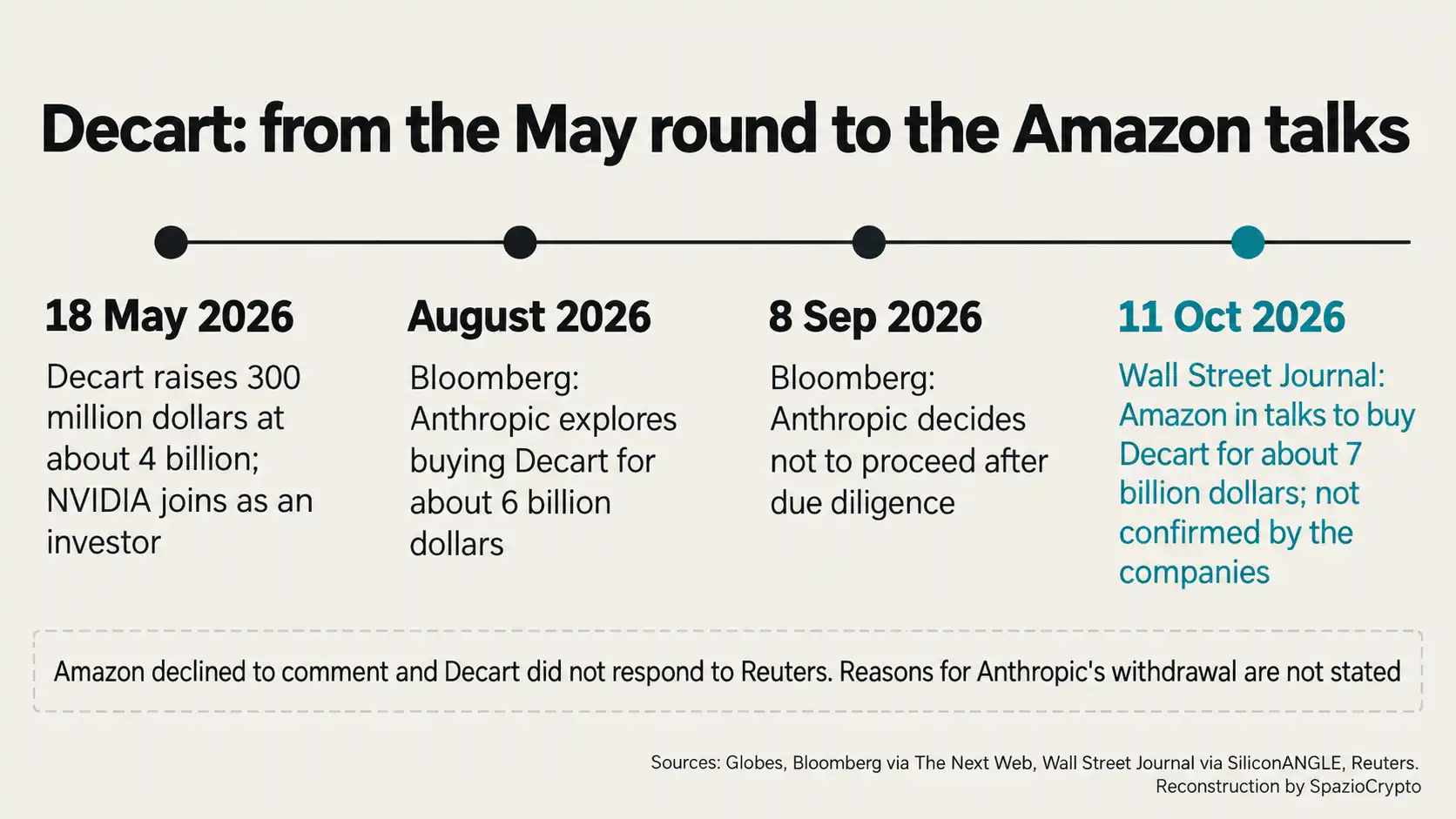
The Wall Street Journal broke the story on Sunday, October 11, citing people familiar with the discussions. According to secondary coverage by SiliconANGLE, a deal could materialize soon, provided talks don't collapse and no rival bidder emerges; SiliconANGLE does not report whether any agreement has been signed. As relayed by PYMNTS, the Wall Street Journal also cited a report from Israeli financial daily Calcalist, which had indicated that Decart was in advanced talks to be acquired by a major technology company.
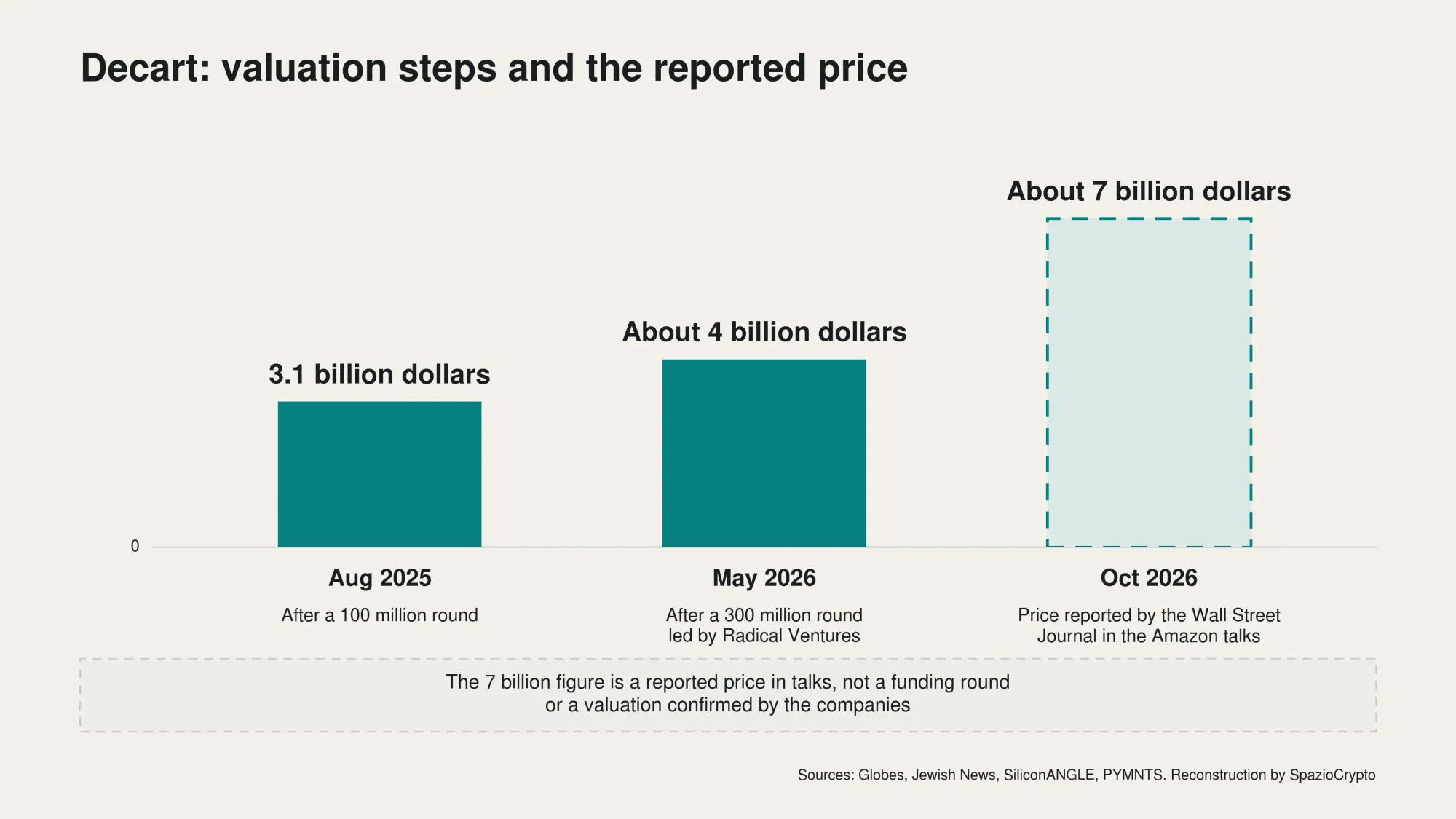
The reported price is approximately $7 billion. Decart was valued at nearly $4 billion in May, according to PitchBook data cited by the Wall Street Journal and picked up by Business Standard, meaning the reported figure would represent a sharp jump in valuation within just a few months. No source reviewed specifies a final deal value, the precise scope of the technology being acquired, or the regulatory approvals that would be required.
Who Is Decart and What Does It Do
Decart was founded in 2023 by three Israeli engineers: brothers Dean and Orian Leitersdorf, and Moshe Shalev, according to SiliconANGLE. The company describes itself on its website as a frontier AI lab building “real-time world models.” Several outlets place its headquarters in San Francisco. The product at the center of acquisition interest is DOS, the Decart Optimization Stack, which the company's site presents as an inference and training stack that “unlocks the performance of every major chip” and is built to run on NVIDIA hardware, AWS Trainium, and Google TPUs.
SiliconANGLE describes why chip portability carries commercial value: typically, a neural network must be optimized for the specific chip it will run on, a process that once took months. With DOS, according to the company's claims, that work drops to roughly two weeks, letting organizations shift workloads to alternative processors when requirements change or chip supply is constrained. This is a secondary-source description, not an independent technical verification, and the performance figures Decart cites for DOS 2.0 are the company's own claims.
Beyond DOS, Decart develops world models: Lucy, which its site describes as a system that modifies live video in real time, and Oasis, designed to simulate environments for training robots and autonomous vehicles. In May, Decart closed a $300 million funding round at a $4 billion valuation, led by Radical Ventures with NVIDIA joining as a new investor, according to Globes. A prior round of $100 million at a $3.1 billion valuation was completed in August 2025. Total funding raised exceeds $400 million, per SiliconANGLE and PitchBook.
Amazon's relationship with Decart predates these reported talks. As covered by SiliconANGLE and PYMNTS citing the Wall Street Journal, AWS gave Decart early access to Trainium3, Amazon's chip designed to compete with NVIDIA's offerings, after meetings with the founders. According to Jewish News, Amazon entered as a strategic customer in May: clients of its cloud platform would be able to use Decart's technology. That report does not specify whether Amazon made a capital investment.
The Anthropic Precedent
On September 8, Bloomberg reported that Anthropic had explored acquiring Decart for approximately $6 billion, a figure that had surfaced as early as August, and that after due diligence Anthropic decided not to proceed. According to The Next Web, the reason is not publicly known and the two companies may pursue other forms of collaboration. Ynetnews adds that the discussions involved, in part, Decart's chip-efficiency technology, which would have helped Anthropic extract more capacity from existing infrastructure.
Anthropic's appetite for compute infrastructure is documented separately: TeraWulf signed a roughly 20-year contract with Anthropic for approximately 401 megawatts of power capacity, starting in 2027, as SpazioCrypto reported. BigGo Finance notes that Amazon is already a major investor in Anthropic. None of the sources reviewed indicate whether the two episodes are directly connected, and reading them as a deliberate sequence would be an overreach. Both are reported negotiations, with the Amazon figure coming in higher. SiliconANGLE also notes the possibility that another bidder could emerge.
Why Chip Portability May Matter: Our Reading
What follows is SpazioCrypto's editorial analysis, not a reconstruction of Amazon's motivations, which the company has not disclosed. The starting point is a supply problem. As we reported in our piece on IREN's shift from Bitcoin mining to AI infrastructure, global demand for AI compute may never be fully satisfied, and the Wall Street Journal, in the coverage relayed by secondary outlets, connects Decart's value directly to competition for compute capacity. If a meaningful portion of workloads can be shifted between chips with relatively little engineering effort, buyers of compute gain leverage when any single supply source tightens.
There is also the vendor-dependency angle. NVIDIA still dominates the GPU market, and in June the company raised $25 billion in bond markets to fund AI infrastructure, as we covered in our piece on NVIDIA's bond issuance and Bitcoin miners. Software that reduces the cost of switching chips would, in theory, strengthen the position of alternative chip developers, including Amazon's own Trainium line, and of compute buyers generally. One question worth raising: a neutral software layer becomes less neutral once it's owned by a company that also sells competing chips. The sources reviewed don't address how DOS would be offered to customers after a potential acquisition.
Chip portability is not a complete answer to the compute shortage, either. In our coverage of Google's investment in Finland's energy infrastructure, we argued that the real bottleneck for AI is power, not chips alone, and software portability doesn't generate megawatts. On the workload side, a report from the China Telecom Research Institute, which we covered in the context of AI inference projections, suggested that inference could overtake training as the dominant compute use case by 2029; DOS, per its site, addresses both. Decart's world models, including Oasis, also connect to the physical AI space, where simulation precedes robot training, as illustrated by the NVIDIA and LG factory collaboration in South Korea.
Amazon and Decart: Summary
What is reported and what is not. Sources: Wall Street Journal (via secondary coverage), Reuters, Bloomberg.
- Reported: according to the Wall Street Journal, Amazon is in talks to acquire Decart for approximately $7 billion; Decart develops software for shifting AI workloads across chips and builds world models; Amazon declined to comment and Decart did not respond to Reuters; Anthropic, per Bloomberg, had explored an offer of around $6 billion and withdrew after due diligence.
- Not confirmed: a signed agreement; a final deal value; the exact scope of technology being acquired; required regulatory approvals; Amazon's strategic rationale; the reasons for Anthropic's withdrawal.
- To watch: an official announcement or denial from Amazon or Decart; the possible emergence of a rival bidder; and the terms under which DOS would remain available on chips other than Amazon's own hardware.
The Bigger Picture
If confirmed, this deal would signal that in the race for compute, strategic value is shifting toward the software layer that decides which hardware runs AI models, not only toward chips and data centers themselves. For a startup valued at nearly $4 billion in May, a reported figure approaching $7 billion suggests at least one buyer views that software layer as genuinely strategic. That's our read; the sources don't disclose Amazon's reasoning.
The signals worth tracking are specific: an official announcement from Amazon or Decart, the final price, whether a rival bidder appears, and above all how DOS's neutrality toward non-Amazon chips would be handled post-acquisition. Until those details emerge, this remains a reported negotiation, not a completed deal.