

Kalshi is in talks to raise a new funding round at a $65 billion valuation, with one stated objective being the development of futures contracts on AI computing capacity, according to Reuters, which cited an anonymous source familiar with the discussions on November 12. Kalshi has not confirmed the round, and neither the amount nor the terms have been disclosed. The company's broader bet: turn the fluctuating cost of renting GPUs into an observable, tradable price reference and, eventually, a hedgeable financial instrument.
This article draws on the Reuters report, Kalshi's official announcement of its previous funding round, the Commodity Futures Trading Commission (CFTC) public consultation published on August 19, and materials from Kalshi Research. Information on the possible new round is attributed solely to the anonymous source cited by Reuters. Kalshi's own documents confirm the October raise and the compute market strategy, not the new round.
From $40 Billion to $65 Billion: A Round Still in Negotiation
On October 29, Kalshi announced a $1 billion Series G at a post-money valuation of $40 billion, co-led by Sequoia and Wellington. The company's press release named several product ambitions: new indices, perpetual single-stock futures, and compute markets.
The $65 billion figure carries a different status. According to Reuters, parties are discussing a new raise at that valuation. Kalshi did not immediately respond to the outlet's request for comment. Neither the size of the potential raise nor its terms are known, and there is no confirmation the deal will close at that level.
The gap between the two valuations is striking. It should not be read as a confirmed increase in company value. Forty billion dollars is the post-money valuation Kalshi announced after the completed October round. Sixty-five billion is the number at which, per the Reuters source, a new round is being negotiated. A discussed price and a closed transaction are not the same thing.
The fundraising would fit into Kalshi's push to move beyond event contracts and toward products closer to those offered by traditional exchanges. For background on the prediction market model that underlies Kalshi's core business, our guide to prediction markets explains how contract prices reflect participant expectations about future outcomes.
What Would an AI Compute Future Actually Look Like?
A compute future would allow buyers and sellers of computational capacity to lock in a price today for a specified future period. An AI lab anticipating heavy GPU rental costs could seek protection against price spikes. A capacity operator could use the contract to gain revenue certainty. The financial instrument would transfer price risk between counterparties without requiring physical delivery of chips or server hardware.
The need arises from a structurally fragmented market. GPU rental prices vary by chip model, geographic region, reservation duration, immediate availability, and bundled services. The price of one hour on a specific GPU is not automatically comparable to that of a different accelerator, region, or cloud contract. Capacity can be scarce in one location while available elsewhere, and energy and connectivity costs shift the delivered price further.
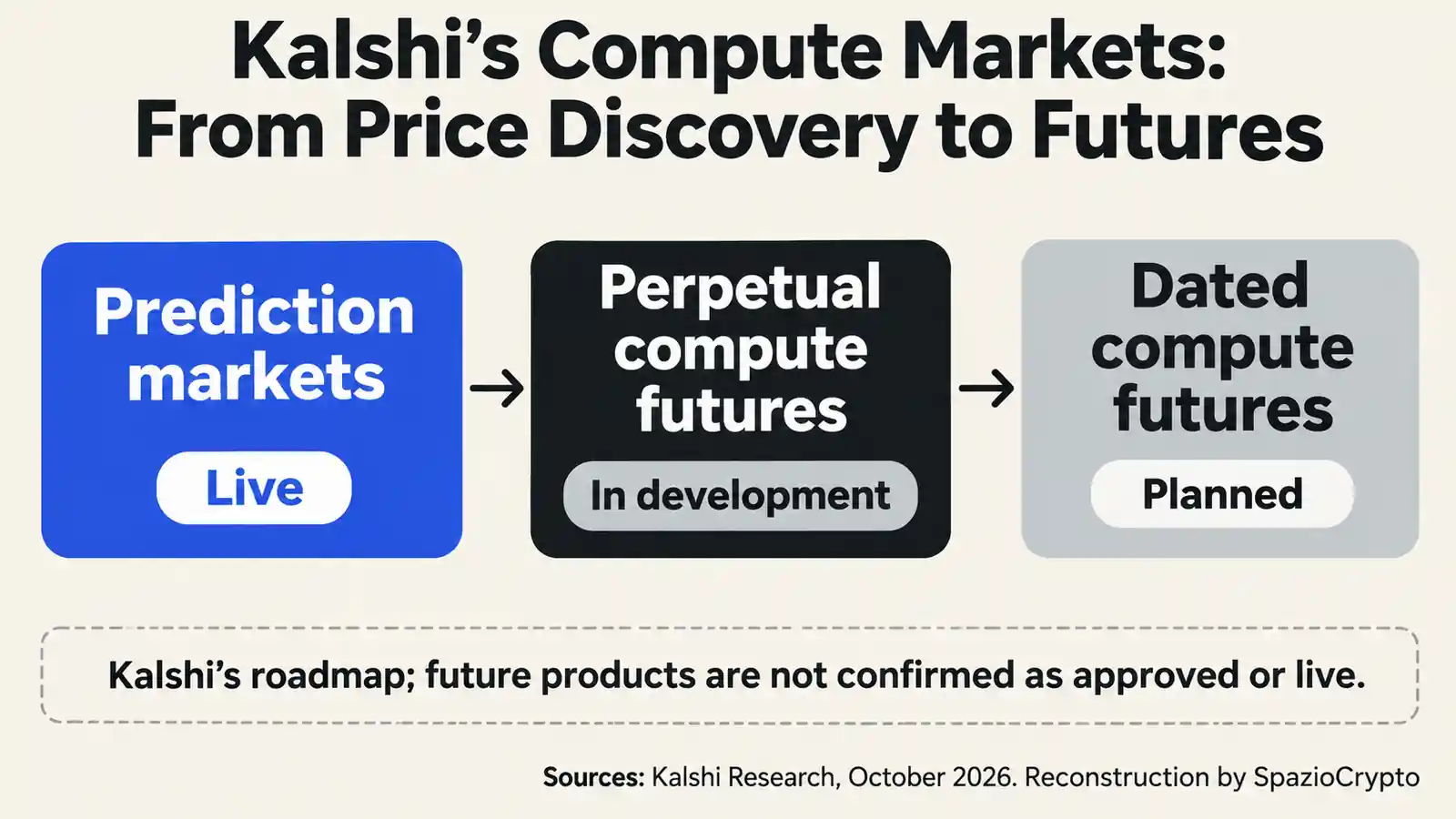
Kalshi Research, in a report published in October, described a multi-phase path: predictive markets and benchmarks first, then perpetual futures, then contracts with defined expiries. The company argues that more standardized instruments could help businesses manage exposure to compute price volatility. That is Kalshi's stated roadmap, not evidence that a mature market or sufficient demand already exists for each of these products.
The story connects to the rapid physical build-out of AI infrastructure globally. SpazioCrypto has covered the transformation of IREN from a Bitcoin miner into an AI data center operator and the broader global race for AI infrastructure. Any financial price, if it materializes, would ultimately rest on physical assets: accelerators, power, space, and networks. The GPU cluster financing described in the HIVE and BUZZ HPC case illustrates how tightly capital and hardware availability are linked. The Drax AI data center project is another example of that physical scaling.
Forward Curves Exist, But They Are Not Tradable Futures
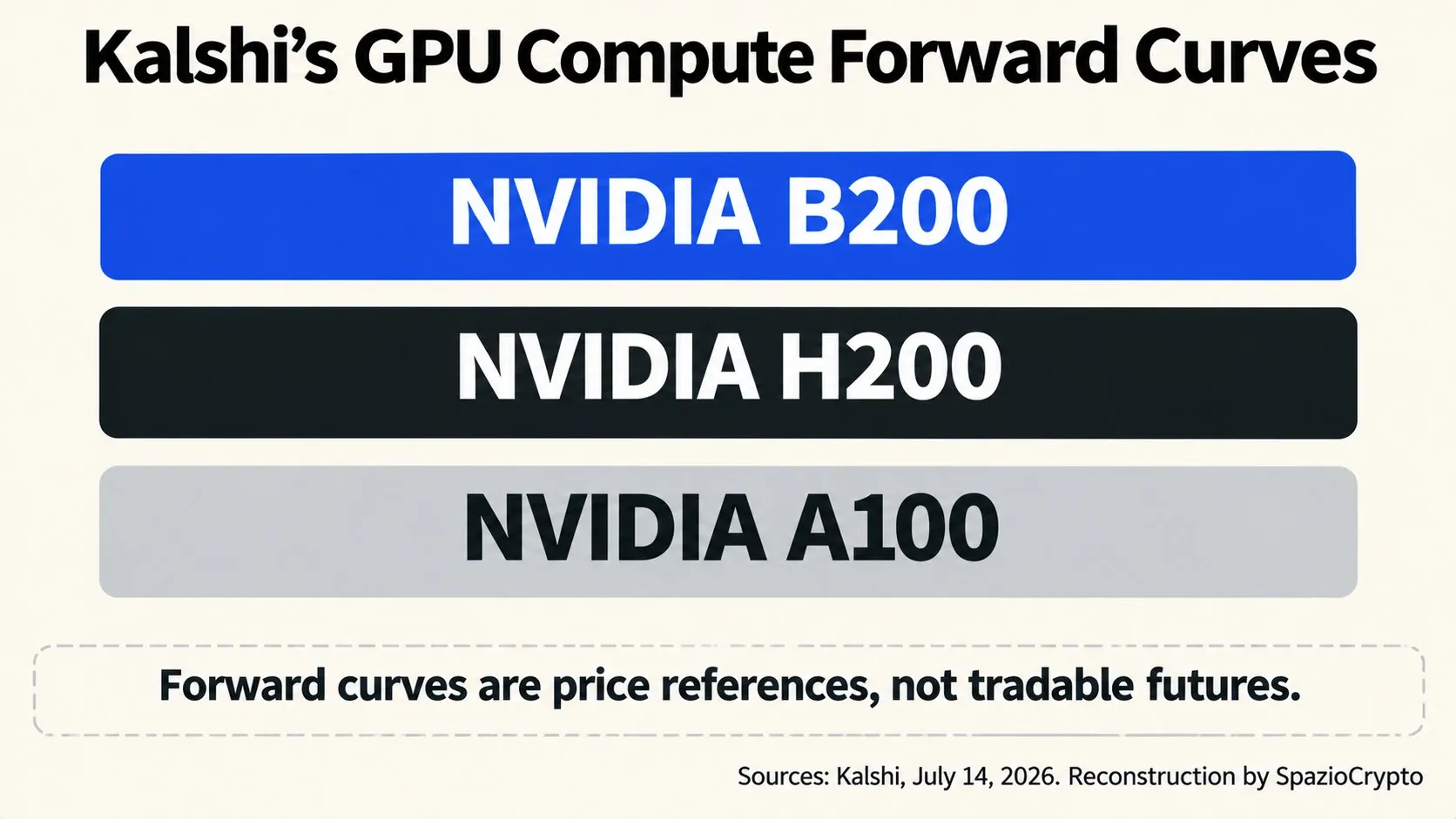
Kalshi has already built some components of this strategy. In July the company published forward curves for Nvidia B200, H200, and A100 GPUs, derived from the implied prices in its own weekly and monthly markets. A forward curve shows what the market expects prices to be for a given resource at future dates. It can serve as a reference for bilateral agreements or for structuring financial products, but it is not itself a tradable futures contract.
Kalshi has stated explicitly that the published curves are not tradable assets. The underlying markets and available transactions on the platform are separate products. In October materials, the company also mentioned perpetual futures and dated contracts as future phases of its compute project, but the final specifications of those contracts have not been announced in any brief reviewed for this article.
A useful benchmark has to answer specific practical questions: which chip model does it represent, in which geographic region, for what duration, at what availability level, and under what service conditions? If the index blends non-comparable capacity types, a hedge may not track the actual cost a company incurs. If the reference market is thinly traded or relies on opaque data, the price becomes vulnerable to distortion.
This is the less-noticed angle of the story. The competitive race is not only about who runs the trading platform. It may hinge on who can define a credible, verifiable, replicable measure of compute cost. That is SpazioCrypto's reading: benchmark control could become a durable commercial advantage, but it has not yet been demonstrated that Kalshi can impose a shared industry standard.
The CFTC Is Gathering Comments, Not Approving Contracts
On August 19, the CFTC opened a public request for comment on derivatives linked to computing resources. The agency solicited views on spot market size and liquidity, surveillance, manipulation risks, customer protection, and perpetual futures. The consultation informs the regulator's supervisory approach. It does not authorize any specific product launch.
Reuters reported that CFTC review of contracts tied to GPU rental prices had been delayed while the agency consulted benchmark providers about manipulation risks. This detail is attributed to Reuters: the CFTC's August 19 release describes a request for comments but does not announce a rejection of compute futures. A procedural delay, if confirmed, is not a permanent prohibition.
Regulation will also have to address the price-formation challenge. Traditional commodities have recognized quality specifications and delivery locations. For compute, a contract must define what “available capacity” means and how products with different performance profiles and service conditions are compared. Benchmark integrity and manipulation are explicitly among the questions the CFTC put to the industry in August.
The regulatory dimension connects to the broader debate around CFTC oversight of Kalshi's markets and the rules applicable to prediction markets generally. Those precedents do not determine the outcome here: compute futures involve distinct products and separate regulatory questions.
The Oil Precedent Is Useful, But Incomplete
The analogy with oil, gas, or metals helps explain the basic function of futures: producers and buyers can transfer price-change risk to parties willing to absorb it. AI compute is not yet a homogeneous commodity. GPUs differ by generation and performance; cloud services add further variables including networking, memory, software stack, availability guarantees, and delivery location.
A financial market could make prices more visible and help operators plan costs. Hedging would only work, though, if the contract tracked the price actually paid closely enough. Otherwise, a company remains exposed to the gap between the negotiated benchmark and its own supply contract, the so-called basis risk.
Other players are moving in the same direction. According to Reuters, CME Group has announced a partnership with Silicon Data to develop compute futures, subject to regulatory review. ICE is also reportedly interested in the sector. Multiple entrants can help a market form, but they can also produce competing benchmarks if common definitions and data sources don't consolidate around a shared standard.
Kalshi at a Glance
What is confirmed, what is not
- Confirmed: $1 billion round at a $40 billion post-money valuation announced by Kalshi on October 29; a roadmap that includes compute markets; forward curves already published.
- Reported: negotiations toward a new round at a $65 billion valuation, per an anonymous source cited by Reuters. Kalshi has not confirmed.
- To watch: whether the round closes and on what terms; contract specifications, benchmark methodology, liquidity, and the CFTC review timeline.
The Bigger Picture
SpazioCrypto's read, stated as such, is that Kalshi is attempting to move from pricing the outcomes of events to pricing a core productive resource of the AI economy. The $65 billion valuation in discussion draws attention, but the real industrial bet is the construction of a credible benchmark: without comparable units, transparent data, and genuine liquidity, a compute future risks failing to cover the costs that companies actually want to stabilize.
The concrete signals to monitor: whether the round closes and at what valuation; which GPUs, regions, and contract durations are covered by the first products; which real transactions underpin the reference price; and what conditions the CFTC attaches to any approval. Until those questions are answered, Kalshi's forward curves remain informational tools derived from its own markets, and AI compute futures remain a strategy under development, subject to regulatory review.