


Revolut has surpassed 6 million customers in Italy, according to a company press release published on October 9, making Italy its fourth-largest market by client count. This is a digital banking story, not a crypto story. The figures cover accounts, salary deposits, savings, and payments. Not a single number in the announcement tells you how many of those customers actually use cryptocurrency. That distinction matters, and we're keeping it front and centre.
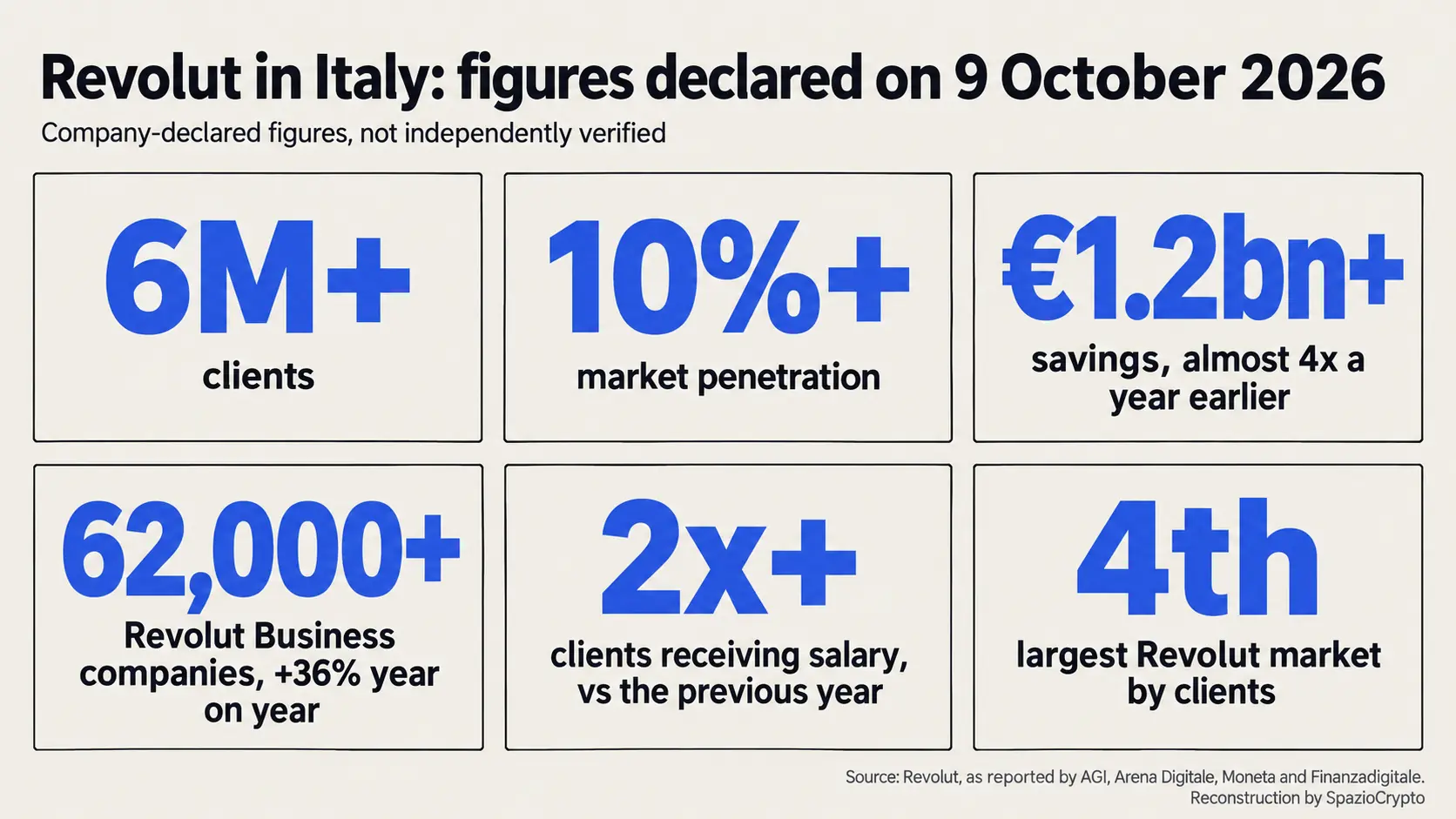
The company's own figures, as reported by AGI, Arena Digitale, and Finanzadigitale, show: market penetration above 10%, savings balances exceeding 1.2 billion euros (nearly four times the level of a year ago), more than 62,000 business clients on Revolut Business (up 36% year-on-year), salary deposits more than doubled, and the addition of F24 tax payments and SEDA direct debit integration in 2026. All figures originate from Revolut's press release and outlets that relayed it. No independent third-party verification has been found.
The Numbers, One by One
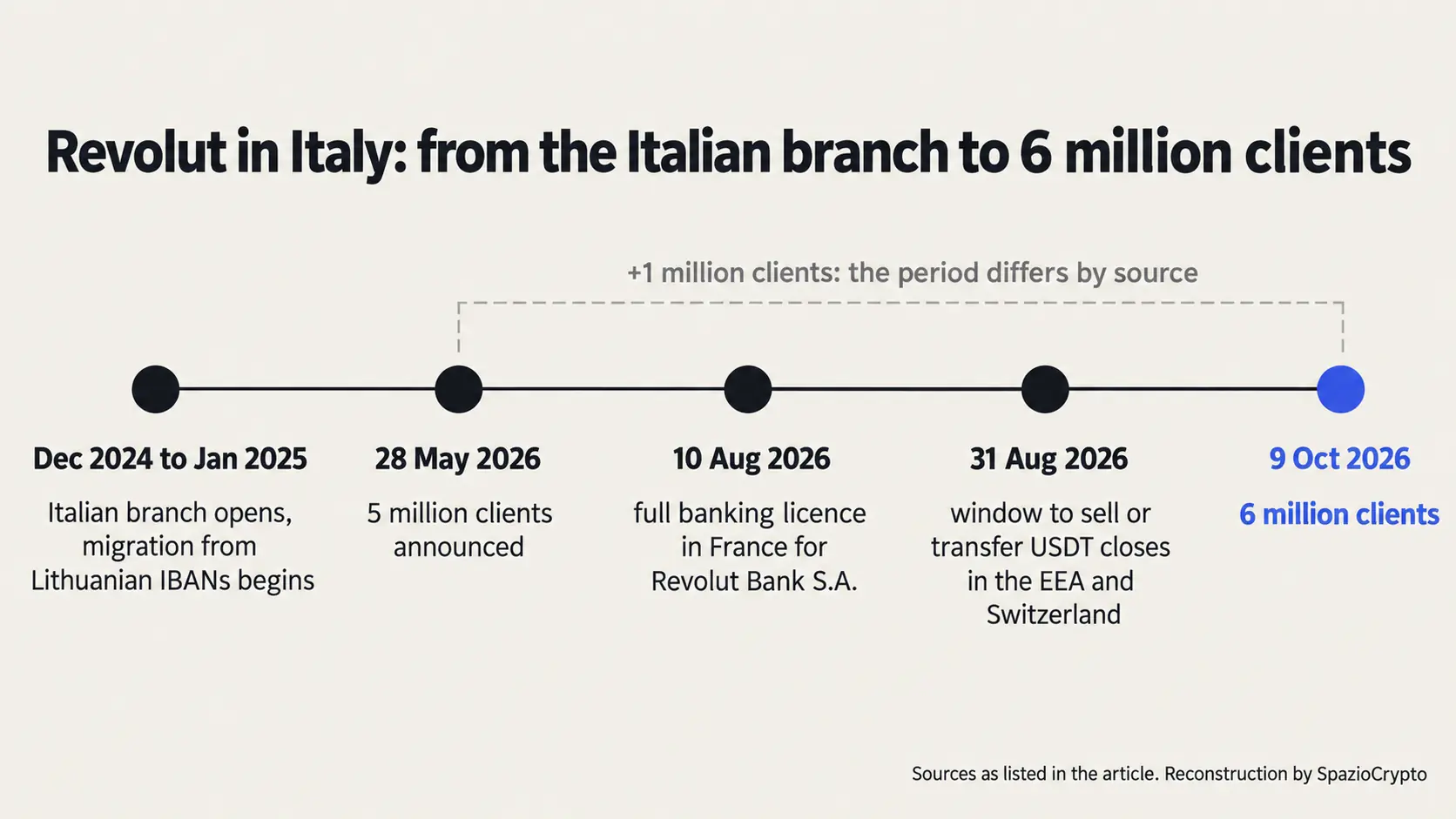
On the customer count: Revolut's release describes reaching 6 million as gaining one million customers over the five-million milestone, which the company placed at the start of 2026. The timeline is a little murky. Revolut had announced the five-million mark on May 28, describing itself at that point as Italy's fifth-largest bank by client count, with a goal of entering the top three within twelve months. Finanzadigitale counts the new million from that May date, which would be just over four months rather than nine. Either way, the base is five million in both scenarios, meaning roughly 20% growth, but the pace looks very different depending on which start date you accept. We're not attributing a specific growth rate because the data is ambiguous.
The October announcement does not update Revolut's ranking among Italian banks, and any comparison between a digital bank's customer count and a traditional bank's requires care. There is no common counting methodology that we could find.
Savings are both the most substantive figure and the least defined. Sources describe “deposited savings” or balances above 1.2 billion euros, with Finanzadigitale reporting a 288% increase without specifying whether that covers deposits only or includes savings products as well. Dividing 1.2 billion euros across 6 million customers gives roughly 200 euros per head. That's our own calculation, not an average balance from Revolut, because we don't know how many customers actually hold those products. What it does suggest is that the savings footprint remains modest relative to the client base.
The salary figure is relative, not absolute. Customers receiving their salary directly into Revolut have “more than doubled,” with Finanzadigitale citing a 116% increase over twelve months, but no absolute number is provided. On the business side, Revolut Business has passed 62,000 Italian clients, making Italy its second-largest market after the UK and, per the press release, the European Union market with the most new business clients in the past year. Users of Revolut Pay, the checkout payment feature, have nearly quadrupled.
F24 and SEDA: Features of a Primary Bank
The two major additions in 2026 share a clear logic. F24 lets Italian customers pay taxes and social contributions directly from the app, initially rolled out for individuals in 2026 and more recently extended to businesses. SEDA stands for SEPA-compliant Electronic Database Alignment, an optional service defined by the Italian Banking Association (ABI) that works alongside standard SEPA direct debits. Its purpose is to exchange mandate information between parties before the first debit is processed. According to Arena Digitale, which relayed Revolut's press release, SEDA allows customers to manage a broader range of recurring financial commitments from within the Revolut account. Both additions are the hallmarks of a bank positioning itself as the account where taxes, utilities, and instalment payments flow through.
This aligns precisely with the stated ambition of Nicola Vicino, General Manager of Revolut Bank UAB's Italian branch: “we want Revolut to become the number one bank in Italy.”
One caveat on SEDA: Finanzadigitale reported that a page on Revolut's help centre described the integration as still in progress, with potential compatibility issues with certain Italian service providers. We could not locate that specific page at time of writing, so we can't confirm which services are fully operational today. The operational status of SEDA should be treated as unverified.
Six Million Customers Are Not Six Million Crypto Users
Revolut's announcement contains zero data on cryptocurrency. It does not say how many Italian customers hold crypto, how much they hold, or what those holdings are worth. Keeping the two sides separate also helps clarify who is regulated by whom. Banking services in Italy are provided through Revolut Bank UAB's Italian branch, a Lithuanian-chartered bank, and Italian customers are expected to migrate progressively to the new Revolut Bank S.A. as the French banking licence takes effect. Crypto services are a separate legal entity: Revolut Digital Assets Europe Ltd, incorporated in Cyprus, which according to Revolut's own help centre holds a crypto-asset service provider licence under MiCA, granted by the Cyprus Securities and Exchange Commission, with a branch registered in Milan. Since the MiCA transitional period ended on July 1, 2026, that is the regulatory perimeter within which the app's crypto features operate in the EU.
For Italian users specifically, the crypto catalogue has narrowed rather than expanded in recent months. Revolut delisted USDT across the European Economic Area and Switzerland: the deadline to sell or transfer the token passed on August 31, because the company determined USDT does not meet MiCA's requirements for stablecoins. EURR, Revolut's own euro-denominated stablecoin, is available only in Denmark, Poland, and Portugal. Italian customers cannot access it yet. Both cases illustrate a dynamic that will shape digital banking across Europe: a large customer base does not determine what can be offered. The regulatory framework does.
Context: Digital Payments Already Mainstream in Italy
Revolut's expansion is happening in a market where digital payment behaviour was already well established before Revolut arrived. According to data from the Bank of Italy that we analysed in our piece on digital payments in Italy, 88% of card payments at point-of-sale terminals occur via contactless, and roughly one in four physical transactions is completed via smartphone or smartwatch. Cash remains the most-used instrument by transaction count in physical retail, but the cultural shift toward digital payment was already underway. A digital bank scales more easily where the behaviour has already changed. That's our reading of the context; the press release does not make that claim directly.
Revolut in Italy: What the Numbers Say (and Don't Say)
What is declared, what is not. Sources: Revolut press release as reported by AGI, Arena Digitale, Moneta, and Finanzadigitale
- Declared by Revolut: over 6 million customers, fourth market by client count, market penetration above 10%, savings above 1.2 billion euros, 62,000+ business clients (up 36%), salary deposits more than doubled, F24 and SEDA added in 2026.
- Not disclosed: crypto data, breakdown of the 1.2 billion euros, active customer count, absolute number of salary customers, and exact timeframe for the additional one million.
- Watch for: Italian customers using crypto, EURR launch in Italy, migration to the French bank entity, and confirmed operational status of SEDA.
The Bigger Picture
This announcement signals where competition between banks is actually moving: away from simply opening accounts and toward becoming the account that receives salaries, pays taxes, and manages recurring debits. Revolut is explicit about wanting to be Italy's number one bank, and the metrics chosen for the October release, namely salaries, F24, SEDA, and business clients, all point in that direction. Crypto doesn't appear. That's telling. The USDT and EURR situations reinforce a broader point: when crypto and stablecoins sit inside a banking app, their reach is determined by regulatory rules like MiCA and by product decisions, not by the size of the customer base.
The concrete signals worth watching: an official figure from Revolut or an Italian authority on how many Italian customers actually use crypto; a launch date for EURR in Italy; progress on the migration to Revolut Bank S.A. under the French licence; confirmed operational status for SEDA across Italian service providers; and an updated ranking among Italian banks by customer count. Until those data points arrive, the six million figure tells you a great deal about the strength of a banking app in Southern Europe. It tells you almost nothing about crypto adoption.