

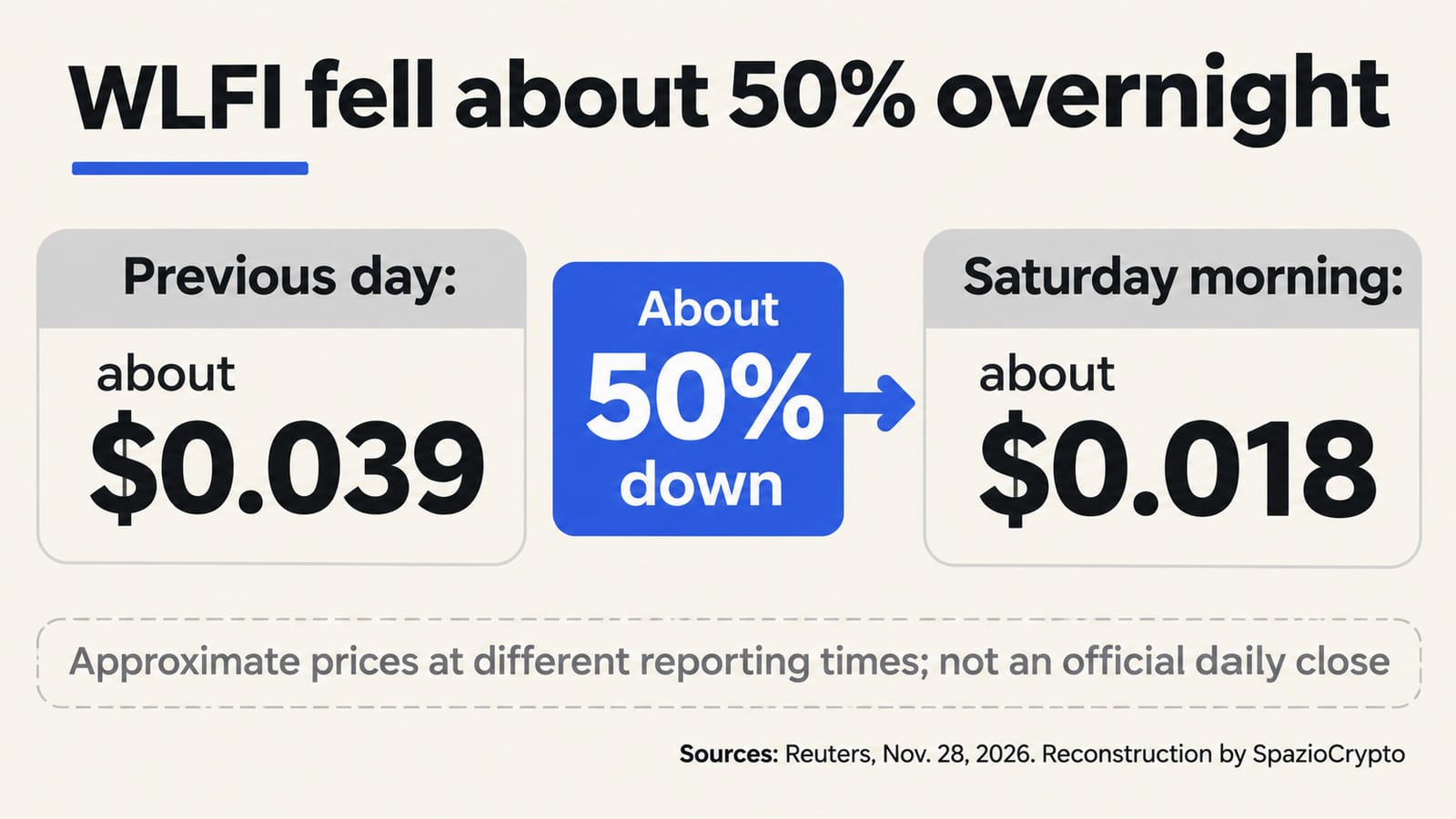
World Liberty Financial's WLFI token lost roughly half its value in a single session, falling from approximately $0.039 to $0.018 between November 27 and 28, 2026, according to Reuters. During the same window, World Liberty reported that Binance had automatically closed perpetual futures positions on both sides of the market. Binance confirmed it is reviewing market activity and execution data. No cause, user count, or individual loss figures have been disclosed.
This article draws on reporting by Reuters, The Block, and The Washington Post. Original posts on X by World Liberty and Binance returned a 403 error when accessed directly; their contents are cited here as reproduced by those outlets, attributed to the respective authors. Sources diverge on intraday prices because they captured different timestamps; that distinction is preserved throughout.
We are aware that overnight, Binance automatically closed WLFI perpetual futures positions on both the long and short sides. We have also seen reports from users whose positions were profitable prior to closure but resulted in losses upon settlement.
— WLFI (@worldlibertyfi) November 28, 2026
We want to clarify that…
We are aware of the reports regarding WLFI perpetual futures positions. Our team is actively reviewing the market activity and execution data.
, Binance (@binance) November 28, 2026
User protection and market integrity are our top priorities. Users are always free to contact Binance Customer Support directly. https://t.co/XLRfEaqw1u
The Price Loses About Half Its Value in One Session
Reuters reported that WLFI was trading at approximately $0.018 on the morning of November 28, compared with roughly $0.039 the day before. The outlet described the move as a roughly 50% overnight loss and noted that the token had already shed more than 90% from the level at which trading began in September 2025. These are approximations captured at specific moments, not official daily closing prices.
The Block recorded a different intraday low of $0.0158 on Binance, with a subsequent reading near $0.0171. Those observations don't automatically contradict the Reuters figure: they reflect different phases of the same session. The gap matters because a momentary low doesn't describe the price at which every trader could execute an order. The token's launch had already seen sell-offs from some large holders, as covered in our earlier analysis of WLFI's first trading days.
World Liberty Reports Long and Short Position Closures
In its first public update, World Liberty stated that Binance had settled and closed WLFI perpetual contracts on both the long and the short side. The project then clarified that the derivatives market and the auto-deleveraging (ADL) mechanism are operated independently by the exchange. World Liberty said it had no involvement in the closures and no authority over how positions are managed, closed, or settled.
The alert concerns derivatives, which allow traders to gain price exposure without holding the underlying token directly. When a position is closed automatically, the trader loses that exposure without placing a new order. Leverage can amplify price moves when a liquidation forces other participants to reduce their own positions, as we explained in our piece on liquidations in leveraged markets. That general mechanism doesn't by itself prove it caused WLFI's decline.
Binance Reviews Market Activity and Execution Data
Binance said in a post on X, as reported by Reuters, that it was aware of the reports and was actively reviewing market activity and execution data. The statement doesn't confirm that the exchange's systems made an error, nor does it explain why positions were closed. No technical report reconstructing the order sequence, settlement prices, or ADL application has been published.
The Block reported that some profitable short positions were closed via the ADL mechanism. That's a journalistic reconstruction based on available data, not a technical explanation released by Binance. Our earlier report on liquidations recorded in crypto markets shows why aggregate position-closure figures don't determine the outcome for every individual account.
Treasury Reduces Debt, but Doesn't Explain the Decline
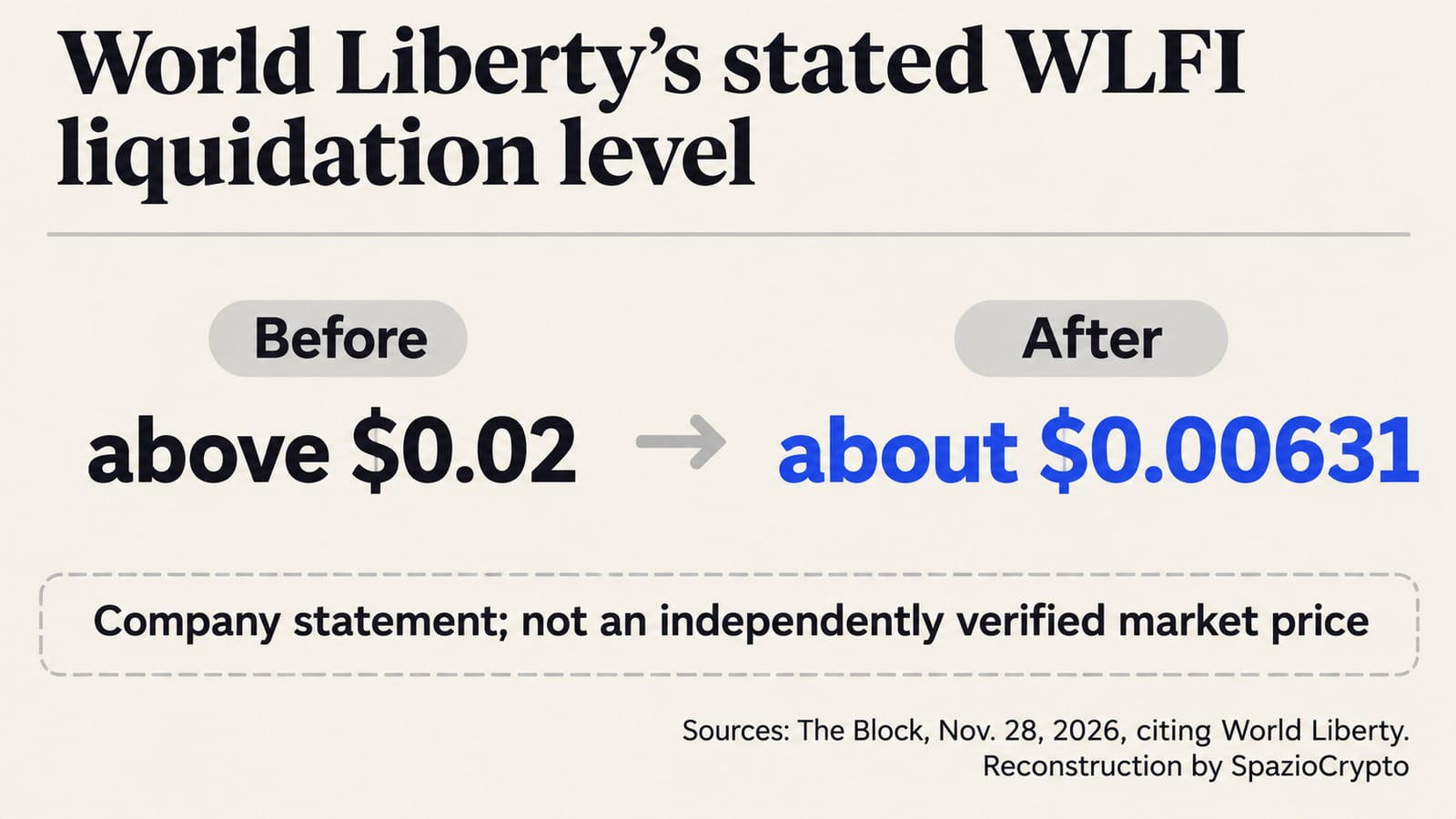
In a later update, World Liberty said it had sold a portion of its ETH and mETH reserves to repay debts. The project stated it had consolidated three lending positions into two, closed one position, and reduced its stated liquidation level for WLFI collateral from above $0.02 to approximately $0.00631. World Liberty specified that no WLFI tokens were sold in the process.
The Block reported, citing on-chain data it tracked, that the treasury had sold approximately $20 million worth of ether and reconstructed some on-chain movements related to a loan on Dolomite. That figure and the associated dynamics are attributed to The Block and the data it cited, not to a certified balance sheet published by World Liberty. The reduction in the liquidation level is a project statement. It doesn't demonstrate that the ETH sale triggered the futures closures or the spot price decline.
USD1 and the Limits of Reserve Reassurances
World Liberty maintained that USD1 stablecoin reserves are separate from the treasury's lending positions and are not exposed to that debt. Around the same time, The Block observed that USD1 briefly fell to approximately $0.94 against USDT on Binance before recovering to near $0.997. That figure describes a market price recorded by the outlet; it doesn't demonstrate that reserves were insufficient. The project and its stablecoin were covered in our earlier article on USD1's regulatory path.
The link between a stablecoin and its declared reserves doesn't eliminate exchange-rate swings on a single platform. At the same time, a temporary peg deviation doesn't establish a solvency problem. Assessing the reserve claim requires verifiable data on composition, custody, and coverage, not just a price recorded during a period of sharp volatility.
What Remains to Be Established
Binance has not disclosed how many positions were closed, which precise procedure was triggered, or whether formal complaints have been received. World Liberty described effects reported by users, but individual loss figures have not been independently confirmed. The relationship between spot-market selling and futures contract closures is also still unresolved.
The episode fits into a broader debate about risks tied to crypto projects associated with political figures. The Trump family's involvement with World Liberty was already the subject of our analysis of the family's crypto ventures. For Binance, the European regulatory context is a separate matter from this technical episode, though the platform remains central to market-access and licensing questions documented in our dedicated Binance overview.
WLFI: What Is Confirmed and What Is Not
A summary of the confirmed facts, open questions, and signals to monitor.
- Confirmed: Reuters reports a decline from roughly $0.039 to $0.018; Binance states it is reviewing market activity and execution data.
- Not disclosed: the cause of the closures, the number of users affected, and individual loss amounts.
- To monitor: Binance's review findings, execution and settlement data, and further verifiable information on treasury positions.
The Bigger Picture
Our reading, stated as such: in this episode the spot price, the derivatives, and the treasury debt all moved within the same time window, but temporal coincidence alone is not sufficient to establish a single cause. The core question isn't about assigning blame to Binance or World Liberty before the data is in. It's about understanding how exchange risk mechanisms interact with a highly volatile token and with lending positions collateralized by that same asset.
The concrete signals to follow are Binance's technical explanation, the prices and timestamps of the closures, the number of accounts affected, and any formal documentation of complaints. For the treasury, subsequent communications on debt and collateral matter most. For USD1, independent reserve verification and the token's price trajectory after the temporary deviation are the factors that will separate routine risk management from potential execution problems.
Sources
WLFI price and Binance's initial response: Reuters, November 28, 2026. ADL closures, treasury movements, Dolomite loan, and USD1 intraday price: The Block, November 28, 2026. Project statements on closures, debt, and USD1 reserves: The Washington Post, November 28, 2026. Original X posts by World Liberty and Binance returned a 403 error when accessed directly; contents cited through Reuters and The Block.