


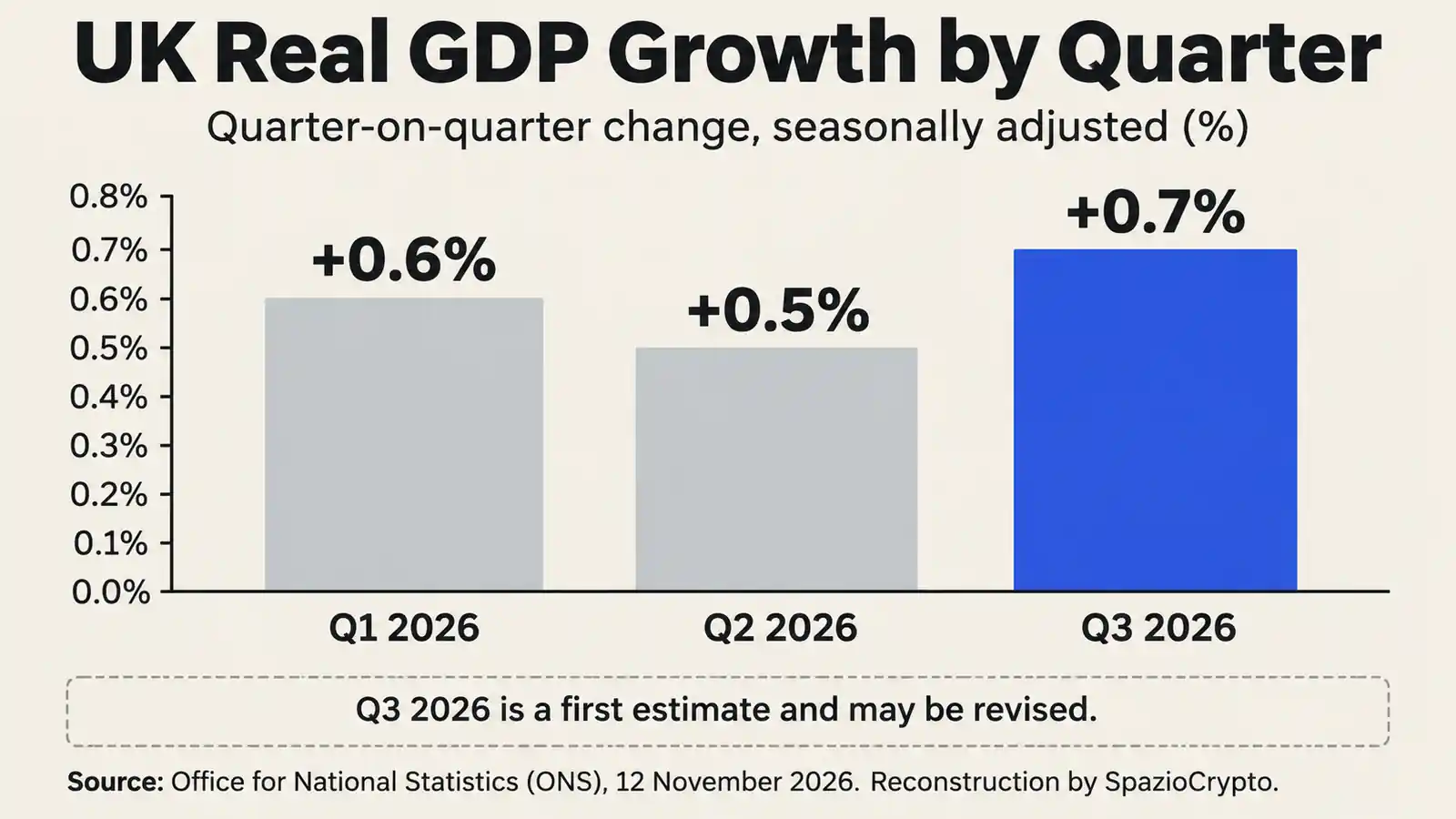
UK GDP rose 0.7% in the third quarter of 2026 compared with the previous three months, according to the first estimate published by the Office for National Statistics on November 12. The result accelerates from the +0.5% recorded in Q2 and brings annual growth to 1.9% versus the same period in 2025. Services were the primary engine, while construction and production turned in weaker performances.
To compile this report, SpazioCrypto consulted the official ONS bulletin and Reuters’ account from November 12. All aggregate and sector-level figures come directly from the UK statistical authority; the estimate is preliminary and subject to revision as more complete data becomes available.
Growth Accelerates, But the First Estimate Carries Caveats
Between July and September, the British economy expanded 0.7% on the previous quarter, according to ONS data. The annual comparison, measuring the change against Q3 2025, registers +1.9%. These are two distinct metrics: the quarterly figure captures the economy’s recent pace, while the annual figure measures how far output has risen over the past twelve months.
The quarterly result beats the 0.5% posted between April and June. That alone doesn’t make it a confirmed trend. The ONS labels this a first quarterly estimate and notes that revisions can go in either direction as additional information feeds into subsequent releases.
 Gross Domestic Product team
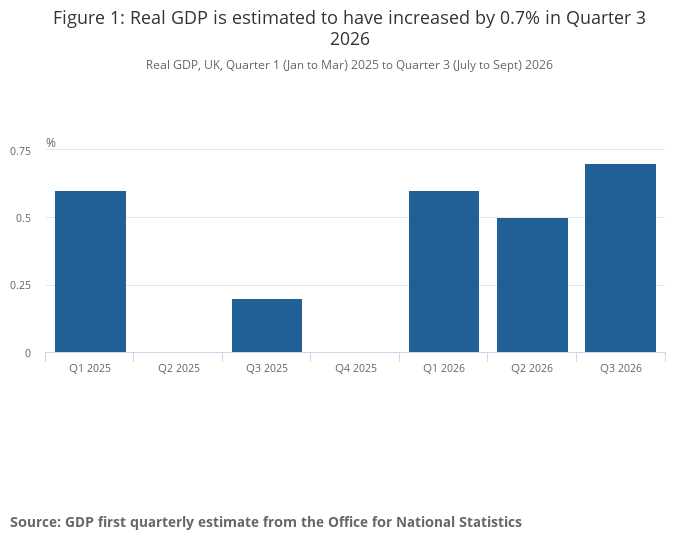
The caution is real. In the November 12 bulletin, the ONS revised August’s monthly GDP growth from +0.1% to zero. September then registered +0.2%, following the +0.4% posted in July. Monthly figures help trace the sequence within the quarter, but they don’t replace the quarterly measure, which aggregates more data and serves as the primary benchmark for growth.
For a plain-language explanation of what GDP actually measures, the SpazioCrypto macro glossary covers how gross domestic product quantifies the value of goods and services produced in a country.
Services Drive Growth, Construction Pulls Back
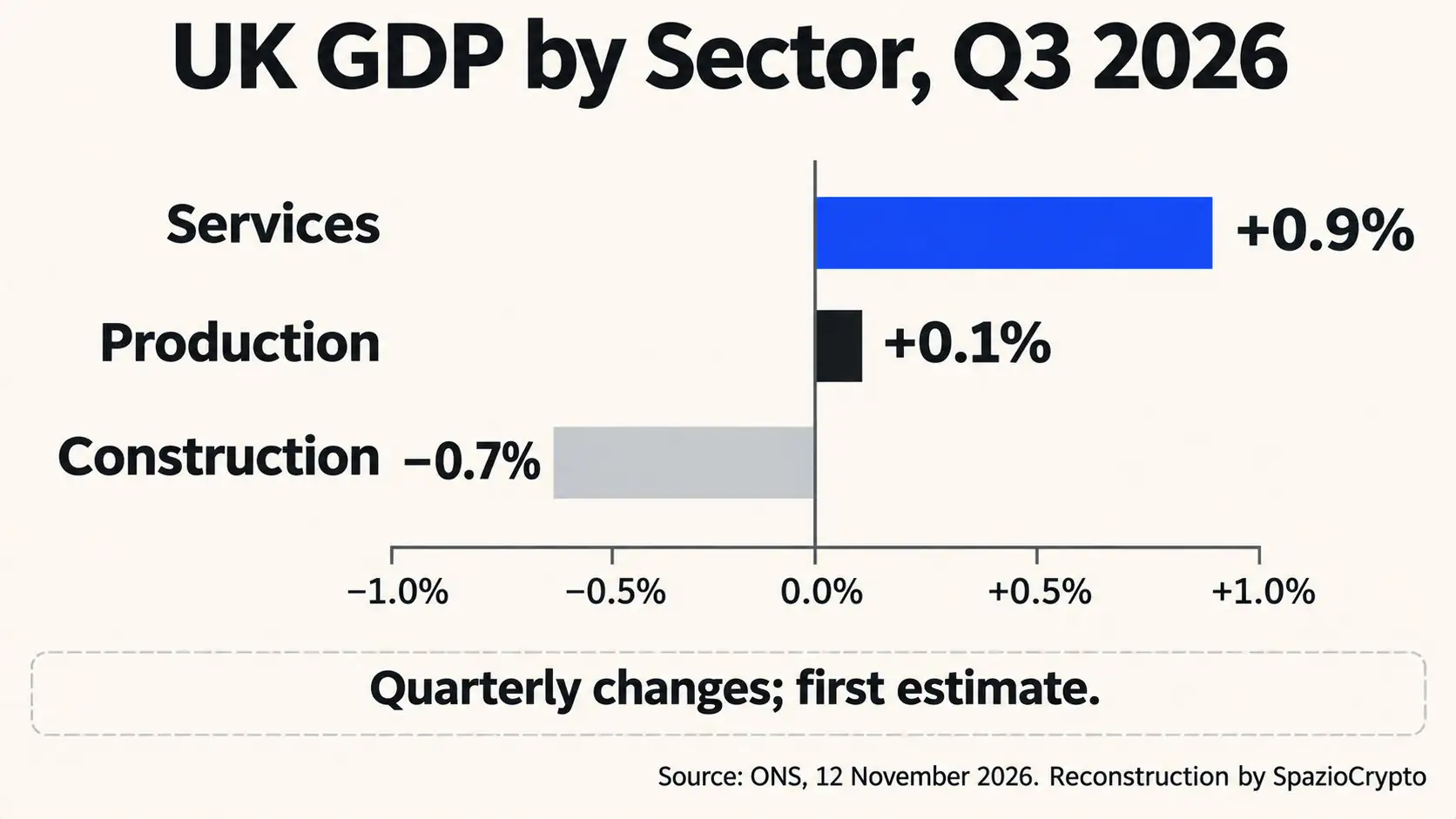
The sectoral breakdown shows growth concentrated in one area. According to the ONS bulletin, services expanded 0.9% over the quarter, outpacing the headline GDP figure, with business-facing activities singled out as a notable contributor. Production edged up 0.1%, while construction contracted 0.7%.
This isn’t a picture of broad-based expansion. Services delivered the main contribution, but the decline in construction shows that one part of the economy remained under pressure. Reading the sectoral data as it stands, the ONS bulletin measures output changes without attributing the construction dip to any single cause.
The divergence also matters for judging the quality of the result. Growth driven by a large, diverse sector like services can sit alongside weakness in more cyclical, investment-sensitive industries. Whether the acceleration spreads will depend on what the next data releases show for production and construction: do they stop contracting, or does the services impulse fade?
SpazioCrypto tracks these indicators in the Macroeconomics section, alongside data on growth, prices, and central bank decisions. For global context, the analysis on US inflation in October and the note on Bank of Japan rate views offer useful points of comparison.
September Closes the Quarter on a Positive Note
The monthly estimate for September, at +0.2%, completed a quarter in which GDP grew in all three months: +0.4% in July, flat in August (after the upward revision was removed), and +0.2% in September, according to ONS data. The August revision matters because it eliminates a small increment that the earlier reading had shown.
Monthly GDP shouldn’t be conflated with the quarterly figure. The ONS is explicit: the quarterly measure is the primary reference, drawing on a wider information set and the ability to balance different components of the national accounts. Monthly readings are useful for tracking near-term direction, but they carry a higher revision risk.
For another example of how to read macro data, the breakdown on Japan’s record yen intervention illustrates the same interpretive discipline. The August revision is a reminder that rapidly published statistics carry a margin of uncertainty. It doesn’t erase the Q3 expansion, but it does argue against treating a first read as a settled verdict on where the British economy is heading.
What This Reading Tells Us About the Broader Picture
The +0.7% quarterly figure offers a constructive signal for UK growth over the summer, but it doesn’t settle the question of resilience in the months ahead. The gap between +1.9% annual and +0.7% quarterly is worth keeping in mind: the annual figure incorporates the full path of the past four quarters, while the quarterly number captures only the most recent pace.
In its November 12 report, Reuters also noted elements relating to artificial intelligence activity and analyst expectations. This article doesn’t treat those as the main explanation for the aggregate figure: the ONS bulletin attributes sectoral growth primarily to services and does not establish that any single segment or investment drove the total increase.
For market observers, economic growth feeds into the broader framework of inflation and rate expectations, but GDP alone doesn’t dictate Bank of England decisions. The markets and borrowing costs section shows how asset prices respond to a constellation of indicators, not to any single data release.
UK at a Glance
The first estimate points to an acceleration on the previous quarter, with services advancing and construction retreating. Upcoming releases may revise the picture and clarify how growth is distributed across sectors.
UK GDP: Confirmed and Open Questions
What the data shows, and what it doesn’t
- Confirmed: Real GDP +0.7% on the quarter and +1.9% year-on-year, per the ONS first estimate; services +0.9%, production +0.1%, construction -0.7%.
- Not established: a single cause for aggregate growth; the figure is preliminary and open to revision.
- To watch: the next quarterly estimate and the trajectory of services, production, and construction.
The Bigger Read
Our editorial read is that the data describes an expanding economy with an uneven push: services are compensating for weakness in construction and near-stagnation in production. Growth is real, but its sectoral breadth remains the question to verify. The concrete signals to track are the revisions to the July-September data, the monthly GDP reading after September, and how growth distributes across sectors going forward. The next ONS release is scheduled for December 22, 2026. If the +0.7% holds, the figure gains credibility; if it shifts, the read on UK economic momentum will need updating too.