


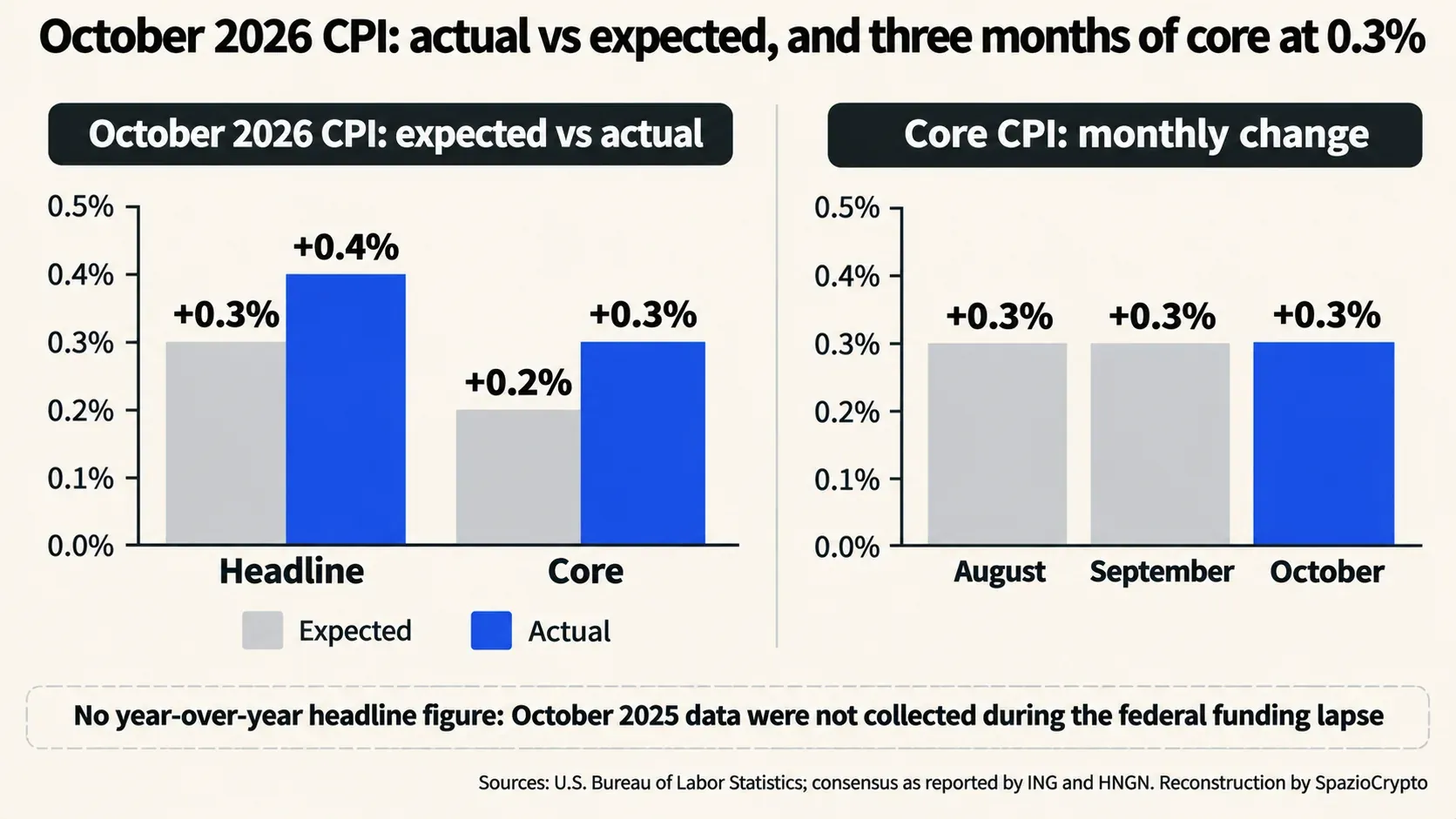
US consumer prices rose 0.4% in October compared to September, beating the 0.3% consensus forecast. The Bureau of Labor Statistics (BLS) published the report on November 10, and the number landed above expectations on both counts: core inflation, which strips out food and energy, climbed 0.3% for the third consecutive month, against a 0.2% estimate. Combined with pointed remarks from Fed officials, the October 2026 CPI print has markets treating a December rate hike as a near-certainty.
This analysis draws on the BLS release, plus commentary from ING, HNGN, and Startup Fortune. Because market-sensitive figures such as Treasury yields and rate-hike probabilities shift throughout the trading session, we present them as ranges rather than single-point estimates.
The Numbers: Headline at 0.4%, Core Posts Third Straight 0.3%
The seasonally adjusted headline CPI rose 0.4% in October, stepping down from the 0.6% posted in September. The core index matched its prior two months exactly: 0.3%, which the BLS noted was “the same increase as in September and August.” According to both HNGN and ING, economists had penciled in 0.3% headline and 0.2% core, so both came in one tenth of a percentage point above consensus.
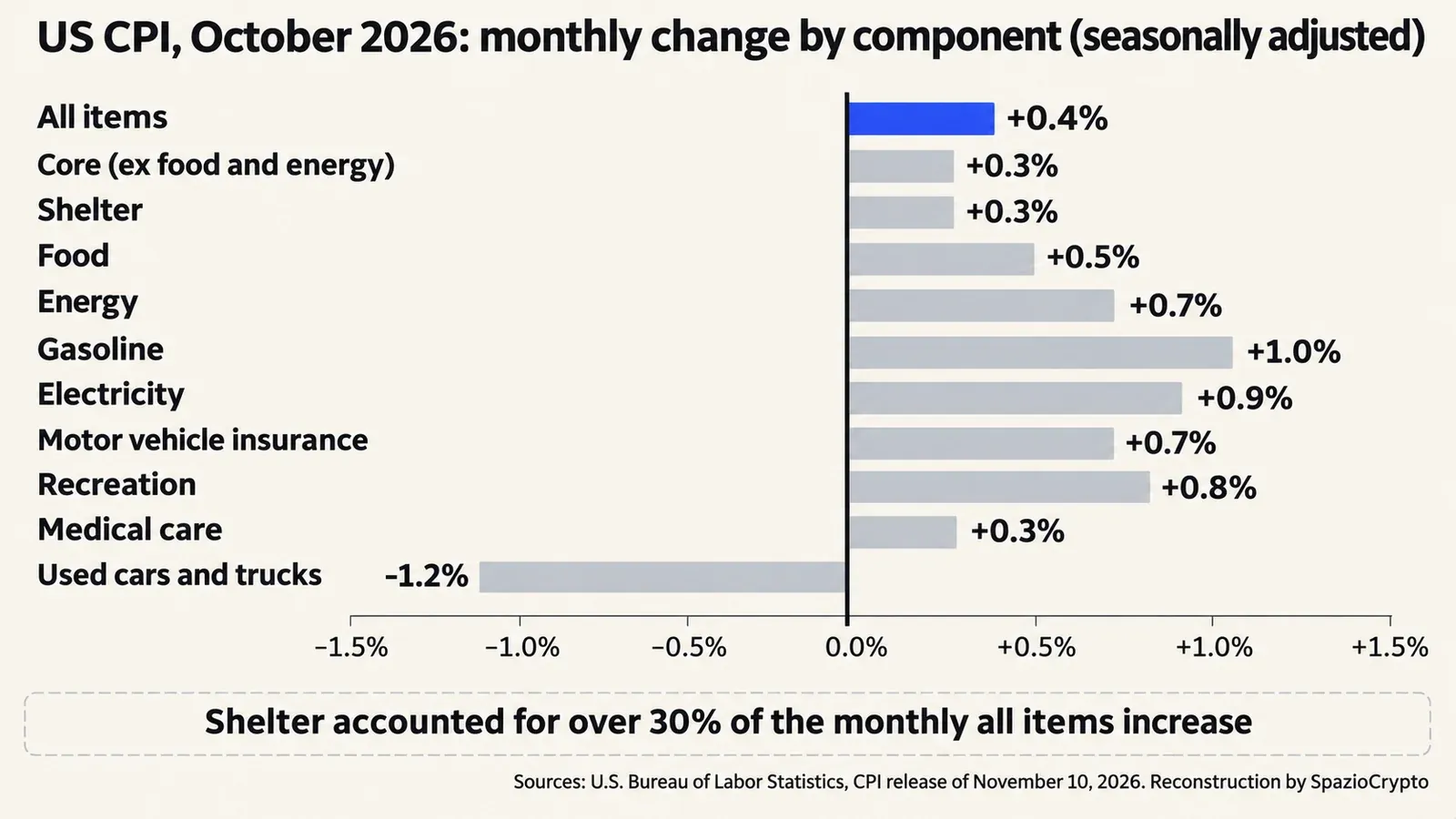
Shelter, the heaviest component in the basket, rose 0.3% and the BLS said it accounted for more than 30% of the total monthly increase. Food prices gained 0.5%, with groceries up 0.4% and dining out up 0.5%. Energy added 0.7%, a sharp deceleration from September’s 5.2% surge, with gasoline rising 1.0% on a seasonally adjusted basis. Used vehicles fell 1.2%. On the upside: medical care services (+0.3%), motor vehicle insurance (+0.7%), and recreation (+0.8%).
The Data Gap: No Annual Comparison Available
There is an unusual wrinkle in this release. The BLS did not publish the year-over-year change for the headline index because it was unable to collect survey data in October 2025 during the federal government shutdown. As the BLS release stated directly: “BLS cannot publish 12-month changes for October 2026 for indexes where October 2025 data are unavailable.” Markets are therefore working entirely from monthly movements.
Some series do carry an annual comparison on a non-seasonally adjusted basis: gasoline is up 37.4% from a year earlier, new vehicles are up 0.7%, and used vehicles are down 3.3%. The BLS release offers no explanation for why these indexes remained available while others did not. The next CPI report, covering November, is scheduled for December 10.
The Fed: December Decision Comes Into Focus
The print arrived on the heels of unusually direct Fed communication. According to HNGN, Fed Governor Christopher Waller said in London, before the release, that a 50-basis-point hike in December should be on the table if core inflation came in around 0.3%. It came in exactly there. After the data, Dallas Fed President Lorie Logan described the reading as higher than expected and, again per HNGN, indicated she sees the need for two additional quarter-point increases.
According to HNGN, the Fed’s target rate currently sits in a range of 3.75% to 4.00%, maintained at the October meeting by a 10-to-2 vote, with the next policy decision due December 9. ING wrote that the market is now fully pricing a 25-basis-point increase. Startup Fortune reported probabilities ranging from 84% to 90% for a quarter-point move and between 10% and 15% for a half-point, an outcome that was barely on the table before the October data dropped.
Markets: Ten-Year Treasury Yield Approaches 5%
US Treasuries repriced quickly. According to HNGN, the ten-year yield climbed to 4.93%; Startup Fortune placed it near 4.99%, with an intraday high of 5.01%, up from 4.88% the previous evening. The two-year yield, which tracks Fed expectations most closely, rose roughly 19 basis points to 4.74%, per Startup Fortune. ING noted that the selloff in bonds had already begun after Waller’s remarks, before the BLS number was even out.
This isn’t the first time the ten-year has approached that threshold this year. In September, SpazioCrypto covered how Bitcoin was navigating the Fed alongside 5% Treasury yields. Equity markets arrived at the October CPI already rattled, following the November 5 Nasdaq sell-off, the worst single session since April 2025. Higher rates typically weigh on risk assets, crypto included, and on inflows to Bitcoin ETFs.
The Bigger Picture: Energy Could Offer Relief in November
Not every signal points in the same direction. According to ING, hopes of a Middle East de-escalation are pulling energy costs lower, and retail gasoline has dropped below $4 per gallon for the first time since mid-July. If that trend holds, November’s headline inflation reading could soften. ING forecasts a 25-basis-point hike in December and no further moves in 2027, as weaker shelter costs, energy prices, and wage growth do more of the disinflation work.
The Fed isn’t the only central bank tightening. In Japan, the Bank of Japan’s board remains divided on the pace of further rate increases, as SpazioCrypto reported in coverage of the internal BoJ debate. Rates rising across multiple major economies also raise the cost of capital for stablecoin issuers investing their reserves, as illustrated by Circle’s Q3 2026 results.
What This Means for Crypto and Global Investors
For investors outside the United States, a Fed hike matters even when it doesn’t directly set local rates. A tighter Fed tends to strengthen the dollar and raise borrowing costs across global credit markets, with knock-on effects on equities, bonds, and crypto assets priced in dollars. Investors holding Bitcoin or US-listed ETFs from accounts in other currencies also carry exchange-rate exposure, which can amplify or cushion price moves in either direction.
Our read: the October print makes a volatile stretch between now and December 9 more likely, with two closely spaced catalysts on the horizon: the Fed’s rate decision itself, and the November CPI the following day. The practical takeaway for anyone tracking this from a non-US vantage point is to separate the data releases, which arrive on fixed schedules, from market reactions, which can easily overshoot the underlying numbers.
October 2026 US CPI at a Glance
What is confirmed, what is not
- Confirmed, per the BLS: headline CPI +0.4% month-on-month; core CPI +0.3% for the third consecutive month; shelter +0.3%, food +0.5%, energy +0.7%; year-over-year headline figure not published due to missing October 2025 data.
- Not specified: the year-over-year headline rate; the exact size of the December Fed move; single-point values for yields and hike probabilities, which vary by source and time of observation.
- To watch: the PCE index due late November; the Fed’s December 9 decision; the November CPI release on December 10.
The Larger Read
Our editorial view, stated plainly: October’s CPI matters more for its persistence than for its size. Three months in a row at 0.3% core tells a clear story: underlying price pressures aren’t easing, and the Fed appears willing to act even without a clean year-over-year comparison. The absence of an annual figure, itself a consequence of the 2025 government shutdown, makes monthly data more load-bearing than usual and market reactions more prone to overswing.
Three signals deserve close attention going into year-end. First, the PCE index, the Fed’s preferred inflation gauge, due late November: Dallas Fed President Logan has suggested it could tick higher. Second, the December 9 decision itself: the choice between 25 and 50 basis points will reveal how urgently the Fed wants to tighten. Third, the November CPI on December 10: a gasoline-driven softening there could meaningfully shift the tone heading into 2027 policy discussions.