

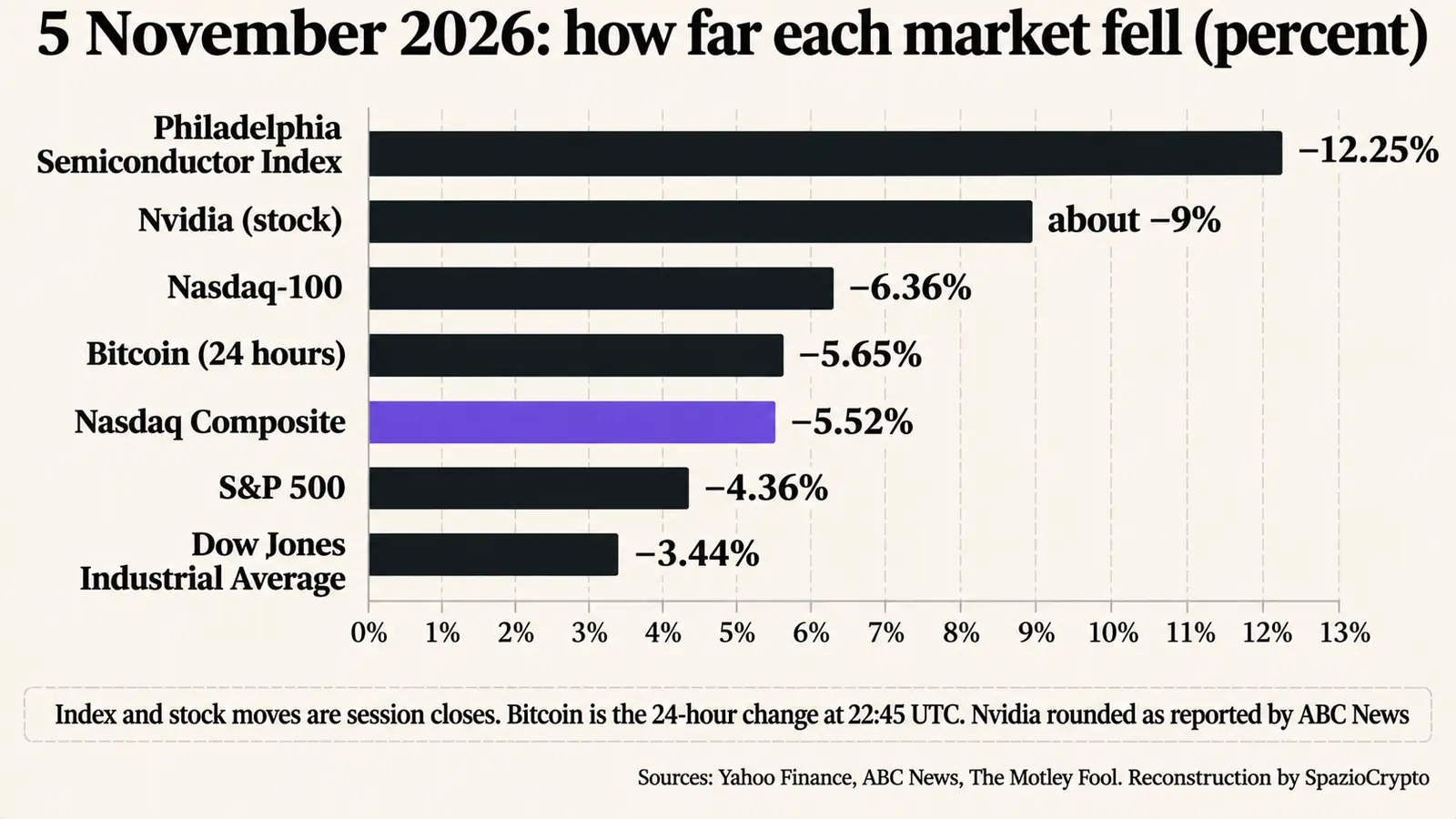
Thursday, November 5, 2026 handed Wall Street its worst session in over a year. The Nasdaq Composite fell 5.52%, the S&P 500 dropped 4.36%, and the Dow Jones lost 3.44%, equivalent to 1,833 points. Semiconductor stocks and AI-linked equities led the selloff, with Nvidia down roughly 9%, according to ABC News. The November 2026 Nasdaq crash pushed the index into correction territory, more than 10% below its peak, erasing in a single session all the gains that had followed the midterm vote.
This report draws on live coverage from Yahoo Finance, ABC News, The National, CoinDesk, CoinCentral, TokenPost, and IBTimes, plus European open reporting from Alanews and QuiFinanza. Reuters and Associated Press sources referenced in the original brief were not accessible with our tools and have not been reproduced.
The Numbers From the Session
The Nasdaq-100 shed 6.36%, its worst single day since March 2020 according to IBTimes, and according to Yahoo Finance wiped out $2.3 trillion in market value. The Philadelphia Semiconductor Index closed at 9,011.14 points, down 12.25%. The Dow Jones finished at 51,523.06. The VIX volatility index closed near 28, a jump of roughly 70%, per IBTimes. The 10-year Treasury yield fell to 4.84%, according to TokenPost, and gold climbed to $4,094 per ounce, according to CoinDesk.
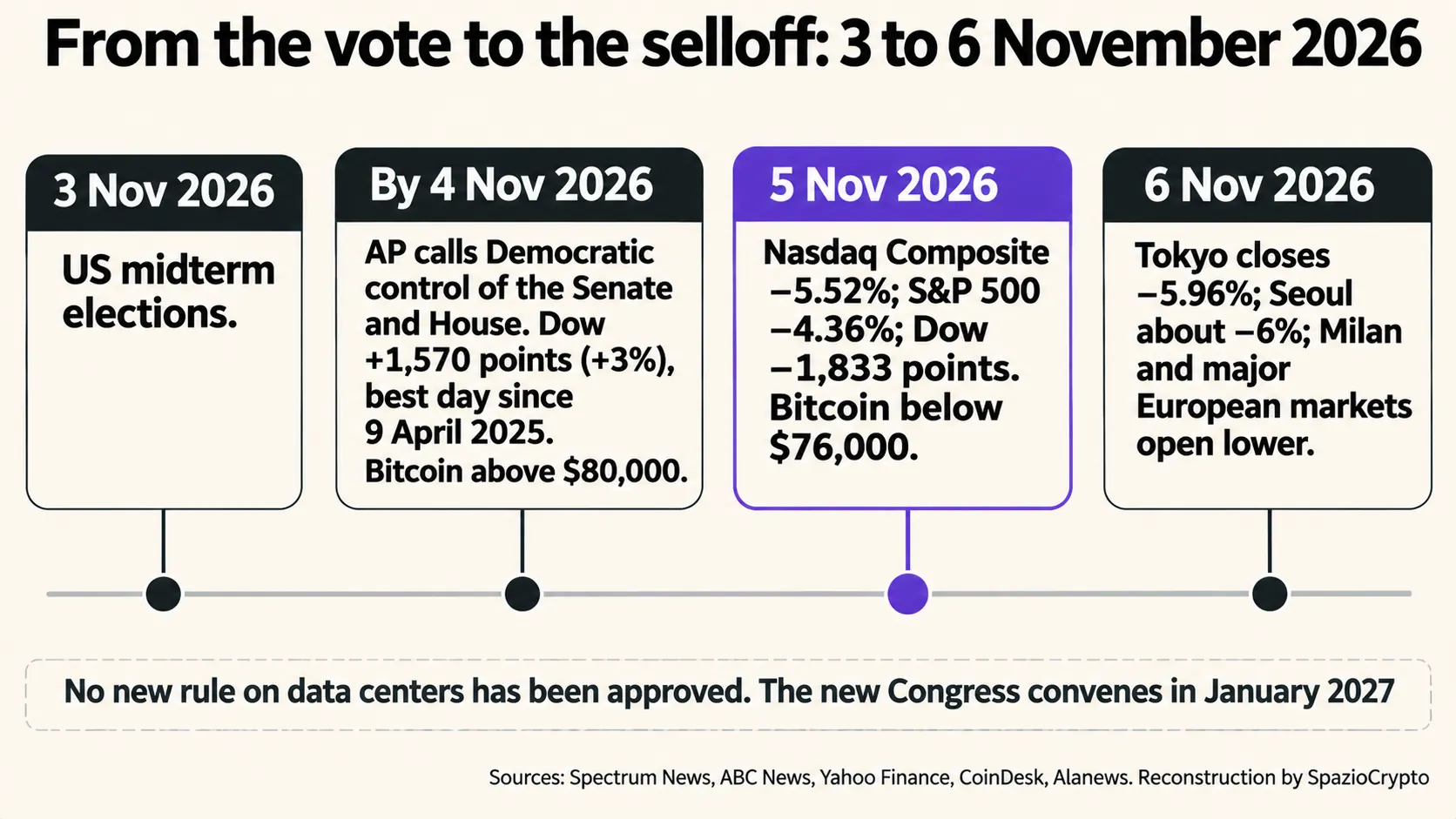
One number captures the speed of the reversal. On November 4, the Dow had gained 1,570 points, up 3%, its best session since April 9, 2025, according to ABC News. Twenty-four hours later, every point of that gain had vanished. According to CoinCentral, the Nasdaq Composite now sits nearly 12% below its October 6 closing record, past the 10% threshold that defines a correction but still well short of the 20% that marks a bear market.
The $3 Trillion Figure: Handle With Care
A widely circulated claim puts S&P 500 losses at around $3 trillion for the day. That figure lacks a clearly declared data source. TokenPost writes that the selloff erased nearly $3 trillion from index companies at the intraday low, not at the closing bell. IBTimes cites roughly $3 trillion without naming a calculation methodology. Alanews puts the figure at approximately $3.2 trillion lost in a single session, without specifying which index perimeter was used.
Estimates for the Nasdaq-100 are lower but more precise: $2.3 trillion according to Yahoo Finance, $2.5 trillion per CoinCentral. These are different measures, reflecting different indices, different timestamps, and different methodologies, so they cannot simply be added together. Market capitalization is always price multiplied by shares outstanding, changing with every trade, the same mechanism we explain in our guide on how to read crypto market cap.
Chips and AI at the Center of the Selloff
Nvidia closed down roughly 9% according to ABC News, and down 9.26% to $181.60 according to Giocare in Borsa. AMD fell 17%, SanDisk lost more than 22%. Among major cloud operators the damage was more contained: Microsoft dropped 3.6%, Amazon and Alphabet each shed 2.2%, per CoinCentral. CoreWeave gave up 10% and Nebius fell 15%. CoreWeave's five-year credit default swaps hit a record 1,267.9 basis points, according to S&P Global Market Intelligence as cited by CoinCentral.
Not all of the pressure came from Washington. Qualcomm, according to IBTimes, reported that smartphone chip revenue fell 26% to $5.14 billion and issued weak guidance for the next quarter. Charlie McElligott of Nomura, quoted by Yahoo Finance, described hedge funds locking in 2026 gains: “they are shooting the generals.” The AI trade had extended deep into traditional finance, as we documented in our piece on how banks and insurers have invested in AI.
The Vote and the Data Centers
According to Spectrum News, the Associated Press called control of both the Senate and House for the Democrats following the November 3 vote. Many Democratic candidates had campaigned against AI data centers, ABC News reports. The National notes that investors are now weighing the risk of tighter regulatory scrutiny and new permitting rules around data center construction. Dan Ives of Yorkville called the result “a seismic shift,” one he expects to slow AI construction projects across the United States.
CoinCentral gathered the market signals. Senator Bernie Sanders called for a national moratorium on data centers. Sherrod Brown, elected in Ohio, said in his victory speech “I don't work for the data centers.” According to a CNBC poll cited by CoinCentral, 56% of voters identified AI and data centers as a decisive or significant factor in their choice. UBS estimates that roughly 30% of the additional capacity projected for 2028 could face construction delays.
The vote alone does not explain everything. Jasper De Maere of Wintermute, quoted by CoinDesk, also tied the selloff to disappointing AI growth data and elevated investor leverage. No new data center regulation has been passed, and the new Congress does not take office until January 2027. The market priced a risk, not a law.
Bitcoin Offers No Safe Haven
Bitcoin fell 5.65% in 24 hours to $75,880, according to The Motley Fool as cited by Yahoo Finance, after having cleared $80,000 on November 4. Ether gave up 7.8%. According to CoinDesk, citing CoinGlass data, more than $1 billion in crypto derivatives positions were liquidated in 24 hours, the majority of them long bets. In the three sessions before November 4, The Motley Fool reports, spot bitcoin ETFs had already seen net outflows exceeding $1.1 billion.
Crypto-linked equities tracked the Nasdaq lower. By mid-morning, according to CoinDesk, Coinbase was down 7.8%, Strategy off 8.3%, and Circle down 10%. Circle is the company expanding USDC into 40 emerging markets. We have also written about Coinbase and USDC in the context of the Noble network on Cosmos. On November 5, in trading, risk dominated every other consideration.
The hardest blow landed on miners that had repositioned as AI compute providers. IREN and Cipher each lost more than 14%, according to CoinCentral and CoinDesk: they carry exposure to both bitcoin and data centers simultaneously. Stablecoins held near $1.00, according to The Motley Fool, and the choice between issuers remains what we cover in our comparison of USDT versus USDC.
Europe Opens Lower on November 6
The shockwave reached Europe when markets opened on November 6. According to Alanews, the FTSE MIB opened down 1.68%, while QuiFinanza had it at -0.97% at 9:04 a.m. Frankfurt, London, and Paris all opened between 1.4% and 1.7% lower. Nexi was Milan's worst performer at 9:23 a.m., down 3.21%. The BTP-Bund spread widened to 111 basis points from 104 the day before. Tokyo, per Alanews, closed at -5.96%, and Seoul lost around 6%.
Milan's opening decline was more modest than Asia's. Our reading is that the session underscores how much of the AI supply chain sits outside Europe, the same imbalance we described in our piece on European finance's dependence on foreign AI. For investors based in Europe, exposure to the Nasdaq typically runs through funds, ETFs, or U.S.-listed equities.
November 5 on Wall Street: What's Confirmed, What Isn't
What holds up under scrutiny, and what doesn't
- Confirmed: Nasdaq -5.52%, S&P 500 -4.36%, Dow Jones -3.44%, semiconductors -12.25%, Nasdaq in correction, Nvidia down roughly 9%, bitcoin below $76,000.
- Unconfirmed: the source of the roughly $3 trillion wiped from the S&P 500; how much of the decline is directly attributable to the vote; any data center regulation already enacted.
- To watch: data center proposals from the new Congress from January 2027 onward; bitcoin ETF flows; the Nasdaq's distance from both its record high and the 20% bear-market threshold.
The Bigger Picture
Our editorial read, stated as such: on November 5, the market priced political risk on the physical infrastructure of AI, meaning land, energy, and permits, not just on valuations. For crypto, the link to AI runs through miners hosting compute workloads. On a day like this, those miners carry two risks at once: bitcoin's price direction and data center policy.
Four concrete signals are worth watching. First, whether the new Congress translates anti-data-center campaign positions into actual legislation after January 2027. Second, whether UBS's estimate of 30% capacity delays gets confirmed or revised downward. Third, whether the Nasdaq stays in correction or drifts toward the 20% decline from its October 6 record. Fourth, whether outflows from spot bitcoin ETFs resume at scale.