
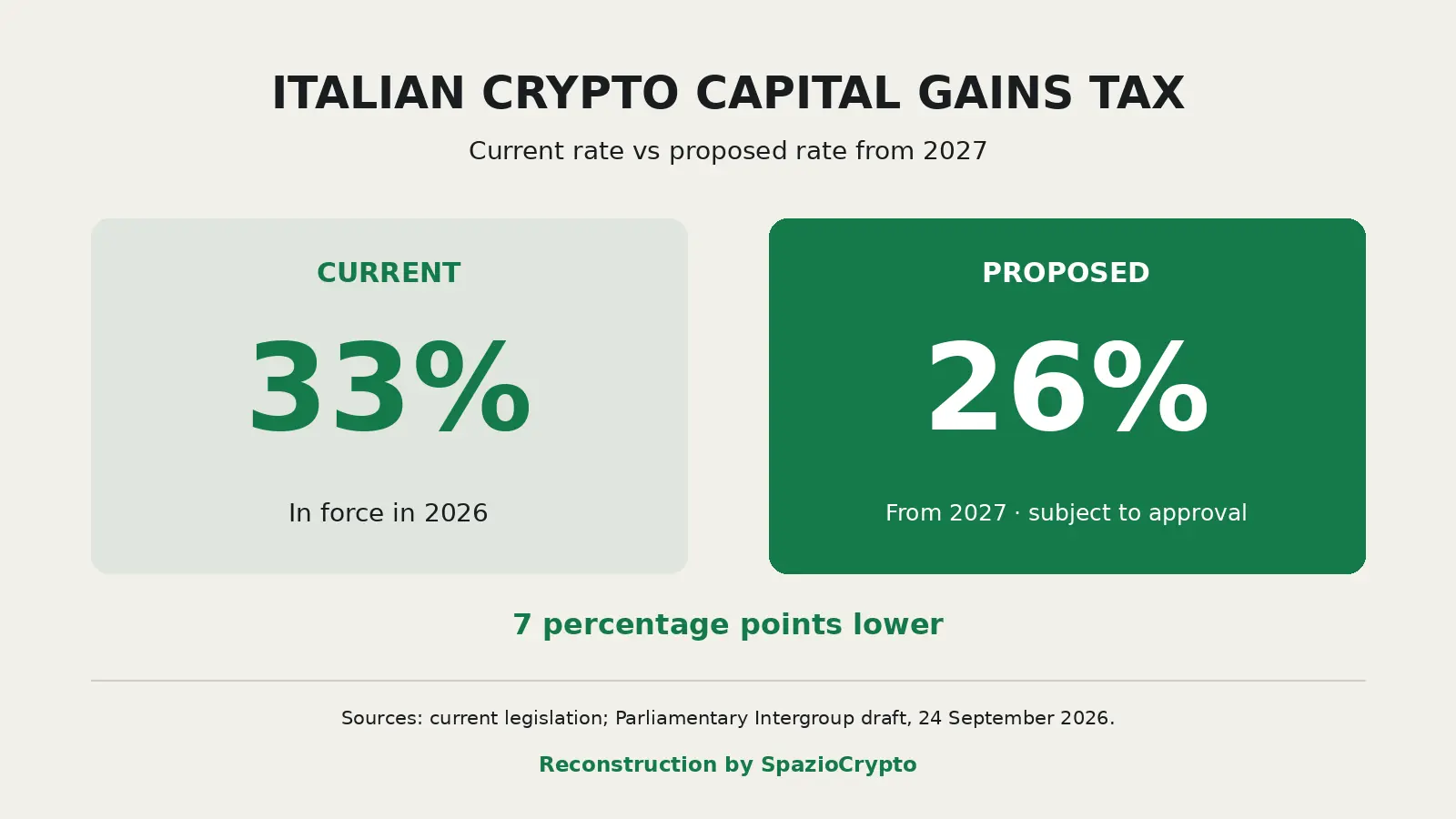
A technical draft emerged today at Italy's Chamber of Deputies that, if enacted, would cut the crypto capital gains tax rate from 33% to 26% starting in 2027. The proposal was presented at the General Assembly of the Parliamentary Intergroup on Digital Assets, Blockchain and Bitcoin, during a full-day working session we covered in our previous analysis. The story of a potential crypto tax cut to 26% from 2027 deserves precise handling, because oversimplification would do a disservice to the facts.


One thing must be stated clearly from the outset: no law was passed today. No formal legislative proposal has been filed. What was presented is a technical draft, developed by one of the Intergroup's fourteen working groups. The Intergroup's own official statement describes it as still requiring verification with parliamentary offices, relevant ministries. Competent administrations before it can become a genuine legislative initiative. Here is exactly what the draft proposes, and the context in which it was presented.
What the Technical Draft Proposes
The working group on digital asset taxation, coordinated by academic and industry figure Ferdinando Ametrano, presented its findings today within the broader Intergroup proceedings. According to the Intergroup's published materials, the technical draft contains four main measures: a return of the crypto capital gains tax rate to 26% from 2027, down from the current 33% rate in force since 2026; the deductibility of costs incurred in conducting transactions; the ability to offset crypto losses against gains from other financial instruments, such as equities and bonds, which current Italian law does not permit; and an annual step-up option for the cost basis of held crypto assets, applied through a substitute tax.
This is not the first time Ametrano has pushed this position publicly. Back in November 2025, during parliamentary debate on the 2026 budget law, he argued publicly for a nearly identical proposal, stressing the need to correct what he called a structural inconsistency in the current framework, one that penalises crypto savings relative to other asset classes without justification. Today's draft is therefore the continuation of a long-running campaign, this time channelled through the more formal structure of the Parliamentary Intergroup.
The Context: A Full Day of Work, Not a Single Announcement
As we reported in our analysis published a few days ago, today's event, titled “Digital Finance, Markets and Monetary Sovereignty: Bitcoin, Blockchain and Tokenisation, a Strategy for Italy”, ran from 10 a.m. to 5:30 p.m. in the Parliamentary Groups Chamber at the Camera, with a total of 164 participants including the 35 members of the Technical Panel and representatives from all fourteen thematic working groups. The taxation proposal is therefore only one of several findings from a much broader day of work that also covered cybersecurity, tokenisation, stablecoins and anti-money laundering.

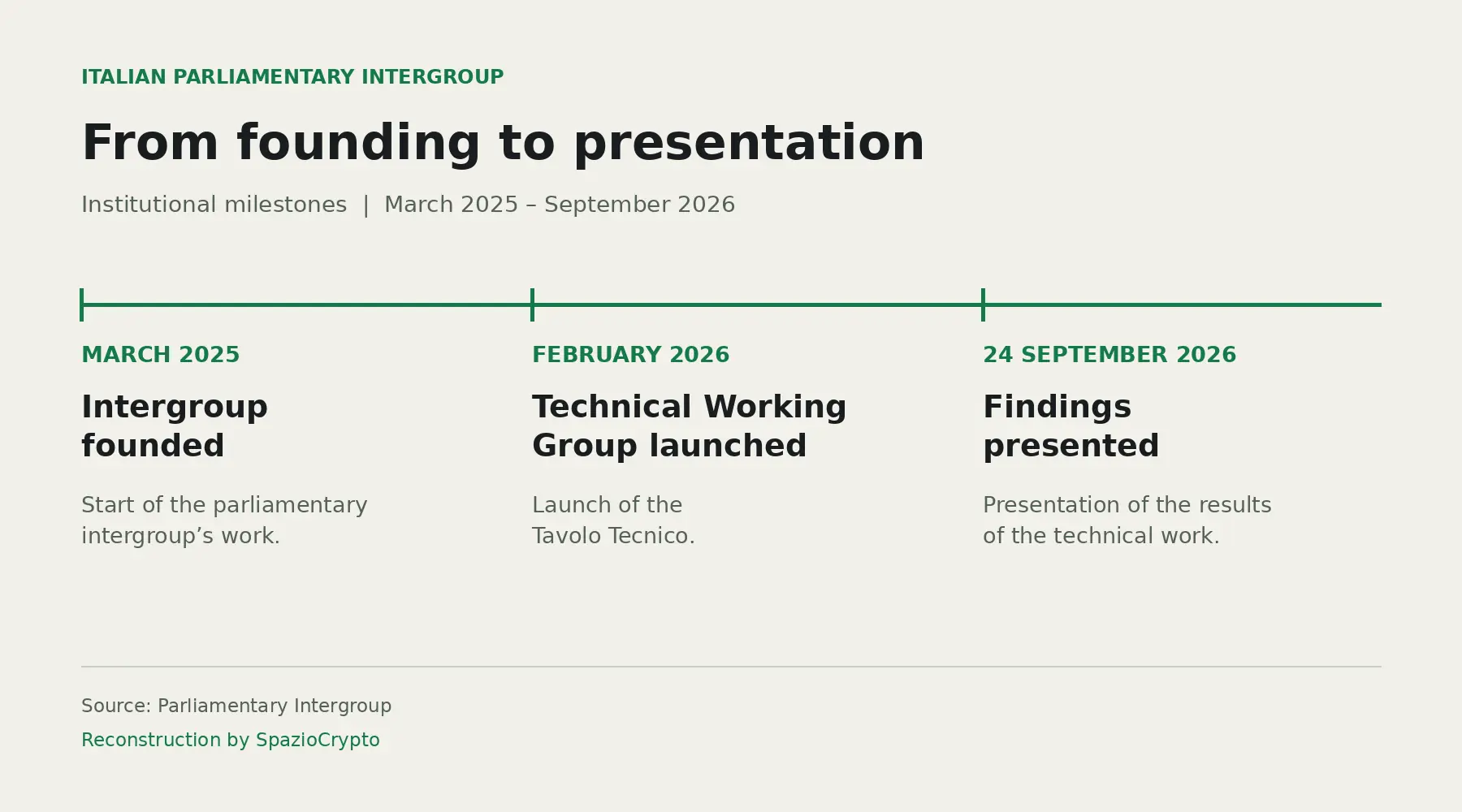
The morning opened with institutional remarks from MP Marcello Coppo, the Intergroup's president and the figure responsible for launching the entire process back in 2025. Scientific coordination of the Technical Panel's work falls to Antonio Annino, while the day's organisation and moderation were handled by Gabriele Del Mese. Among the fourteen thematic group coordinators who presented their findings, alongside Ametrano for taxation, was Roberto Garavaglia, an independent consultant and digital payments specialist, who publicly confirmed his participation as the lead of one of the Intergroup's thematic groups. Each coordinator presented the conclusions from their respective area of expertise, spanning cybersecurity through to tokenisation, collectively forming the overall picture to emerge from the day.
One passage in the afternoon's official Intergroup statement stands out: some of today's findings are considered sufficiently mature to begin a first round of institutional dialogue, while others still require further technical validation. The statement does not specify which proposals fall into which category, so it's not possible to say with certainty that the taxation proposal is already ready for government engagement, though its relatively concrete and detailed nature makes it a plausible candidate.
The Draft at a Glance
What it proposes, and what it is not. Source: Parliamentary Intergroup, CheckSig, September 24, 2026
- What it proposes: 26% rate from 2027, cost deductibility, loss offsetting against other financial instruments.
- What it is NOT: not an enacted law, not a formally filed legislative proposal.
- Next step: formal review by parliamentary offices, ministries, and relevant public authorities.
Why this matters directly for Italian crypto holders
This is precisely what sets today’s proposal apart from a generic parliamentary debate on blockchain: it hits directly at the wallet of anyone holding crypto assets in Italy. Current law raises the substitute tax on crypto capital gains to 33% starting in 2026, per the Italian Budget Law, while preserving a separate 26% rate for certain euro-denominated instruments linked to electronic money. A unified 26% flat rate, if actually enacted, would meaningfully cut the tax burden compared to where things stand today.
Among the rationales the working group presented today to justify the reform, as reported at the session, is a pointed comparison: under the current framework, directly held Bitcoin and exchange-traded products that replicate its price on regulated exchanges can end up facing different tax treatment despite representing, in substance, the same economic exposure. That asymmetry is one of the core arguments the group uses to push for regulatory alignment between the two instruments. On the question of cross-asset loss offsetting, it’s worth spelling out the current constraint: Italian law today applies a “closed-compartment” rule, meaning crypto losses can only offset gains from the same asset category, not from equities or bonds. The draft presented today explicitly targets that restriction.
The bigger picture
Whatever the final outcome, this episode confirms something already visible during the Intergroup’s working session: for the first time, Italy is attempting to build its own independent position on crypto policy, rather than simply transposing European rules. Taxation, in particular, is an area where national governments retain significant legislative room outside EU directives, and that autonomy is exactly what gives this proposal its potential weight in the weeks ahead.
Two observations stand out for anyone following this closely. First, the fact that Ferdinando Ametrano, who has been making this case publicly for at least a year, managed to bring it into the structured process of a parliamentary intergroup with 35 technical members and 14 working groups represents a genuine leap in institutional credibility, well beyond a standard industry lobbying request. Second, none of this should be confused with an approval, even if the subject touches on the real financial interests of crypto holders across Italy. SpazioCrypto will track developments and update this piece as soon as the proposal is formally filed or submitted to Parliament. For essential background on the underlying tax context, our guide on what cryptocurrencies are remains a useful starting point.