
Global stablecoins pose risks that no single national authority can fully assess on its own. That is the core message the Financial Stability Board delivered to G20 finance ministers and central bank governors ahead of the October 15 meeting in Bangkok. On October 12, the FSB published a note on the cross-border risks of stablecoins, accompanied by a letter from its chair Andrew Bailey, governor of the Bank of England. The document introduces no bans or immediate obligations: it is a non-binding analysis that identifies where oversight currently falls short and what would be needed to close the gap.
We reviewed the note and the letter in their original texts, alongside the FSB’s press release and the prior documents they reference. No official videos or dedicated posts on X or LinkedIn were found for this report. The note does not name specific issuers or their market shares, and we have not added any here.

What the FSB Says
The starting point is structural. A stablecoin used across multiple countries can involve a wide range of actors, from the issuer to reserve managers to the underlying infrastructure, each supervised by a different national authority. For that reason, the FSB writes, global stablecoins are “inherently cross-border and cross-sectoral” by nature, and a single authority acting alone may struggle to assess and address risks that cross jurisdictional lines. According to FSB data in the note, the total value of stablecoins stood at around $300 billion at mid-2026, broadly unchanged from a year earlier, with approximately 99% pegged to the US dollar. Today they primarily serve as liquidity for crypto-asset markets, though the FSB flags potential future use in payments and as a store of value.
In his letter, Bailey adds that national regulatory frameworks are advancing at different speeds, that cross-border cooperation is still in its early stages, and that fraud and financial crime linked to structures operating from lightly regulated jurisdictions are a growing concern.
How a Shock Spreads Across Borders
The note maps the transmission channels in detail. Stablecoins trade on secondary markets around the clock, and during a stress event that continuous trading can accelerate sell-offs. If redemptions cannot keep pace with demand, the peg breaks. Contagion to traditional finance can travel through three channels: forced sales of reserve assets, bank deposit withdrawals to fund redemptions, and foreign exchange markets where stablecoins are used for international payments.
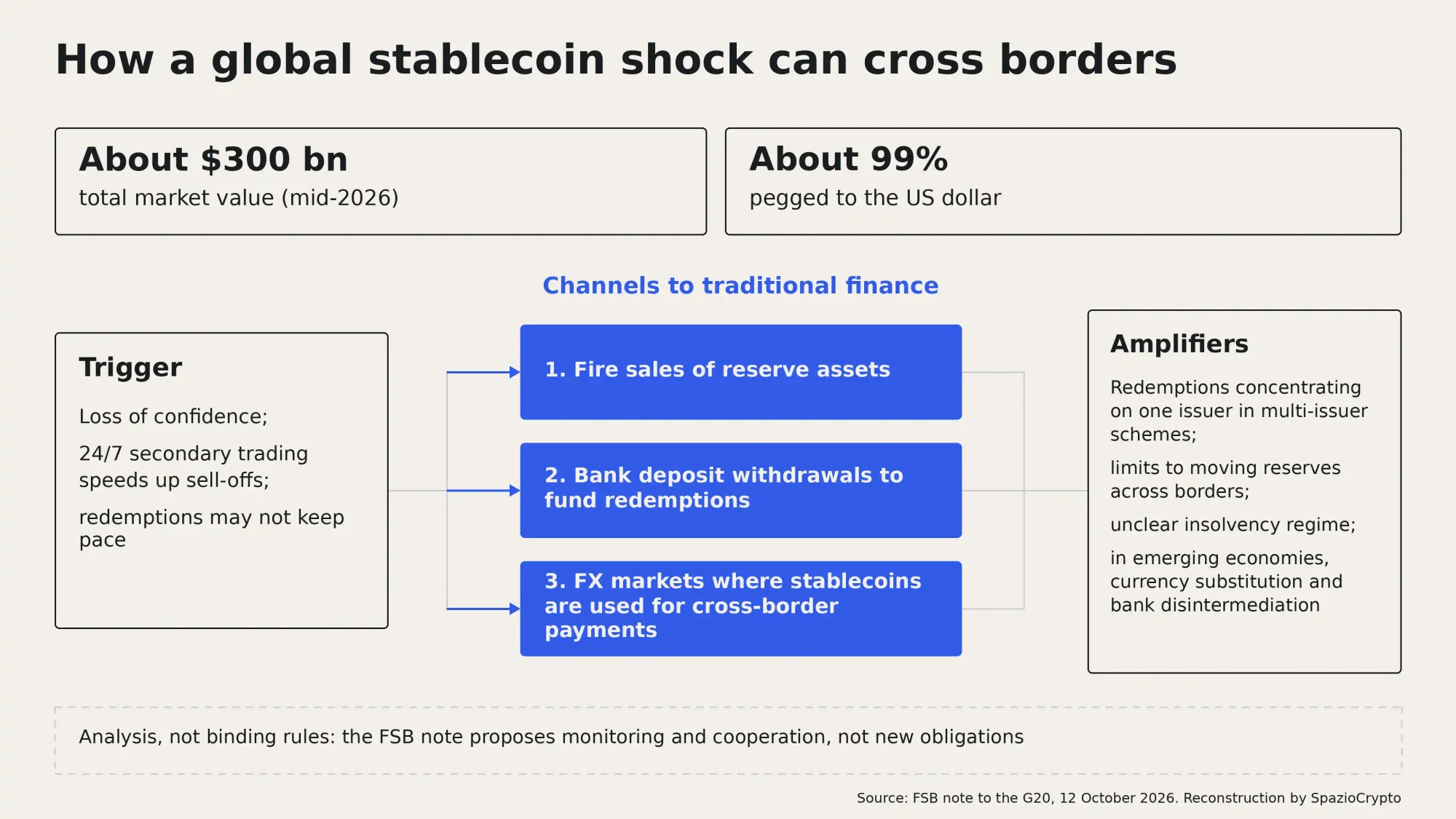
Global structures come with their own amplifiers. In multi-issuer arrangements, where affiliated entities share responsibility for the same stablecoin but hold reserves separately, holders can request redemption from any entity, and demand may concentrate on just one. Moving reserves between countries depends on market conditions, access, and coordination. Complex corporate structures headquartered in lightly regulated jurisdictions create arbitrage opportunities, and it may be unclear which insolvency regime applies. In emerging economies, currency substitution, bank disintermediation, and capital flow management can make stablecoins systemically significant even at relatively modest levels of adoption. This is the same concern the Swiss National Bank has raised about the integrity of bank credit and monetary policy as cross-border use grows, a pattern also visible in Nubank’s integration of USDC and EURC into its global account offering.
The Data Gap
The second major theme of the note is what supervisors can actually see. Stablecoin transactions generate vast amounts of data, but public blockchains are pseudonymous: attributing activity to specific users or countries is often impossible and, when it is possible, not always verifiable. Authorities rely mainly on private data providers whose methodologies are proprietary and inconsistent with each other, raising comparability and credibility issues. Analysing this data properly requires specialist expertise that represents a significant challenge for some countries, emerging economies in particular. Among the indicators the FSB says should be monitored: the depth and liquidity of secondary markets, and the geographic distribution of holdings, redemptions, and reserves, especially in multi-issuer arrangements.
What the FSB Proposes, and What It Does Not
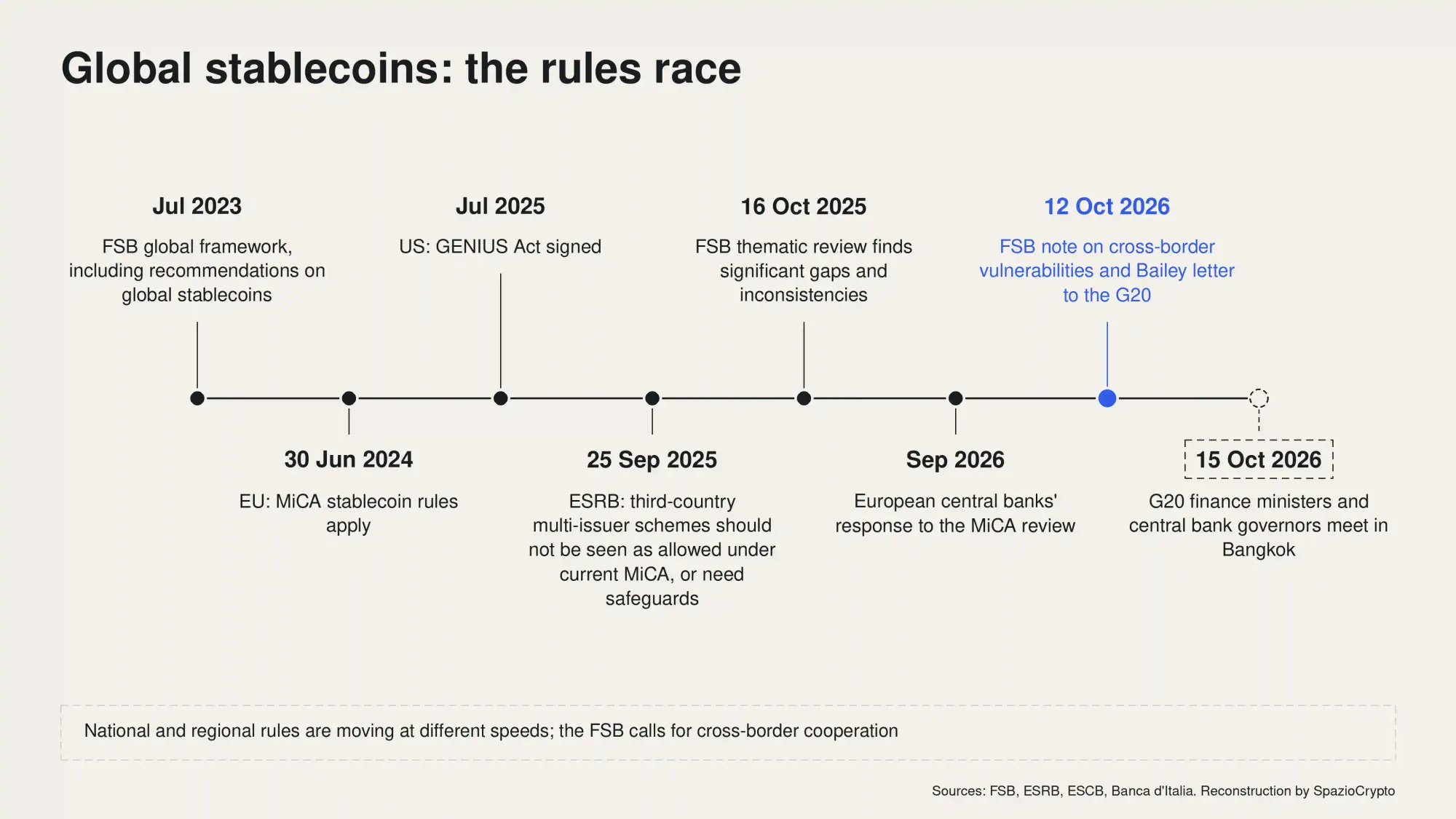
Bailey’s letter sets out four workstreams: strengthening monitoring of cross-border vulnerabilities, supporting implementation of the FSB’s 2023 recommendations on global stablecoins, improving cooperation and information sharing between authorities, and gathering information on how to plan for crisis or failure scenarios with a cross-border dimension. Bailey states that the interaction between different national regulatory frameworks “remains uncertain or undefined” in many jurisdictions, including the treatment of stablecoins issued abroad, and that mechanisms for managing a cross-border crisis are immature. His call is for rules that carry a clear financial stability objective and work coherently at the international level.
None of these steps are binding. Like all FSB output, the note creates no rights or obligations. The broader framework is the FSB’s July 2023 recommendations and the October 2025 thematic review, which found “significant gaps and inconsistencies” in implementation, particularly on stablecoins. The note is part of a package of documents requested by the US presidency of the G20, which also covers artificial intelligence and bank crisis management.
What This Means for Europe and MiCA
In Europe, MiCA’s stablecoin rules have applied since June 30, 2024, but the concern the FSB raises hits a genuine weak point: arrangements in which the same stablecoin is issued both inside and outside the EU by affiliated entities. On September 25, 2025, the European Systemic Risk Board recommended to the European Commission that such arrangements should not be treated as permitted under current MiCA, and proposed alternatives including an equivalence regime with third countries, cooperation agreements, and verification of reserve mobility. In September 2026, the European System of Central Banks, in its response to the MiCA review consultation, called for legal clarity on these arrangements, endorsed the ESRB’s recommendations, and proposed assessing the global-scale relevance of stablecoins, in addition to removing the requirement that 60% of reserves be held in bank deposits.
The FSB's paragraph on multi-issuer arrangements is, in our reading, the global version of this European debate: the same digital currency, reserves held across different countries, and the risk that redemption pressure concentrates on one side. In the United States, the governing framework is the GENIUS Act, signed in July 2025, with the Fed currently drafting rules for bank issuers; the treatment of foreign-issued stablecoins, which Bailey flagged as unresolved, is precisely the fault line where regulatory regimes need to converge. The Bank of Italy has also flagged the divergence between the two models, pointing to risks for bank deposits.
The FSB Note at a Glance
What is confirmed, what is not
- Confirmed: the note and cover letter dated 12 October, prepared for the G20 meeting of 15 October in Bangkok; a market of approximately $300 billion at mid-2026 per FSB data, 99% denominated in dollars; three contagion channels and four workstreams; no binding legal effect.
- Not specified: new rules or deadlines; market shares for individual issuers; a numbered list of indicators.
- Watch for: the G20 communiqué of 15 October, the MiCA review on multi-issuer schemes, U.S. rules on foreign-issued stablecoins, and FSB work on cross-border crisis management.
The Bigger Picture
A global stablecoin today is almost always a dollar stablecoin: 99% of the market fits that description, as the FSB's October 2026 note confirms. For Europe, the challenge is therefore twofold, covering both supervisory capacity and monetary sovereignty, and the FSB note brings the debate back to the level where decisions actually get made: cooperation among authorities that share neither the same data nor the same rulebook. With the market holding steady around $300 billion for roughly a year per FSB figures, regulation still has a chance to get ahead of the next growth wave rather than chase it.
The signals worth tracking are specific. Will the G20 finance ministers and central bank governors pick up the FSB's framing in their 15 October communiqué? How will the European Commission resolve the multi-issuer puzzle in the MiCA review? How will the United States treat stablecoins issued abroad under the GENIUS Act framework? And what will the FSB's cross-border crisis management workstream actually produce? Until those pieces fit together, oversight of a genuinely global instrument remains a patchwork of national vantage points.