

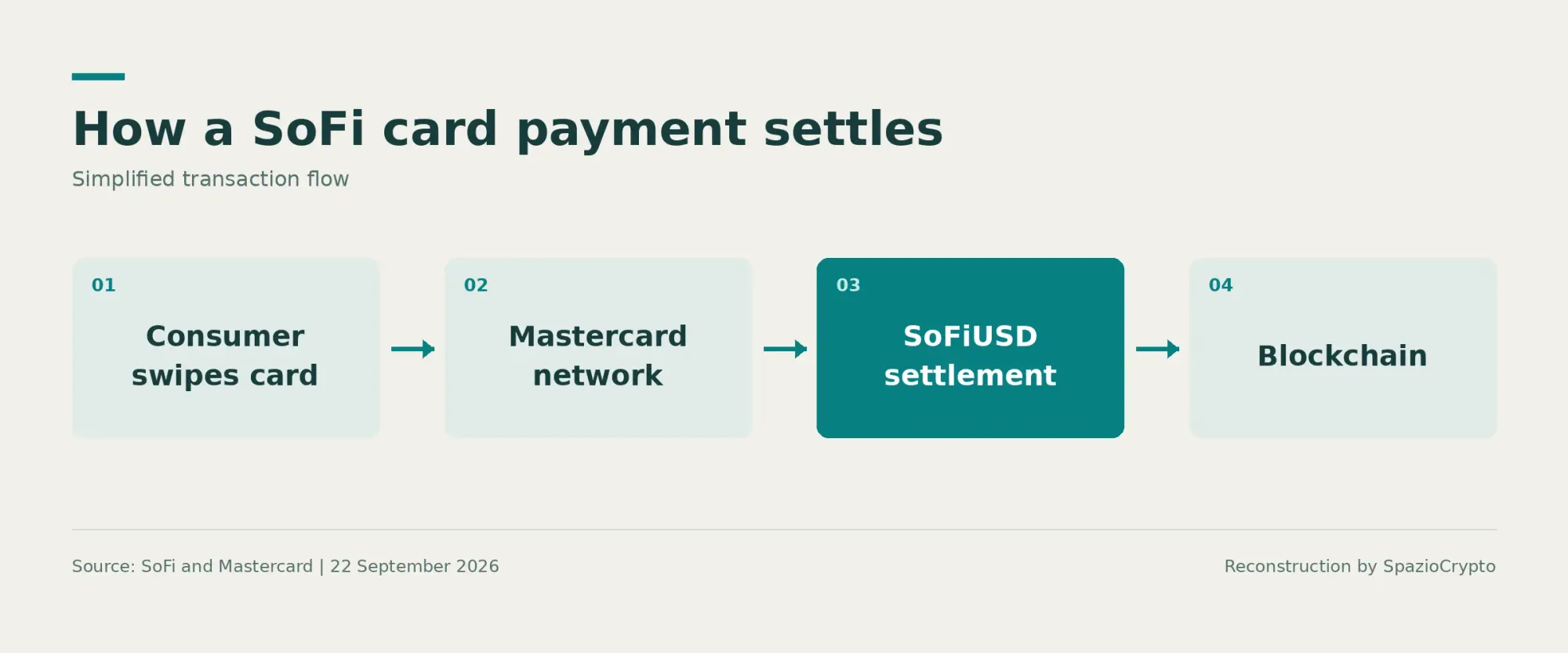
SoFi Bank has gone live, with real money, with settlement in its own SoFiUSD stablecoin for its entire debit and credit card program on the Mastercard network. The announcement, made jointly by the two companies on September 22, covers a program expected to process more than twenty-five billion dollars in annualized volume. That makes SoFi the first US bank with a national bank charter to use its own stablecoin to settle a card program at Mastercard scale. This SoFi SoFiUSD Mastercard news shows how stablecoins can slot into payment infrastructure that already exists, rather than building a parallel one.
The heart of the story, the thing that sets it apart from a routine technical announcement, is the sequence it describes: consumers keep paying with what looks like a completely ordinary card, the transaction runs over the Mastercard network, but the underlying settlement happens in SoFiUSD, directly on the blockchain. Here is how it works in detail, and why the news fits neatly with what other markets saw over the same period.
 SoFi

How it works in practice
SoFiUSD is a stablecoin pegged one-to-one to the dollar, backed mainly by cash reserves, and it is the first stablecoin issued by a bank holding a national bank charter in the United States. The agreement with Mastercard, first announced in March, went live in September: transactions are now actually settled on the blockchain. One interesting technical detail is that SoFiUSD runs on several public blockchains, including Ethereum.
The most significant aspect from a user-experience standpoint is that merchants do not need to hold SoFiUSD or change their existing payment systems to benefit from the new setup. Through SoFi's business banking platform, merchants with an account at the bank can receive settlement funds instantly and withdraw them as cash at any time, at no extra cost. As SoFi's chief executive summed it up, this means businesses get faster access to their money thanks to the speed of the blockchain, while keeping the safeguards that come with a regulated bank.
Beyond its own program: the ambition to become infrastructure for other banks
One part of the plan makes this news even more interesting than it first appears, and it reaches beyond SoFi's own card program. The company plans to offer the same stablecoin settlement option to other banks through Galileo, its banking services platform, extending the service well past the boundaries of its direct card program. If that plan materializes, SoFiUSD could go from a simple internal tool to full-fledged settlement infrastructure offered to third parties, a sizable leap in ambition.
A Mastercard executive in charge of digital commercialization described the launch as the shift from exploration to concrete implementation, stressing that stablecoins only become truly relevant when they solve real problems companies face every day, while preserving the trust, scale and protections of Mastercard's infrastructure. SoFi shares reacted positively to the news, rising a few percentage points in the session of the announcement.
The launch at a glance
What it involves. Source: SoFi, Mastercard, September 22, 2026
- Scale: more than $25 billion in annualized card volume.
- For merchants: no changes required, instant funds that can be withdrawn 24/7.
- The ambition: offering the service to other banks through the Galileo platform.
Two different architectures, two different markets
This is where the news becomes especially interesting when read alongside what happened in another market over the same period. Only a few hours earlier, as we reported in our piece on the British banks, a group of major UK institutions had completed the first interbank transactions using tokenized bank deposits, an instrument that keeps exactly the same legal status as an ordinary deposit in a current account. SoFi, by contrast, took a different route: issuing its own regulated stablecoin directly, legally distinct from a plain bank deposit, though still issued by a supervised banking entity.
Two markets, then, are testing two different architectures side by side to bring bank money onto the blockchain: in the United Kingdom, banks prefer to tokenize the existing deposit directly; in the United States, SoFi opts instead for a bank stablecoin issued for the purpose. Both approaches are ultimately aiming at the same underlying goal, one we had already identified when analyzing Nubank's launch of Nu Global and the launch of World Money: making the underlying blockchain progressively invisible to the end user, who simply keeps seeing a balance, a payment, a card.
The bigger picture
This launch strongly confirms a trend we have been seeing again and again in recent weeks: stablecoins are ceasing to be a separate, recognizable product for the end user and are increasingly becoming the invisible infrastructure behind payment experiences people already know. Whether it is a digital bank account, an identity app turned into a financial tool or, as in this case, a perfectly ordinary credit and debit card program, the end result for the person paying stays the same: no noticeable difference, even though a technology completely different from the traditional one is running under the hood.
For observers, the lesson is twofold. On one hand, this case shows that mass adoption of stablecoins will probably come precisely through this kind of quiet integration into existing, widely used infrastructure, rather than through building entirely new, parallel payment networks. On the other, SoFi's plan to extend the service to other banks through its own technology platform suggests we may be only at the start of a phase in which stablecoin settlement becomes an infrastructure service that a handful of specialized firms offer to many other financial institutions, a model to watch closely in the coming months. To better understand these instruments, our guide on what stablecoins are remains a useful starting point.