

CleanSpark signed a 20-year contract for a data center in Sandersville, Georgia, and raised billions to build it. Yet in fiscal year 2026, the segment designed to host artificial intelligence workloads recorded zero revenue and zero profit. CleanSpark's FY2026 results across its mining and AI data center operations reveal two distinct phases of the same transition: Bitcoin mining still generates income, while the AI infrastructure remains under construction.
This analysis draws on CleanSpark's earnings press release and the Form 10-K filed with the SEC on November 24, 2026, as well as reporting by The Block. The filing confirms that the $987.1 million figure is the company's consolidated net loss for the full year. The zero revenue and profit line applies specifically to the Data Center Infrastructure segment. The Sandersville tenant is not named in the document.
The Annual Loss Is Not the AI Project's Bill
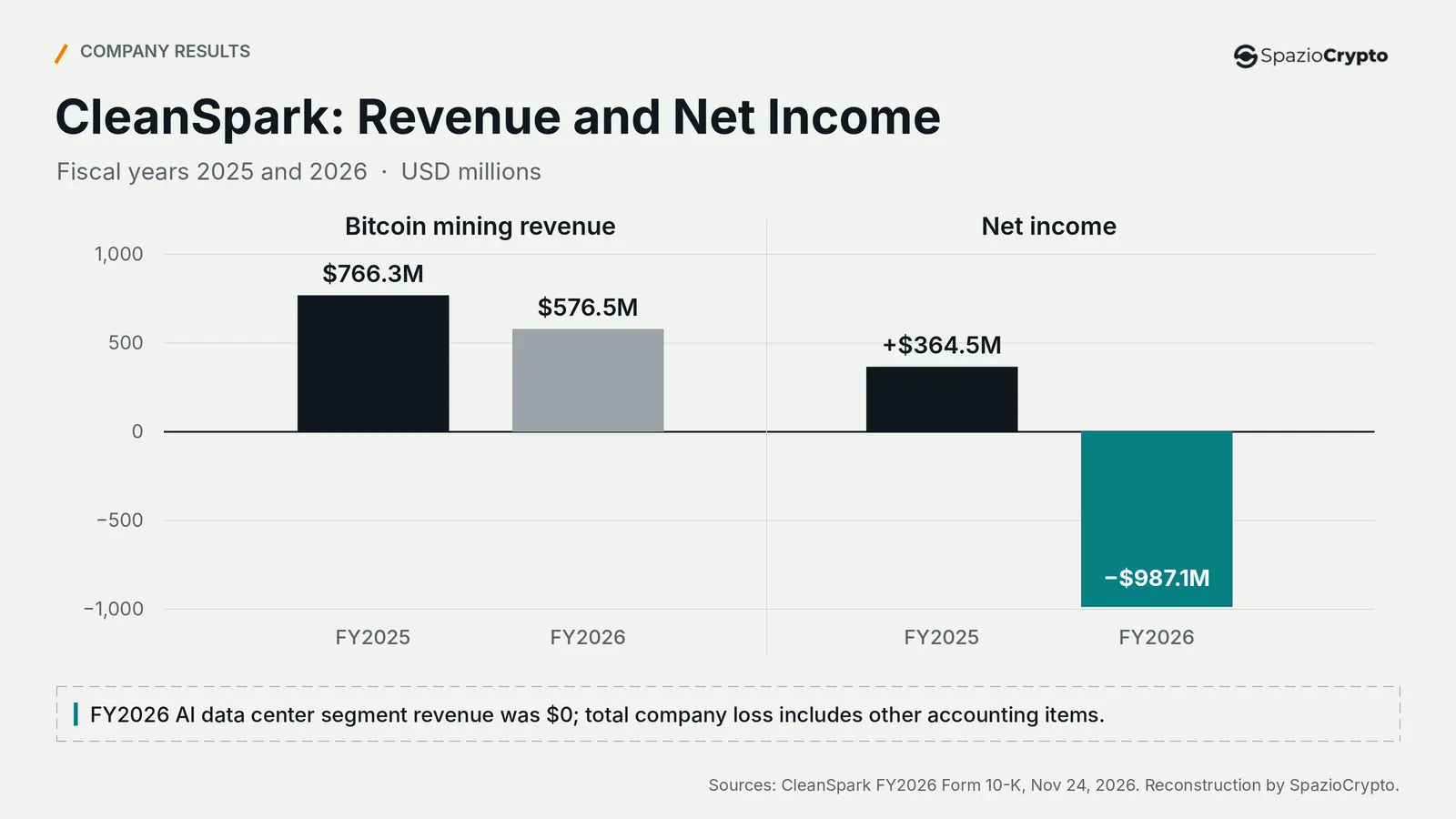
In the fiscal year ended September 30, CleanSpark reported $576.5 million in net Bitcoin mining revenue, down 25% from the prior year, according to the company's Form 10-K filed with the SEC. The consolidated net loss came in at $987.1 million, compared with net income of $364.5 million in fiscal 2025. In Q4 alone, revenue fell 46% to $120.9 million, though the company still posted a quarterly net income of $9.8 million.
The gap between the full-year result and Q4 performance is worth keeping in mind: the headline loss figure does not describe the operational trend of any single quarter. Within the 10-K, specific line items include $281.6 million in Bitcoin fair-value losses, $118.7 million in losses on Bitcoin-collateralized receivables, and $177.1 million in impairment charges. These are components of the total result, not an isolated measure of the AI transition's cost.
The impairment figure includes $168.1 million tied to the planned conversion of the Sandersville site and the write-down of certain less-efficient mining machines. The company also recorded $428.2 million in depreciation and amortization. Net cash used in operating activities reached $468.4 million. These data points help distinguish accounting losses from cash consumed, without erasing the fact that Bitcoin mining remains the sole source of actual revenue today.
Pressure on the core mining business arrives as listed miners are increasingly valued on data-center prospects too. SpazioCrypto has tracked the shift of Bitcoin miners toward artificial intelligence infrastructure and the thesis that energy assets and existing sites can be repurposed for compute workloads. In CleanSpark's case, the SEC filing lets readers verify exactly how much of that thesis has actually reached the income statement.
The Data Center Infrastructure Segment Starts from Zero
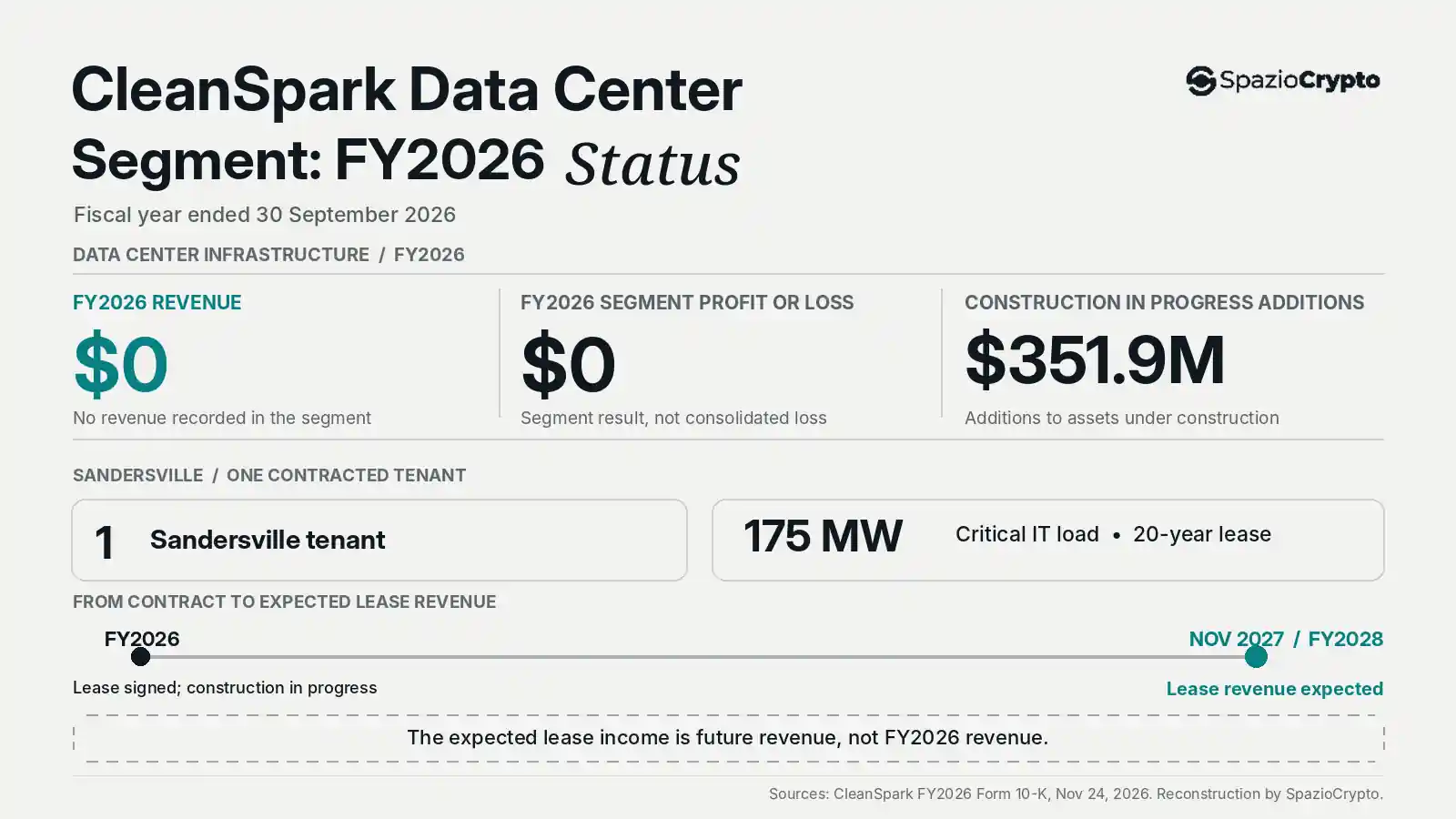
CleanSpark organized its FY2026 results into two segments: Bitcoin Mining and Data Center Infrastructure. The second covers the development, leasing, and hosting of AI and HPC workloads. Per the 10-K, that segment recorded no revenue, no material segment expenses, and no profit or loss in 2026. The company describes it as still in the startup phase. That does not mean the project has no contract; it means the contract had not yet begun generating lease revenue within the fiscal year that just closed.
The filing identifies a single global tenant for the Sandersville, Georgia facility, and discloses $351.9 million in construction-in-progress capital assigned to the segment. The lessee is not named in the 10-K. CleanSpark projects tenant improvement revenue during fiscal year 2027, with lease commencement fees expected starting November 2027, which falls within fiscal year 2028.
Comparing CleanSpark here with other operators helps frame the phase, not project identical outcomes. SpazioCrypto's analysis of TeraWulf's AI contract and miner conversion shows why power capacity matters for new compute workloads, and why construction timelines, delivery milestones, and actual signed contracts remain decisive. CleanSpark has a lease agreement. Sandersville revenue has not started.
Sandersville: Contract Signed, Cash Not Yet Flowing
The agreement covers 175 MW of critical IT load and runs for 20 years, with two five-year extension options. The 10-K estimates approximately $6.56 billion in contractual lease payments over the initial term, excluding extensions and variable real estate cost reimbursements. That $6.6 billion figure is a contractual value distributed over time: not revenue already collected, and not a campus valuation.
To fund the development, a subsidiary issued $2.276 billion in senior secured notes at 7.875%, maturing in 2031, as disclosed in the Form 10-K. Net proceeds are earmarked to cover remaining project costs, repay certain equity contributions already made, and fund debt service reserves. CleanSpark describes Sandersville as fully financed. The project, though, remains under construction, and the first data hall is targeted for November 2027.
The 10-K states that lease commencement is expected in November 2027, with phased delivery potentially running through March 2028. Those are company projections, not realized results. The plan to wind down mining operations at Sandersville is also scheduled for fiscal 2028, not completed. In the interim, the site continues hosting Bitcoin mining activity, and the transition has already produced accounting impairment charges.
The 885 MW in Texas Are Not 885 MW of Live AI Capacity
CleanSpark has acquired properties and power agreements in Texas to develop potential data center campuses. Company communications reference a combined capacity of up to 885 MW. The 10-K breaks this down as 285 MW of power agreements in Austin County and 300 MW in Brazoria County, with an additional 300 MW of possible expansion. None of this capacity is leased to a customer or ready to generate revenue.
In the earnings release, the company specifies that 585 MW received a conditional ERCOT Batch Zero classification as baseload: 285 MW at Sealy and 300 MW in Brazoria Phase 1. The remaining 300 MW at Brazoria carry a conditional studied-load classification. These categories are distinct and remain subject to steps within the Texas electricity interconnection process. Collapsing all 885 MW into “operational AI capacity” erases precisely the distinction the filing makes visible.
SpazioCrypto's coverage of data centers and digital infrastructure and of the mining sector tracks further cases of this energy-to-compute conversion. The common thread is access to power and existing sites; what separates projects is grid interconnection, permitting, capital, construction, and actual contracts. Announced megawatts are not interchangeable with energized power, delivered IT capacity, or billed revenue.
What This Means for Investors Watching Miner-to-AI Pivots
The 10-K places all of CleanSpark's operations and assets in the United States. No international operations appear in the filing. The case is still instructive for anyone evaluating publicly listed miners that have announced energy-repurposing strategies: the gap between announced megawatts and booked revenue is real, and CleanSpark's filings make it unusually transparent.
The financing approach also illustrates a path different from pure Bitcoin accumulation. MARA, in a case SpazioCrypto has covered separately, used part of its own Bitcoin reserves as collateral to raise capital for energy and AI investments. The MARA Bitcoin-collateralized loan offers a financing comparison, but not an automatically equivalent model to CleanSpark's project-level secured debt.
CleanSpark also features in analyses of listed miner equities and their sensitivity to Bitcoin price movements. SpazioCrypto's deep-dive on Bitcoin's price decline and miner correlation with AI equities provides market context, but does not confirm that CleanSpark's data center strategy will be profitable.
CleanSpark at a Glance
What the filing confirms, what it doesn't.
- Confirmed: FY2026 Bitcoin mining revenue of $576.5 million, consolidated net loss of $987.1 million, and zero revenue or profit in the Data Center Infrastructure segment, per the SEC Form 10-K filed November 24, 2026.
- Not disclosed: the identity of the Sandersville tenant, and any AI revenue earned in FY2026, which the filing records as zero.
- To watch: progress on Sandersville construction, start of tenant improvement revenue in fiscal 2027, first lease payments targeted for November 2027, and the status of the Texas projects.
The Bigger Picture
CleanSpark has not yet completed the transformation described by the market narrative around it. The company has converted a portion of its energy infrastructure expertise into a significant long-term contract and raised dedicated financing. The segment meant to monetize AI, though, closes FY2026 with zero revenue. The real indicator of this transition is the distance between announced power, authorized capacity, delivered data halls, and booked lease payments.
The concrete signals to monitor next are: construction progress at Sandersville, the actual start of tenant improvement revenue, the first lease commencement date, capital deployment from the $2.276 billion notes offering, and any commercialization of the Texas sites. The plan to exit Bitcoin mining in Georgia by fiscal 2028 and the pending ERCOT classifications remain future milestones. For now, mining pays the bills and the AI segment is a contractualized promise that has yet to produce a single dollar of revenue.
Sources
Annual and quarterly results: CleanSpark earnings press release, November 24, 2026. Segment revenue, impairment charges, lease contract, financing, timelines, and Texas classifications: SEC Form 10-K for the fiscal year ended September 30, 2026. Reporting on results and the quarterly decline: The Block, November 24, 2026. Official video material: CleanSpark FY2026 results webcast.