

Google completed the first end-to-end test of Project Suncatcher on October 30, 2026: a ground station sent a prompt to a satellite, a TPU on board powered up, Gemma 4 ran an inference, and the result came back to Earth. The test closes a full Terra-to-orbit-to-Terra loop. What it does not yet show is whether a continuous, reliable, or cost-competitive orbital data center is remotely feasible.
 Travis Beals
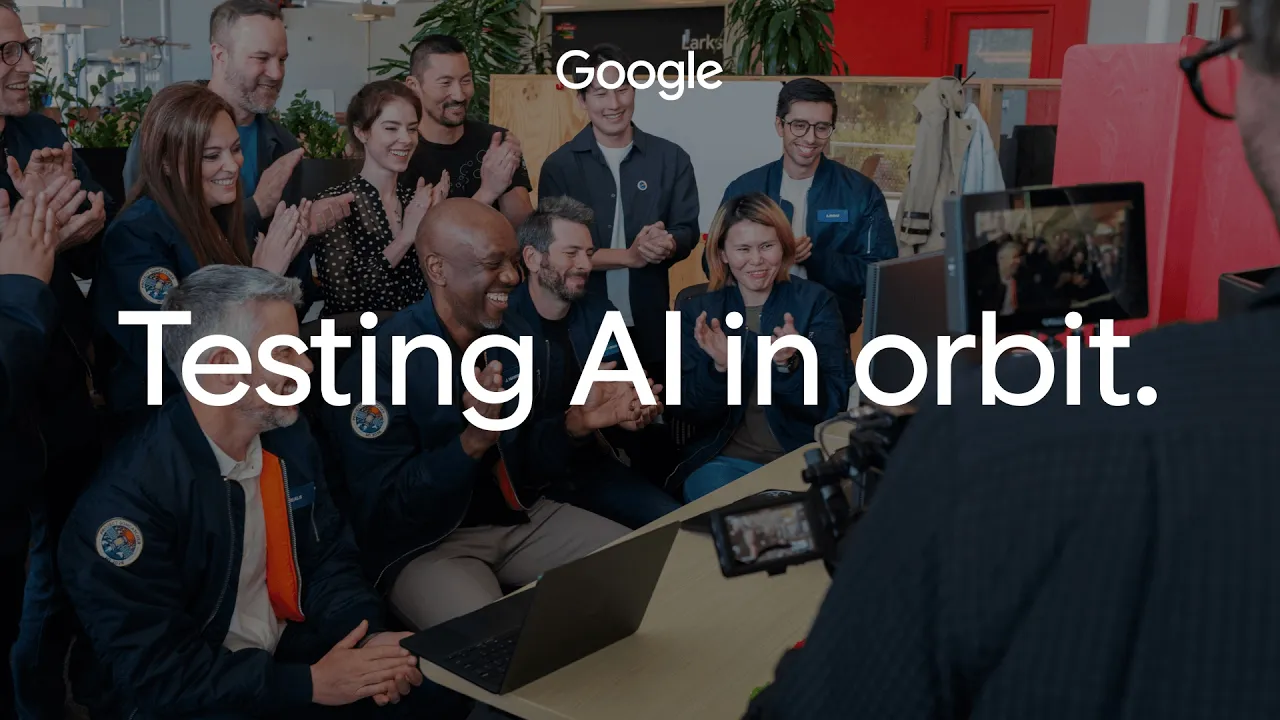
Google asked Gemma 4 to compose a haiku about space during a pass over Svalbard, Norway. After that first output, the team tested additional prompts, including limericks and satellite telemetry queries. Google describes the milestone as the first AI inference generated in orbit by a data-center-class TPU. The company did not specify the exact chip version in its announcement post.
The Loop from Ground to Orbit and Back
The test involved several distinct steps: a ground station uploaded the prompt, the onboard system activated the TPU, Gemma 4 produced a response, and that response was transmitted back to Earth. The significance lies in closing the full cycle, not in the complexity of the generated text. A haiku is computationally trivial; the meaningful result for Project Suncatcher is having verified the send-execute-return sequence in a real orbital environment.
Google did not publish latency figures, precise execution duration, inference throughput, measured power consumption during the test, or communication error rates. Those figures would allow a quantitative comparison with a terrestrial data center inference run. Their absence does not erase what was demonstrated, but it does make benchmarking against ground infrastructure impossible at this stage.
An additional detail comes from TechCrunch, which reported that the satellite carries four TPUs but can activate only one at a time. According to TechCrunch, the satellite generates up to one kilowatt of electrical power and the chip has an operational limit of roughly twenty minutes per activation. These figures are attributed to TechCrunch and are not part of Google's official announcement. The distinction matters: the demonstration does not correspond to a multi-chip cluster processing distributed workloads continuously.
The Prototype Has Been in Orbit Since October 1
The satellite launched on October 1 aboard SpaceX's Transporter-18 mission. Google built the prototype in partnership with Planet and, after launch, confirmed contact with the vehicle and the start of initial checkouts. The October 30 test followed the commissioning phase and early system health checks.
 View Profile

Project Suncatcher is a research program, not a commercial service. Google is studying whether machine learning infrastructure can be placed in orbit, using solar-powered satellites and, over the longer term, optical inter-satellite links. The company's long-term vision involves interconnected satellite constellations. The October test involved a single prototype and a limited sequence of inferences. More detail is available via research.google.
Next Tests Cover Heat and Radiation
Google announced that upcoming tests will measure TPU behavior under thermal stress and radiation exposure. The company has identified a two-satellite link test as its next major milestone, targeted for 2027. The project must therefore address not just single-vehicle model execution, but hardware stability and inter-satellite communication between moving vehicles.
Thermal management is a central technical challenge. In the vacuum of space there is no air to carry heat away from components the way convection cooling does in standard data centers. According to Google's research documentation, the satellite uses a system of heat pipes and radiators. The October test announcement did not publish thermal results or TPU reliability metrics under sustained conditions.
One Haiku Does Not Prove Economic Viability
Low Earth orbit offers solar panels more continuous light exposure than many ground installations. Google has stated that, in a suitable orbital configuration, a panel could generate up to eight times more energy than an equivalent panel on Earth. That is an estimate tied to a hypothetical project configuration, not a measurement from the satellite that generated the haiku.
Abundant sunlight alone does not resolve cooling challenges, communication latency, maintenance constraints, component lifespan in a radiation environment, or the cost of launches. Google's research paper presents a long-horizon valuation model that depends on assumptions about future launch costs. It is not a current-state cost accounting, and it does not show that orbital AI infrastructure is already competitive with terrestrial alternatives.
What This Means for Developers and Cloud Users
The announcement describes a research experiment, not a product launch. No new API, no orbital compute capacity, and no commercial availability date have been announced. The next concrete milestone the company has cited is the two-satellite link test in 2027, which itself depends on passing thermal and radiation stress evaluations first.
Project Suncatcher: What We Know
Confirmed vs. still open
- Confirmed: Google sent a prompt to the satellite, ran Gemma 4 on an orbital TPU, and received the output on the ground on October 30, 2026.
- Not disclosed: latency, inference throughput, measured power draw during the test, and any data on continuous operation.
- Watch for: thermal and radiation stress results, and the two-satellite link test announced for 2027.
The Bigger Picture
The value of this test is not that a satellite wrote a poem. It's that Google verified a complete command-to-inference-to-return chain operating in real orbital conditions. The demonstration remains tightly scoped: one model, one prototype, one lightweight workload. Calling it an “AI data center in space” would conflate the long-term research goal with what has actually been validated so far.
The concrete next steps are thermal and radiation endurance of the TPU hardware, repeatable workload execution across multiple passes, and the two-satellite communication test. Only after those milestones can technical scalability be assessed. Economic viability and environmental impact will require separate data on launch costs, component lifespan, energy budgets, and ground infrastructure. For now, Suncatcher has received one response from orbit. It has not yet shown it can host an operational data center.