

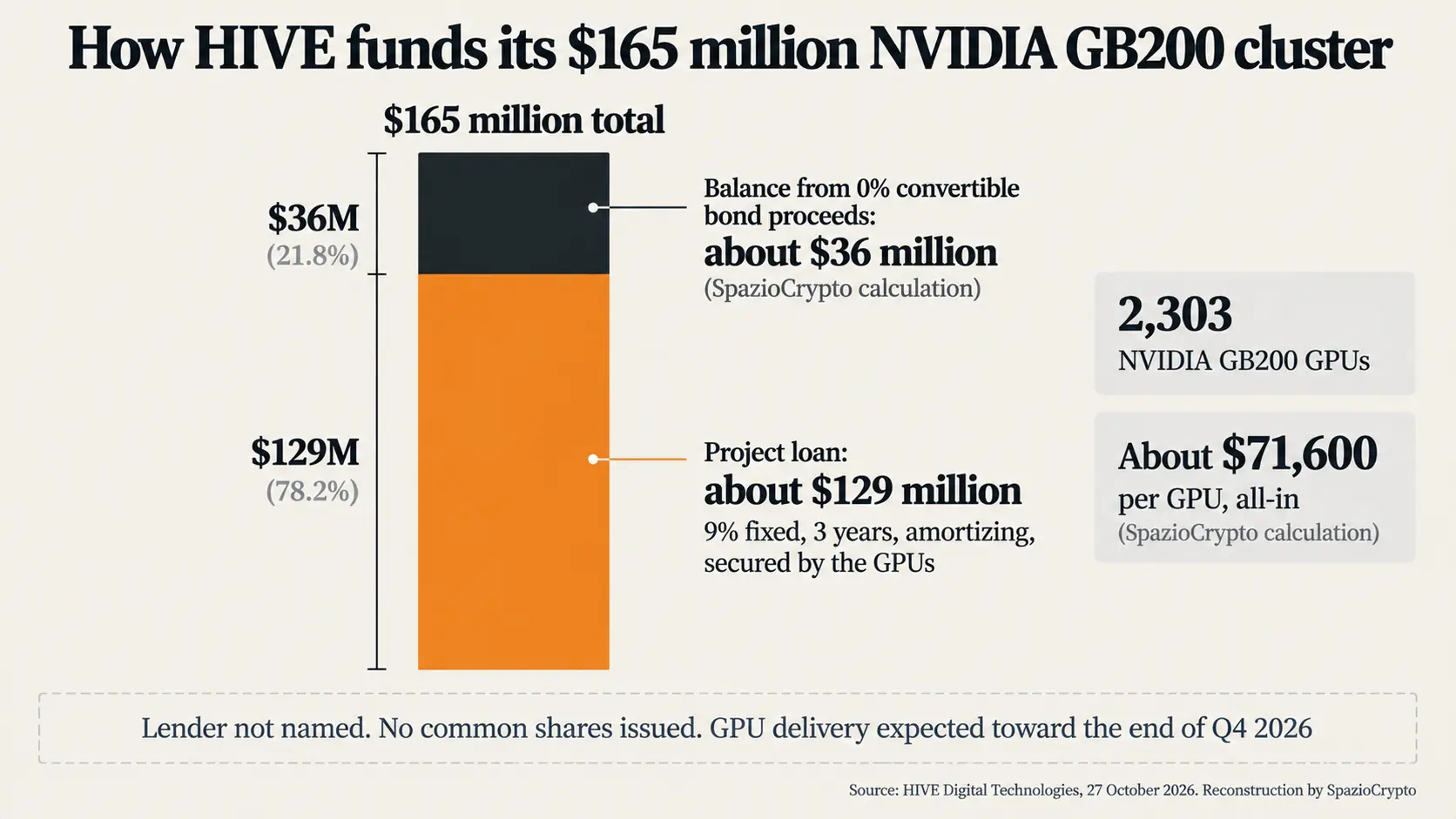
HIVE Digital Technologies has done something less dramatic and more revealing than most Bitcoin miners who promise an AI pivot. On October 27, the company announced a loan of approximately $129 million at a fixed 9% rate, structured to repay itself through a customer contract rather than Bitcoin price movements. The HIVE and BUZZ HPC financing deal covers roughly 80% of a $165 million cluster featuring 2,303 NVIDIA GB200 GPUs, dedicated to Cohere, the Canadian large language model company. The GPUs have not yet arrived: delivery is expected toward the end of Q4 2026, and both revenue and repayment remain promises written into a contract.


This analysis draws on HIVE's October 27 press release, its June 18 announcement covering the original contract, and executive chairman Frank Holmes's interview with Proactive, published October 28 on Yahoo Finance. The Nasdaq retransmission of the press release was inaccessible with our tools. Installment and margin calculations are our own and indicative.
A Loan That Repays Itself With a Contract, Not Bitcoin
The debt was extended to BUZZ Alpha Cloud, an entity indirectly controlled by HIVE through BUZZ HPC, by an institutional lender the press release does not name. The stated terms are specific: approximately $129 million, fixed rate of 9%, three-year term, with principal and interest repaid over the life of the loan. Collateral consists of the GPUs and other project assets, a limited-recourse guarantee from BUZZ HPC, and a pledge over the shares of BUZZ Alpha Cloud. At maturity, HIVE states, the GPUs will remain its property with no residual payments, and no common shares are being issued.
This is project finance logic applied to a compute factory: debt secured by hardware and repaid with a single customer's revenue. The remaining portion of the cluster, roughly $36 million by our calculation, comes from zero-coupon convertible notes HIVE placed this year for $245 million gross. It's a different approach from many competitors, who have funded their AI transition by selling bitcoin to build data centers.
The Numbers: Installments, the Contract, and What Remains
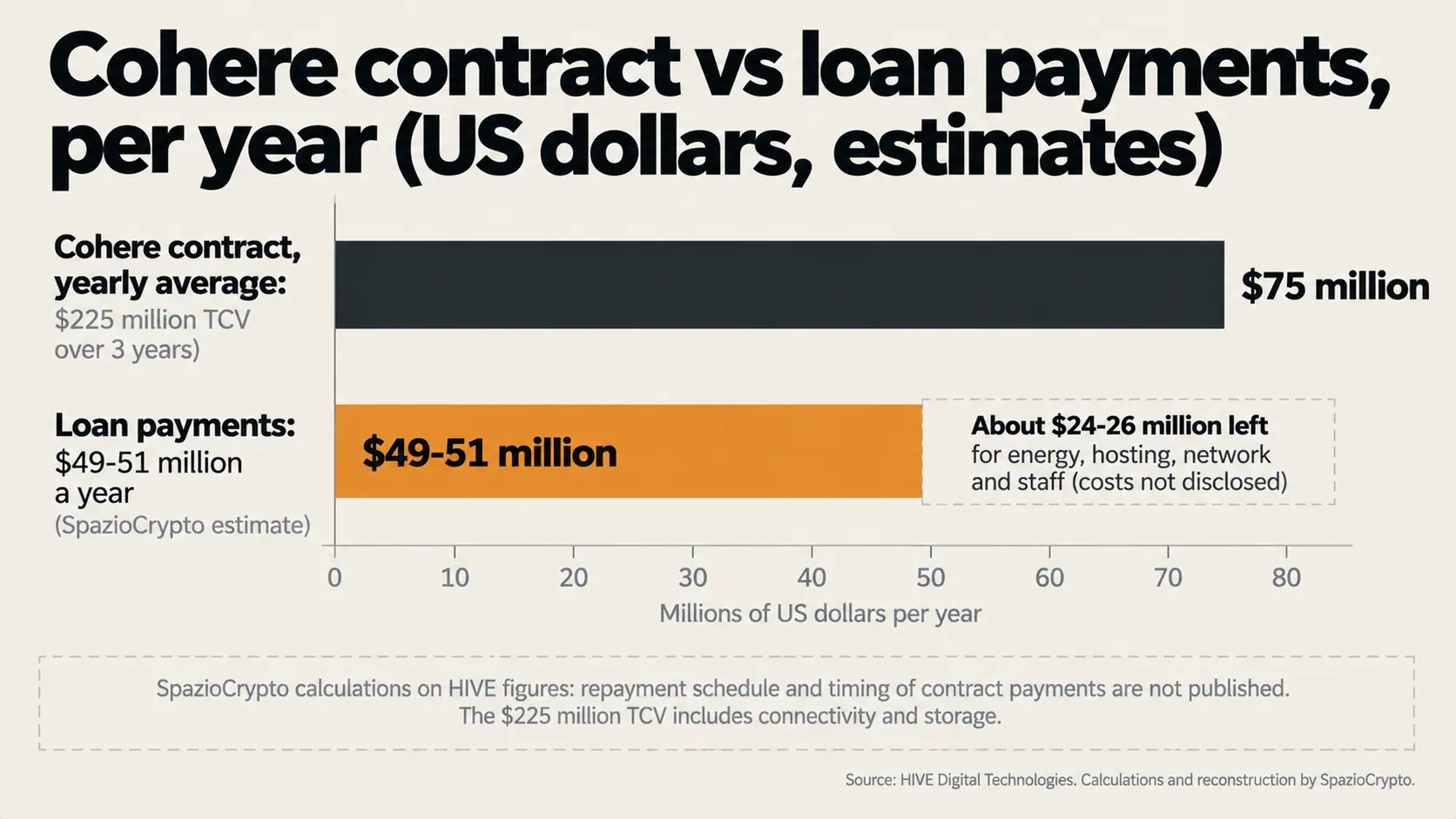
The Cohere contract is valued at $225 million over three years, according to HIVE, including connectivity and storage. In June, the same contract had been cited at approximately $220 million for compute alone. That averages out to $75 million per year. A $129 million loan at 9%, repaid over three years with level payments, costs between $49 million and $51 million annually, depending on whether payments are monthly or annual. This is our own indicative calculation, since the amortization schedule has not been published. The ratio of average annual revenue to annual debt service comes to roughly 1.5x.
That margin has to cover everything else: power, colocation space, networking, staffing, maintenance. HIVE does not disclose these costs. Another number frames the bet: $225 million divided by 2,303 GPUs and by three years of hours works out to approximately $3.70 per GPU per hour, by our calculation, with connectivity and storage included. That's the price the AI compute market must keep paying through 2029, as the hardware ages.
The Paradox: A Miner That Finances Itself With AI
The contrast with today's financials is sharp. In the fiscal year ended March 31, 2026, according to The Block, HIVE recorded $297.8 million in revenue: $278.3 million from mining and $19.5 million from high-performance compute hosting. Mining accounted for over 93% of the total, by our calculation. In the first quarter of the following fiscal year, according to The Energy Mag, revenue rose to $79.1 million, with 1,004 bitcoin mined and 24 EH/s of operating hashrate. The quarter still closed with a $142.9 million loss, driven primarily by an $84.7 million provision tied to a Swedish tax dispute.
The cash that keeps HIVE running today still comes from Bitcoin, a business that has passed through periods of declining hashrate and compressed margins. The debt, by contrast, is raised against AI. Our read is that this isn't a contradiction; it's a deliberate choice. A multi-year compute contract is collateral that institutional lenders understand far better than a cryptocurrency price.
Canadian Sovereign AI, Paid for With American Capital
HIVE frames the project as sovereign infrastructure: the October press release states that compute will remain within Canadian borders, and the June announcement identified the Bell facility in Merritt, British Columbia. “Sovereignty in the AI age will depend on where the compute sits and who controls it,” Holmes stated in the press release. In his interview with Proactive, he added that no American entity truly controls that data center.
Holmes also acknowledged that the majority of capital is coming from U.S. institutional lenders and credit funds, because Canadian banks are not advancing significant sums for data center expansion. That's the most interesting tension in this story: sovereignty covers where the machines are, not where the money comes from. The lender behind this loan, it bears repeating, has not been identified.
What Can Go Wrong, According to HIVE Itself
The most instructive risks are the ones the company lists in its forward-looking disclosures. GPU delivery delays and cost overruns. The possibility that the customer fails to perform under the contract or declines to renew. Revenue falling short of debt service or the financial covenants required, including the coverage ratio. Enforcement of collateral in the event of default. GPU obsolescence arriving faster than expected, with resale value lower than projected.
There are also minor inconsistencies worth noting. The GPU count is 2,303 in the October press release and 2,304 in the June announcement. The original service start window was late 2026 to early 2027; now the language points to delivery toward year-end. These are small discrepancies, but they're a reminder that every figure is a projection until the cluster switches on.
What Actually Changes
The type of risk changes. A miner's fortunes track Bitcoin price and network difficulty; an AI compute provider lives by contracts, delivery schedules, customer credit quality, and the speed at which hardware depreciates. HIVE says it has signed $600 million in GPU cloud contracts this year across three agreements. It's the same road that IREN is walking, targeting up to $30 billion in new data centers, and that TeraWulf has taken, with a contract worth more than the company itself, though on a much smaller scale.
The relationship with leverage also shifts. Miners who used bitcoin as collateral, like MARA with half its reserves, tied their debt to cryptocurrency volatility. HIVE ties its debt to a customer and to equipment that depreciates. Our read is that the second risk is more predictable, not smaller.
HIVE and BUZZ HPC: What's Confirmed and What Isn't
What is confirmed, what is not:
- Confirmed: approximately $129 million loan at a fixed 9% rate over three years with amortization; covers roughly 80% of a $165 million cluster with 2,303 NVIDIA GB200 GPUs; collateral is the GPUs and project assets; no common shares issued; three-year Cohere contract with $225 million total contract value.
- Not disclosed: lender identity, repayment schedule, loan covenants, cluster operating costs, customer payment timing.
- To watch: GPU delivery expected toward end of 2026, service launch for Cohere, first contract revenue, financing for other GPU contracts signed during the year.
The Bigger Picture
Our read is that the miner-to-AI story is entering its least-told phase: the credit phase. Early conversions were funded with bitcoin on the balance sheet and stock market enthusiasm. The next wave is funded with GPU-secured loans and customer contracts, in a market where Nvidia itself raised $25 billion with a bond offering. Mining gave HIVE energy, sites, and machine-management expertise. AI is asking it to become its own small credit institution, meeting debt payments on schedule every single month.
Four signals are worth watching closely. First: GPU delivery by year-end, which determines when revenue can begin. Second: Cohere's contract performance over the three-year term. Third: how HIVE finances the other GPU contracts signed in 2026, which will show whether this structure is repeatable. Fourth: the market value of those GB200 units in 2029, when HIVE owns them outright.