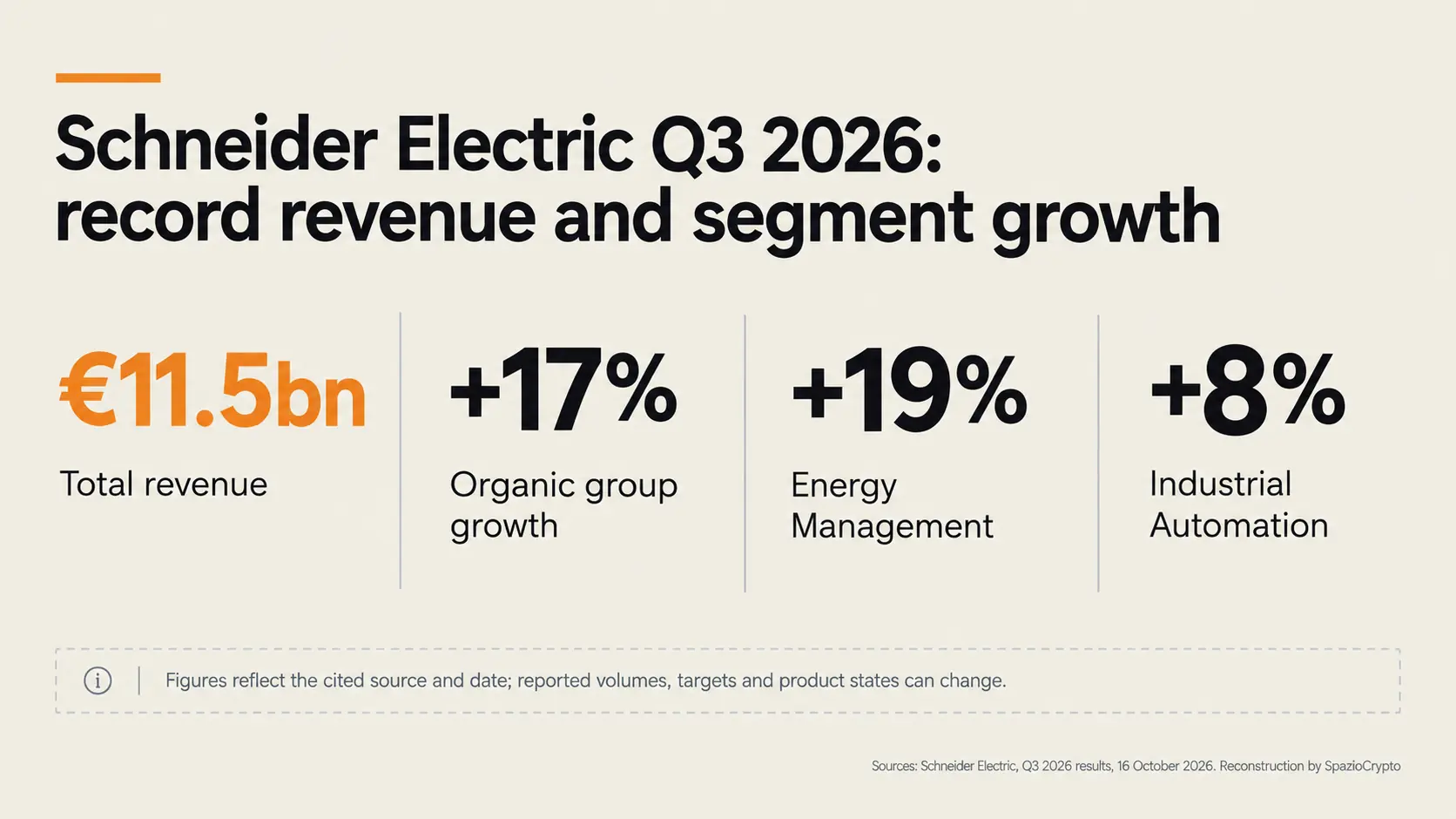
On October 16, 2026, Schneider Electric reported quarterly revenues of 11.5 billion euros, up 17% on an organic basis, according to the company's official results page. Schneider Electric's data center business is the primary demand driver: orders from the sector grew at a triple-digit pace. That's a powerful signal for the electrical infrastructure supply chain feeding artificial intelligence, but it doesn't mean data centers alone produced every euro of that record revenue figure.
A note on sources: this analysis draws on Schneider Electric's official results page, Reuters coverage, and a LinkedIn post by CEO Olivier Blum. No paywalled sources were used. Customer-level detail, the absolute value of data center orders, and the share of revenues directly attributable to AI are not published by the company.
An 11.5 Billion Euro Quarter
Schneider Electric described Q3 2026 as the strongest quarter in the company's history by revenue. Energy Management, the division covering most technologies for distributing and controlling electricity, grew 19% organically. Industrial Automation added 8%. Growth came from every region: China and East Asia posted 26%, per company disclosures, while North America came in at 20%.
These numbers place Schneider in the global race for AI infrastructure from a very different vantage point than chip makers or cloud operators. Schneider sells circuit breakers, uninterruptible power supplies, energy management systems, cooling, and automation. The value is created before a single model is trained, at the moment a building must convert megawatts of raw power into stable electricity for thousands of accelerators.
Triple-Digit Demand Does Not Mean Triple-Digit Revenue
The most attention-grabbing line in the press release is also the one that deserves the most scrutiny. Schneider refers to triple-digit growth in data center demand during the quarter and to the execution of its order backlog. The company does not publish a euro figure for that demand, nor does it claim that data center revenues tripled. Demand, orders, and billed revenue are distinct metrics that can fall in entirely different accounting periods.
The backlog offers visibility into 2027 and 2028, according to CEO Blum in his LinkedIn post. That, too, is a qualitative statement. An order can be delivered in multiple phases, amended, or tied to a client's own construction schedule. Reading the result correctly requires separating the structural need for power (explored in our analysis of how much energy data centers consume) from the speed at which that need converts into recognized revenue.
Schneider also doesn't specify what share of demand comes from new campus builds, expansion of existing sites, or equipment replacement. Those are three distinct industrial cycles. New campuses require permits and grid connections. Expansion can proceed module by module. Replacement follows less dramatic but more predictable renewal timelines.
The Bottleneck Shifts from Chips to Electricity
Schneider's growth makes clear that AI is not only a compute market. Every high-density rack needs power delivery, conversion, protection, monitoring, and heat dissipation. As rack densities rise, the complexity of the entire supporting system grows with them. The AI energy bottleneck becomes, in practice, a market for suppliers who can integrate physical hardware with software management layers.


This position may prove more defensible than simply having access to a GPU. An accelerator chip can change generation quickly; switchgear, cooling systems. Automation remain tied to the operational life of the facility. The risk runs the other direction: delivering on that growth requires factories, specialized staff, and logistics capacity. A record backlog is only an advantage if the company converts it without delivery delays or margin compression.
Reuters reported that Schneider raised its 2026 target for adjusted EBITA growth to an organic range of 18-21%. That is a corporate target, not an achieved result. The quarter supports the upward revision, but it doesn't eliminate currency risks, execution costs, or the possibility of client deferrals.
Cooling, Grid, and Generation Collapse into One Decision
Large hyperscalers are sourcing energy through renewable contracts, dedicated gas supply, battery storage, and new nuclear projects. The debate around nuclear-powered data centers makes clear there's no single winning answer. Grid connection timelines and generation lead times can be longer than the time it takes to rack up servers.
Schneider sits at the junction point. The company doesn't need to predict which AI model wins; it needs to make whatever power source the client has chosen actually usable inside a facility. That technological neutrality reduces the risk of dependency on a single AI lab, but it exposes Schneider to the broader capital expenditure cycle. If hyperscalers cut or defer capex, the order book could lose momentum.
For now, the signals point the other way. AI data center capex remains elevated and operators are locking in availability across multiple years. Schneider's result adds a concrete data point: demand is reaching electrical infrastructure manufacturers, not staying confined to cloud group investor presentations.
Why This Quarter Matters for Bitcoin Miners and Crypto Operators
Bitcoin miners shifting toward HPC are competing on the same physical terrain: available power, grid connections, transformers, cooling capacity, and construction timelines. Schneider's record quarter doesn't prove that every mining site can become an AI data center. It does show that the critical components are now being sought by clients with much larger balance sheets and multi-year capital programs.
That competition may push up the value of already-energized sites, but also the cost of completing them. A miner with contracted megawatts but lacking redundancy, fiber connectivity, and appropriate cooling doesn't yet own HPC-grade infrastructure. Schneider's quarter helps draw the line between raw electrical availability and the ability to deliver reliable digital services.
Google's project in Finland, bridging data centers and energy, offers a useful comparison: investments are becoming territorial, dependent on local grid capacity, local generation, and regulatory approval. The equipment is only one part of a much larger system.
The Summary
- Confirmed: quarterly revenues of 11.5 billion euros, 17% organic growth, Energy Management up 19%, and triple-digit data center demand growth.
- Not disclosed: absolute value of data center orders, precise share of AI revenues, individual client names, and delivery schedules per project.
- To watch: backlog conversion in 2027-2028, production capacity, and whether Schneider hits its revised 2026 EBITA target.
The Bigger Picture
The clearest read on this quarter is that attention is shifting from the cost of building an AI model to the capacity to power one. AI becomes an industrial cycle the moment it generates orders for circuit breakers, thermal management systems, and automation hardware. Schneider monetizes precisely the transition from digital promise to physical plant.
The decisive signal won't be another isolated record quarter. It will be the quality of backlog conversion: delivery times, margin trends, the composition of new orders, and whether demand proves repeatable. If those elements hold, electrical infrastructure will remain one of the few segments where the AI build-out produces visible revenues before the economic returns of the models themselves are clear.